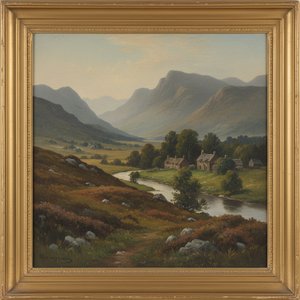
David Payne (1843 – 1894): A Derbyshire Landscape Visionary
David Payne was a Scottish landscape painter who achieved considerable renown during the Victorian era, particularly for his depictions of Derbyshire and his masterful use of trompe l'oeil techniques. Born in Annan, Dumfriesshire, he possessed an early aptitude for art fostered by his father’s profession as a mason and nurtured further at Annan Academy alongside fellow artist William Ewart Lockhart.
Payne initially pursued a career as a house painter before dedicating himself to artistic pursuits. He relocated to Derby in 1869, establishing himself amidst the burgeoning industrial art scene of the city. His formative influence stemmed from George Turner, “Derbyshire’s John Constable,” who also resided in Derby and shared a passion for capturing the beauty of the rural landscape.
Payne's artistic style evolved over time, embracing both traditional landscape painting and innovative trompe l'oeil illusions. He gained recognition through exhibitions at prestigious venues such as the Royal Birmingham Society of Artists (RBSA), Nottingham Museum & Art Gallery, and was a member of the Royal Scottish Academy (RSA). His work exemplifies the Romantic spirit of his time—a fascination with nature combined with an ambition to elevate art beyond mere representation.
A pivotal moment in Payne’s career arrived in 1882 when he won the Derby Art Gallery Medal for Industrial Art with his sculpture “The Two Anglers.” This award underscored his commitment to artistic excellence and cemented his reputation as one of Derby's leading artists. The sculpture itself, alongside his paintings—particularly “Market Place (The Royal Visit, Derby, 21 May 1891)”—now reside in Derby Museum & Art Gallery.
Payne’s dedication to capturing the essence of Derbyshire extended beyond artistic endeavors; he actively participated in civic life. Notably, he was present at the laying of the foundation stone for the Derbyshire Royal Infirmary in 1891 alongside Queen Victoria and Sir Alfred Haslam—a scene immortalized in his painting “Market Place.” Furthermore, Payne’s legacy continues to inspire artists today, with his paintings adorning institutions like Southampton City Art Gallery.
Payne married and raised fourteen children. He passed away peacefully in Sheffield in 1894, leaving behind a rich artistic heritage that remains celebrated for its sensitivity to light, color, and the sublime grandeur of the British countryside.