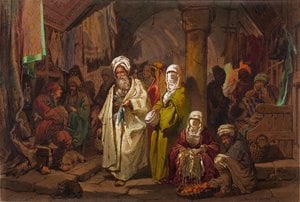
Count Amadeo Preziosi: A Painter of Exotic Shores
Count Amadeo Preziosi (1816-1882) remains a captivating figure in 19th-century art, largely due to his evocative depictions of the Eastern Mediterranean – particularly Egypt and Constantinople (modern Istanbul). More than just a chronicler of travel, Preziosi was an artist deeply immersed in the cultures he encountered, capturing not only the visual splendor but also the atmosphere and spirit of these vibrant locales. His work offers a rare glimpse into a world transitioning between tradition and modernity, a testament to his keen observation and artistic sensitivity.
Born into a noble Maltese family with strong Italian roots, Preziosi’s early life was shaped by a blend of European sophistication and the island’s unique cultural identity. Initially destined for a legal career – a path dictated by his father – he soon abandoned academic pursuits to pursue his true passion: art. This decision, somewhat unconventional for an aristocrat of his time, led him to study at the École des Beaux-Arts in Paris, immersing himself in the artistic currents of the era and honing his skills under renowned instructors. However, it was the allure of the East that ultimately drew him away from Europe’s established art circles, leading him on a transformative journey to Constantinople in 1842.
Constantinople: A World Revealed
Preziosi's arrival in Constantinople marked a pivotal moment in his artistic development. Unlike many Western artists who approached the city with a detached, almost anthropological gaze, Preziosi sought genuine engagement with its people and customs. He quickly established himself as an observer of remarkable detail, documenting the bustling marketplaces, the intricate architecture, the colorful costumes, and the daily rituals of Ottoman life. His early drawings, meticulously rendered in watercolor, served as a foundation for his later paintings, capturing the city’s chaotic beauty and the subtle nuances of its diverse population.
His commissions from Robert Curzon, the British Ambassador's private secretary, further solidified Preziosi’s position within Constantinople’s artistic community. The “Costumes of Constantinople” album, a collection of meticulously observed portraits and scenes, became an instant success, showcasing his ability to portray both individual personalities and collective life with equal skill. He wasn’t merely sketching; he was actively participating in the social fabric of the city, learning its languages, customs, and gaining the trust of its inhabitants – all reflected in the authenticity of his work.
A Palette of Orientalism
Preziosi's artistic style is often categorized as “Orientalist,” a term that reflects the Western fascination with the East during the 19th century. However, Preziosi’s approach transcends simple exoticization. He avoided stereotypical depictions of harem life or veiled women, instead focusing on portraying everyday scenes and individuals with remarkable sensitivity and respect. His use of light and color is particularly noteworthy – he masterfully employed warm hues to capture the intensity of the Mediterranean sun and create a sense of atmosphere that is both luminous and evocative.
His paintings frequently feature glimpses of veiled women, not as objects of mystery or allure, but as integral parts of the city’s social landscape. Works like “Hadice Hanim,” depicting a contemplative woman from Istanbul, exemplify this approach – capturing her inner life and quiet dignity with subtle brushstrokes and nuanced expressions. Similarly, "The Egyptian Dancer" showcases the vibrant energy of Middle Eastern dance through dynamic composition and rich color palettes.
Legacy and Influence
Despite his success in Constantinople, Preziosi ultimately chose to return to Malta, where he spent the remainder of his life. He continued to paint prolifically, producing a substantial body of work that offers invaluable insights into 19th-century travel and culture. His albums – “Souvenir of Cairo,” “Costumes of Constantinople,” and “Recollections of Eastern Life” – remain prized possessions in museums and private collections worldwide.
Count Amadeo Preziosi’s legacy extends beyond his individual artistic achievements. He represents a bridge between Europe and the East, an artist who embraced cultural exchange with open arms and translated his experiences into works of enduring beauty. His paintings serve as a poignant reminder of a world in transition – a world where tradition and modernity collided, creating a landscape of unparalleled richness and complexity. His work continues to be studied for its technical skill, its evocative atmosphere, and its profound understanding of the human spirit within diverse cultural contexts.