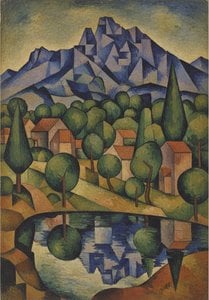
César Klein (14 September 1876 – 13 March 1954) stands as a pivotal figure in German Expressionism, embodying its ambition to grapple with the anxieties and traumas of the early 20th century through visceral imagery and emotionally charged abstraction. Born in Hamburg, Germany, Klein’s formative years instilled within him a meticulous craftmanship honed by an apprenticeship under a master craftsman—a grounding that would profoundly shape his artistic approach throughout his prolific career. This dedication to technique wasn't merely stylistic; it represented a conscious rejection of Impressionism’s fleeting beauty and embraced instead the forceful assertion of inner emotion onto canvas.
Early Influences & Artistic Training: The Düsseldorf School of Painting & November Group
Klein’s artistic journey commenced at the Hamburg School of Applied Arts, followed by intensive studies at the Düsseldorf Art Academy and the Royal Museum of Applied Arts in Berlin—institutions renowned for fostering a rigorous academic tradition. However, Klein swiftly transcended these boundaries, recognizing the limitations of purely representational art in conveying the psychological complexities he sought to explore. He joined forces with Walter Gropius and other avant-garde thinkers at the Bauhaus, where he championed innovative approaches to design and architecture—a testament to his belief that artistic expression should serve a broader societal purpose. This collaboration cemented Klein’s position as a champion of functional aesthetics intertwined with emotional resonance. The Düsseldorf School of Painting instilled in him a disciplined understanding of form and composition, while the November Group fostered a spirit of collective experimentation and intellectual debate.
Klein’s artistic output spanned a remarkable range of mediums, demonstrating his mastery of diverse techniques. His lithographs and woodcuts are characterized by meticulous detail and textural richness—a deliberate contrast to the smooth surfaces favored by Impressionists. He skillfully manipulated color and light in stained glass windows and mosaics, creating immersive visual experiences that aimed to evoke profound emotional responses. These explorations weren’t simply stylistic choices; they reflected Klein's conviction that artistic expression could communicate ideas beyond mere visual perception. The meticulous craftsmanship evident in his prints underscored his commitment to conveying emotion through precise execution and textural variation.
Klein's artistic legacy extends beyond his studio practice, encompassing significant contributions to theatrical design and architectural decoration. His monumental mural for the Marmorhaus cinema in Berlin—a daring undertaking that pushed the boundaries of spatial perception—stands as a symbol of Expressionist ambition. Furthermore, he collaborated closely with Ernst Toller on *Hinkemann*, crafting a stage set that powerfully conveyed the psychological tension inherent in the drama. These projects underscored Klein’s belief that art could engage audiences on multiple levels—visually, emotionally, and intellectually. The Marmorhaus commission showcased his ability to transform architectural spaces into immersive environments, while Toller's production benefited from his profound understanding of dramatic storytelling.
The Degenerate Art Exhibition & Legacy: Confronting Societal Anxiety
Klein's work gained notoriety during the infamous Degenerate Art exhibition of 1937—a politically motivated showcase orchestrated by the Nazi regime that condemned Expressionism as “degenerate” and undermined its artistic merit. Despite this censure, Klein’s oeuvre continues to inspire admiration for its uncompromising honesty and expressive power. His exploration of psychological themes—fear, anxiety, alienation—resonates powerfully with contemporary audiences, securing his place as a seminal figure in the history of modern art. César Klein's enduring influence testifies to the transformative potential of art to confront societal anxieties and champion artistic innovation.
Redakcia WahooArt.com
Otestujte si oko
Pri každej otázke je iba jedna správna odpoveď.
Otázka 1:
Kým bol César Klein?
Otázka 2:
V roku ktorého sa narodil César Klein?
Otázka 3:
Čo bolo hlavným smerom jeho tvorby?
Otázka 4:
S ktorým významným architektom spolupracoval César Klein?
Immerse yourself in the raw emotion of German Expressionism. Explore 25 iconic masterpieces by Ernst Ludwig Kirchner, from bold street scenes to vibrant landscapes. Find inspiration for museum-quality art reproductions and decor. Discover all masterpieces on WahooArt.com.
Explore the profound legacy of Paul Cézanne. Discover how his mastery of geometric forms and vibrant color bridged Impressionism and Cubism, offering timeless inspiration for fine art collectors and enthusiasts seeking to understand the foundations of modern art.
Je dielo umelca Cesar Klein stále chránené autorským právom?
Nie, diela tohto umelca patria do public domain.
Ako dlho žil/a Cesar Klein?
78 years (1876–1954)
Kedy a kde sa narodil/a Cesar Klein?
1876, Hamburg, Nemecko
Kým bol César Klein?
Nemcom
Kedy Cesar Klein zomrel?
1954
Aké je najobľúbenejšie dielo autora Cesar Klein na platforme ArtsDot.com?
Two Glass Doors
Do ktorého umeleckého obdobia patril/a Cesar Klein?
Modernizmus
Čo bolo hlavným smerom jeho tvorby?
Výrazovstvo
Čo bolo hlavnou témou jeho diel?
Psychologické obrazy
Kto je Cesar Klein?
César Klein: A Pioneer of Expressionist Synthesis
César Klein (14 September 1876 – 13 March 1954) stands as a pivotal figure in German Expressionism, embodying its ambition to grapple with the anxieties and traumas of the early 20th century through visceral imagery and emotionally charged abstraction. Born in Hamburg, Germany, Klein’s formative years instilled within him a meticulous craftmanship honed by an apprenticeship under a master craftsman—a grounding that would profoundly shape his art