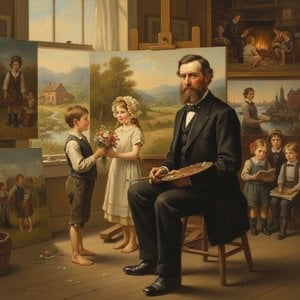
Ben Solowey: A Renaissance Artist Rooted in Observation
Ben Solowey (1900–1978) stands as a singular figure in American art history—a sculptor, painter, and draftsman who defied categorization yet achieved remarkable breadth and depth. Born in Warsaw, Poland, on August 29, 1900, his early life was marked by upheaval as his family emigrated to St. Petersburg, Russia, before relocating to Philadelphia when he was fourteen. This formative experience instilled in him a lifelong fascination with observation and meticulous detail—qualities that would define his artistic practice for decades.
- Early Education & Influences: Solowey’s formal training began at the Pennsylvania Academy of the Fine Arts (PAFA) where he studied under Hugh H. Breckenridge and Daniel Garber, absorbing the conservative traditions of the academy alongside the progressive ideas championed by Henry McCarter. Notably, his teachers encouraged him to draw from plaster casts and nude models—a cornerstone of academic art training that profoundly shaped his artistic vision.
- Parisian Awakening: In 1924, Solowey embarked on a transformative journey to London and Paris, fueled by a desire to immerse himself in the European artistic landscape. He sought inspiration from masters like Delacroix and Courbet, alongside the Impressionists—artists who championed capturing fleeting moments of light and color. Cézanne’s geometric approach and Rodin's sculptural explorations further broadened his artistic horizons.
- Portraiture & Broadway Glamour: Solowey gained considerable renown as a portrait artist, commissioned by publications like *The New York Times* and *Herald Tribune* to depict the dazzling personalities of Broadway and Hollywood. He sketched iconic figures such as Ethel Barrymore, Fanny Brice, Claudette Colbert, Katharine Cornell, Marlene Dietrich, Helen Hayes, Katharine Hepburn, Walter Huston, George S. Kaufman, Mary Nash, Lily Pons, and Basil Rathbone—capturing their likenesses with remarkable accuracy and psychological insight.
- Bucks County Legacy: Following his marriage to Rae Landis in 1930, Solowey established a secluded farmhouse in Bucks County, Pennsylvania—a haven for artistic contemplation and creative production. There he meticulously restored the historic building and pursued diverse artistic endeavors, including sculpting, furniture making, and frame crafting. His studio remains a museum dedicated to preserving his legacy as an artist of profound sensitivity and technical virtuosity.
Solowey’s artistic style was characterized by a paradoxical blend of meticulous realism and expressive manipulation—a technique he termed “the balancing of contradictory tendencies.” He painstakingly rendered details from observation, yet simultaneously employed perspective and color to create illusions of depth and atmosphere. His canvases often featured simplified forms alongside recognizable elements, resulting in an aesthetic that captivated viewers with its subtle tension and luminous beauty.
- Notable Paintings: Among Solowey’s most celebrated works are “Rae Seated (Green Dress)” (1935), a masterful depiction of Rae Landis bathed in soft light; and numerous landscapes capturing the serene vistas of Bucks County—works that exemplify his unwavering commitment to portraying the natural world with profound empathy.
- Influence & Recognition: Solowey’s influence extended beyond his immediate peers, inspiring generations of artists who admired his uncompromising artistic integrity. Critics lauded his ability to convey emotion through subtle gestures and nuanced color palettes—a testament to his mastery of technique and his unwavering dedication to capturing the essence of human experience.
Ben Solowey’s enduring legacy resides not only in his impressive oeuvre but also in his steadfast belief that “painting is a way to relax” – a philosophy that underpinned his lifelong pursuit of artistic excellence. His studio, now a museum, stands as a poignant reminder of a singular artist who transformed observation into art and celebrated the beauty of the everyday world.