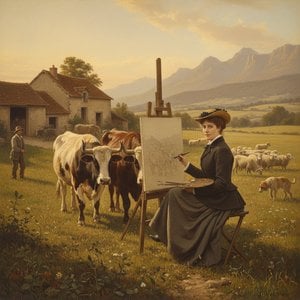
Auguste Jouve: A Visionary of African Wildlife
Auguste Jouve (1846 – 1889) stands as a singular figure in late nineteenth-century French art, recognized primarily for his extraordinary depictions of African fauna—a realm where meticulous observation blended seamlessly with artistic imagination. Born in Marlotte, Seine-et-Marne, France, he emerged from an artistic lineage marked by the influence of his father, Pierre Jouve, a ceramist who instilled in him a profound appreciation for form and materiality. This formative experience would prove pivotal in shaping Jouve’s distinctive style—one characterized by painstaking detail and imbued with a palpable sense of wonder.
- Early Life & Artistic Training:
Jouve’s upbringing amidst the creative fervor of Parisian ateliers fostered his burgeoning talent. He honed his skills through self-directed study and experimentation, absorbing stylistic cues from luminaries like Jules Auguste Sage and Henri Fantin Latour—artists who championed realism alongside expressive color palettes. Notably, Fantin Latour's masterful handling of light and texture served as a significant inspiration for Jouve’s own artistic endeavors.
The Pursuit of Detail: Technique and Style
Jouve’s artistic approach distinguished itself through an unwavering commitment to anatomical accuracy combined with a remarkable ability to convey emotion. He meticulously studied animal specimens—often visiting zoos and museums—to capture their musculature, skeletal structure, and subtle movements with breathtaking precision. This dedication to realism was tempered by a stylistic inclination toward Art Nouveau, evident in flowing lines and decorative embellishments that enhanced the dynamism of his compositions. His canvases pulsated with life, reflecting not merely what he saw but also what he felt—a testament to his profound empathy for the natural world.
Notable Works & Recognition
Jouve’s oeuvre comprises a substantial collection of paintings and sculptures focusing on African animals, including elephants, rhinoceroses, giraffes, lions, and monkeys. Among his most celebrated pieces are “Still Life with Flowers,” showcasing an exquisite rendering of botanical specimens bathed in luminous light—a technique honed during his formative years under Fantin Latour’s tutelage—and “Grapes and an Apple,” a masterful study of fruit that exemplifies Jouve's meticulous attention to texture and color. His work garnered considerable acclaim within the artistic circles of Paris, securing him membership in Société des artistes français.
Legacy & Influence
Auguste Jouve’s contribution to French art history extends beyond his individual creations; he was awarded the Prix Abd-el-Tif in 1907 and subsequently the Prix d'Indochine in 1921—honors recognizing his artistic merit and furthering his reputation as a champion of naturalistic representation. Furthermore, he is remembered as the father of Pierre Paul Jouve, another artist who continued to explore themes of wildlife and beauty. Jouve’s legacy resides not only in his stunning artworks but also in his unwavering dedication to capturing the essence of African fauna with unparalleled artistry—a feat that cemented his place among the foremost painters of his era.
Further Exploration
For a deeper understanding of Auguste Jouve’s artistic journey, consult Wikipedia:
Paul Jouve. You can also admire his artwork on WahooArt:
Still Life wit Flowers, Auguste Jouve, 1870 - 1877.