Introduction
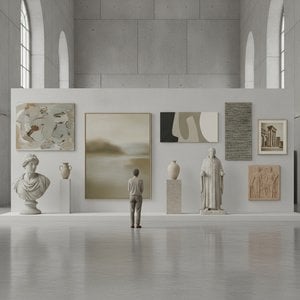
Step into a space where the clamor of vibrant color fades, replaced by a profound, whispered elegance. There is a unique, quiet power in a palette defined by putty tones —those sophisticated, muted neutrals that sit softly between warm beige, weathered stone, and delicate taupe. To wander through a collection dominated by these hues is not to witness a lack of color, but rather to experience the mastery of light, shadow, and texture. It is an invitation to slow our breathing and observe the subtle nuances that often escape us in more boisterous compositions.
Historically, the use of such restrained palettes has been a hallmark of eras seeking depth over decoration. From the somber, atmospheric dignity of the Old Masters to the soft, light-drenched transitions of Impressionism, these neutral tones have served as the perfect stage for drama. These pigments allow the artist to focus on the soul of the subject —the way a single highlight catches a cheekbone or how a shadow recedes into the velvet darkness of a corner. Culturally, this aesthetic speaks to a timeless pursuit of serenity and understated luxury, a movement away from the superficial toward the eternal.
In our contemporary world, these artworks remain deeply meaningful because they offer an anchor of tranquility. In an age of digital saturation and high-contrast imagery, the muted, earthy tones of these masterpieces provide a much-needed visual sanctuary. They remind us that strength does not always require a shout; often, it is found in the quietest whisper of a brushstroke.
As we prepare to journey through our curated selection, prepare to be captivated by the subtle complexities of the neutral spectrum. We have selected ten extraordinary works where putty tones do not merely exist—they dominate, creating atmospheres of unparalleled grace and enduring mystery. Let us begin our exploration of these muted marvels.
Guernica - Pablo Picasso
 Guernica - Pablo Picasso
In the hauntingly silent echoes of Guernica by Pablo Picasso, one finds a visceral scream frozen in time. As part of our mission at WahooArt.com to democratize beauty and bring the world's most profound legacies into the private sphere, we recognize this work as a cornerstone of emotional expression. It earns its place among the top paintings dominated by putty and monochromatic tones not through mere colorlessness, but through a deliberate, journalistic starkness. The palette of ash, grey, and bone-white strips away the distraction of hue, forcing the viewer to confront the raw, fragmented geometry of human suffering.
Picasso’s Cubist mastery transforms a historical tragedy into a universal symbol of resilience. The muted, neutral tones create an atmosphere of somber gravity that is both unsettling and profoundly moving. This aesthetic of desaturated strength offers a sophisticated anchor for modern interiors, providing a focal point of intellectual depth and historical weight. Through our high-fidelity, hand-painted oil reproductions, you can bring this transformative, monumental presence into your own home, office, or personal gallery, ensuring that the power of Picasso’s protest continues to resonate in the contemporary space.
Marilyn Diptych - Andy Warhol
 Marilyn Diptych - Andy Warhol
To stand before Andy Warhol’s 1962 Marilyn Diptych is to witness the haunting intersection of glamour and grief. While the left panel erupts in a fever dream of saturated, artificial hues, it is the transition into the muted, monochromatic right side that truly arrests the soul. Here, the vibrant silkscreen layers begin to fade, revealing subtle putty tones and desaturated greys that evoke the inevitable decay of memory and the ephemeral nature of fame.
The mechanical repetition of Monroe’s visage creates a rhythmic, almost hypnotic atmosphere, where the stark black-and-white imagery acts as a somber requiem. This interplay between electric color and ghostly, neutral shadows offers a profound depth that transcends mere Pop Art. In a contemporary interior, such a piece serves as a sophisticated anchor; its balance of high-contrast energy and quiet, neutral tones provides a contemplative focal point, inviting guests to reflect on the beautiful, fading traces of our shared cultural icons.
Frida Kahlo - `The Two Fridas` - Frida Kahlo
 Frida Kahlo - `The Two Fridas` - Frida Kahlo
In Frida Kahlo’s 1939 masterpiece, The Two Fridas , there is a gaze that follows you—not with judgment, but with profound understanding . This isn’t merely a portrait; it is a mirror reflecting the fractured duality of the human soul. Within this composition, the 'putty' tones and muted, neutral flesh tints serve as a somber, grounded canvas for the visceral drama unfolding between the two figures.
As you stand before this work, notice how the desaturated, earthy mid-tones of the skin and the stormy, greyish sky create a heavy, atmospheric tension. These neutral palettes allow the shocking crimson of the exposed hearts and the delicate, blood-stained white lace to command your attention. The painting captures Kahlo at her most vulnerable, navigating the emotional wreckage of her divorce through a fusion of Surrealism and Mexican folk tradition. Now, imagine that gaze in your own space. Not watching you, but reminding you : you are seen. You are part of this enduring story of resilience.
Composition VIII - Wassily Wassilyevich Kandinsky
 Composition VIII - Wassily Wassilyevich Kandinsky
In Wassily Kandinsky’s 1923 masterpiece, Composition VIII , the light does not merely illuminate the canvas; it is composed with the precision of a symphonic movement. While many collectors seek vibrant pigments, this work finds its profound strength in the subtle, muted foundations—those essential 'putty' tones and pale, neutral backdrops that allow the geometric drama to breathe. These understated, earthy neutrals act as the silent stage upon which fiery reds, deep blues, and sharp blacks perform their rhythmic dance.
As you stand before this landmark of abstract expressionism, notice how the soft, desaturated background prevents the complex interplay of circles and triangles from becoming overwhelming. It provides a spiritual stillness, a visual breath that anchors the energetic tension of the intersecting lines. Kandinsky didn't just paint shapes; he orchestrated a visual score where the neutral tones provide the essential resonance. Bringing such a sophisticated balance into your home transforms a simple wall into a portal of intellectual and emotional depth, proving that true mastery lies in the harmony between bold movement and quiet, muted grace.
The Night - Max Beckmann
 The Night - Max Beckmann
Step into a world of profound psychological tension, where the air feels heavy with the echoes of a fractured era. Max Beckmann’s 1919 masterpiece, The Night , does not merely depict a scene; it captures the very essence of post-war trauma and existential dread. As you gaze upon this cornerstone of the Neue Sachlichkeit movement, you are met with a claustrophobic interior where distorted figures collide in a dance of chaos and alienation.
This work earns its place among the top 10 famous paintings dominated by 'putty' tones through its masterful use of a muted, somber palette. The composition is anchored by desaturated ochres, ashen grays, and fleshy, putty-colored skin tones that evoke a sense of decay and wounded humanity. These neutral, earthy hues provide the perfect canvas for sudden, jarring flashes of crimson and stark white, heightening the painting's visceral impact. To possess such a piece is to invite a profound dialogue into one's space—a reminder that even within the most unsettling shadows, there is an enduring, raw beauty found in the truth of the human condition.
Joan Miró- Catalan Landscape (The Hunter) - Joan Miró
 Joan Miró- Catalan Landscape (The Hunter) - Joan Miró
Imagine standing amidst the quiet, sun-drenched plains of Catalonia at dawn, where the boundary between reality and a dream begins to dissolve. In Joan Miró’s 1924 masterpiece, Catalan Landscape (The Hunter) , this ethereal transition is captured through a sophisticated palette of putty tones , earthy ochres, and muted terracottas. The painting does not merely depict a landscape; it breathes the very essence of the subconscious, utilizing soft, neutral foundations to anchor its more vibrant, surrealist punctuations.
This work earns its place among the top 10 famous paintings dominated by putty tones because of how these desaturated, organic hues provide a serene stage for Miró’s playful, biomorphic symbols. The muted background creates a sense of infinite, quiet space, allowing the eye to wander through a rhythmic dance of lines and shapes without overwhelm. For the discerning collector or interior designer, integrating such a piece into a modern living space offers more than mere decoration; it introduces a profound sense of architectural harmony and intellectual depth, inviting a moment of meditative stillness amidst the complexities of contemporary life.
Woman I - Willem de Kooning
 Woman I - Willem de Kooning
In Willem de Kooning’s Woman I , the unsettling presence of fleshy, putty-like tones serves as the emotional anchor amidst a storm of Abstract Expressionist chaos. These muted, skin-adjacent hues do not offer comfort; instead, they ground the painting's more violent reds and jarring greens, creating a visceral sense of raw, post-war vulnerability. This mastery of a discordant palette—where neutral, fleshy undertones collide with aggressive impasto strokes—is precisely why this work earns its place among the top 10 famous paintings dominated by 'putty' tones .
For the discerning interior designer or collector, integrating a piece with such complex tonal depth can transform a modern living space. The way these fleshy neutrals interact with stark blacks and whites allows you to curate an atmosphere of sophisticated tension. In a minimalist dining room, the painting’s heavy texture and muted mid-tones provide a powerful focal point that balances contemporary sleekness with historical gravity, injecting a sense of movement and psychological depth into your architectural landscape.
Portrait of Ambroise Vollard - Pablo Picasso
 Portrait of Ambroise Vollard - Pablo Picasso
In the Portrait of Ambroise Vollard , Pablo Picasso does not merely capture a face; he deconstructs an era. As a cornerstone of our exploration into the top 10 famous paintings dominated by 'putty' tones , this 1910 masterpiece exemplifies how a muted, monochromatic palette can amplify intellectual depth. By stripping away the distraction of vibrant color, Picasso utilizes a sophisticated spectrum of ochre, slate gray, and earthy browns to focus entirely on the structural revolution of Analytical Cubism.
The subject, the legendary art dealer Vollard, is rendered through fragmented geometric planes that challenge our very perception of reality. There is a profound, somber beauty in these neutral, putty-like hues; they create a sense of timelessness and weight that resonates deeply within modern minimalist interiors. In today’s curated spaces, where neutral color palettes and textural complexity are highly sought after, this painting serves as a powerful dialogue between historical radicalism and contemporary aesthetic restraint, proving that true emotional resonance often lies in the subtle interplay of shadow and form.
Le bonheur de vivre (The Joy of Life) - - Henri Matisse
 Le bonheur de vivre (The Joy of Life) - - Henri Matisse
Acquiring a piece inspired by Le bonheur de vivre by Henri Matisse is more than an aesthetic choice; it is an investment in the very legacy of modernism and a profound statement of refined taste for the discerning collector. As a cornerstone of the Fauvist movement, this 1906 masterpiece commands immense market prestige, its influence resonating through every era of 20th-century abstraction. While Matisse is celebrated for his 'wild beast' palette, this work achieves a rare equilibrium through its use of muted, neutral undertones—subtle putty and sand-colored highlights that anchor the more vibrant, rhythmic strokes of the landscape.
The composition breathes with a dreamlike vitality, where figures dance amidst a lush, stylized Eden. The interplay of light and flattened forms creates a sensory experience of liberation and warmth. For the contemporary connoisseur, integrating a high-quality, hand-painted oil reproduction of this masterpiece into a modern luxury interior provides an unparalleled sense of aesthetic authority. It brings the soulful, sun-drenched atmosphere of a historical landmark into a sophisticated home, offering a timeless focal point that exudes status and cultural depth.
Man at the Window - Gustave Caillebotte
 Man at the Window - Gustave Caillebotte
In Gustave Caillebotte’s 1875 masterpiece, Man at the Window , the lines of Parisian architecture aren’t merely drawn; they are choreographed . This is not a simple composition; it is a dance frozen in time, where the heavy, muted 'putty' tones of the urban landscape perform a silent duet with the figure’s quiet introspection. The palette—a sophisticated arrangement of desaturated grays, stone beiges, and somber blacks—creates a rhythmic stillness that anchors the viewer in a moment of profound solitude.
The painting achieves a breathtaking balance, using the architectural precision of Haussmann’s Paris to make the weight of urban isolation feel like harmony. A singular, vibrant red chair provides the only pulse of warmth, preventing the neutral tones from becoming stagnant. As you contemplate this study in realism, ask yourself: what if your living room could hold that same equilibrium? What if your walls could breathe rhythm through the soft, diffused light and the evocative, neutral textures found in Caillebotte’s legendary brushwork?
Conclusion
As the light fades on our exploration of these muted, soulful palettes, we are reminded that the beauty of 'putty' tones lies not in their subtlety, but in their profound ability to anchor a space with quiet strength and timeless grace. These masterpieces are far more than mere relics of art history; they are living presences, breathing textures of canvas and oil that continue to move the human heart and shape the very atmosphere of our most cherished environments. They offer a sanctuary of calm, inviting a contemplative stillness into the modern world.
At WahooArt.com , we view these works as essential partners in the art of fine living. For the interior designer curating a boutique hotel, the architect composing a private villa, or the collector seeking to infuse a residence with heritage, we serve as your dedicated creative collaborator. We do not merely provide reproductions; we facilitate the realization of an artistic vision through museum-quality, hand-painted oil works that capture every delicate brushstroke and tonal nuance. From bespoke multi-panel installations that command a grand staircase to professional digital mockups that allow you to visualize a masterpiece on your specific wall, our mission is to transform architectural spaces into curated galleries.
Whether you are seeking the tactile depth of an impasto Van Gogh or the soft, atmospheric light of a Monet, we invite you to discover how these understated tones can redefine your next project. We invite you to wander through our full collection and find the piece that speaks to your soul, ensuring that every interior you touch becomes a lasting, breathtaking artistic statement.