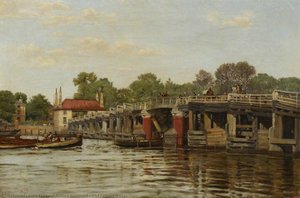
Frederic Almore Winkfield: Bridging Victorian London and Romantic Landscape
Frederic Almore Winkfield (born circa 1860, died 1937) emerged as a prominent British watercolorist during the late Victorian era, capturing the serene beauty of the Thames River and its environs with meticulous detail and imbued with a palpable sense of atmosphere. While biographical information remains somewhat sparse—a testament to the often elusive nature of artistic lives—Winkfield’s oeuvre speaks volumes about his artistic vision and reflects the broader trends shaping British art at the turn of the century.
His formative years were spent in Fulham, London, where he absorbed the influences of Romantic landscape painting championed by artists like Turner and Constable. These masters instilled in Winkfield a profound appreciation for capturing fleeting moments of sublime grandeur—the dramatic interplay of light and shadow across water surfaces—a technique that would become central to his artistic practice. Early works demonstrate a masterful command of watercolor pigments, skillfully blended to achieve luminous tonal gradations and conveying the subtle nuances of color observed in nature. He diligently studied Turner’s atmospheric compositions, particularly those depicting storms over the sea, striving to emulate the artist's ability to convey emotion through visual representation. Constable’s dedication to portraying rural England with accuracy and honesty served as another crucial inspiration, shaping Winkfield’s commitment to capturing the authentic character of his subjects.
Winkfield’s artistic career gained considerable momentum through exhibitions at the Royal Watercolour Society (RWS) and other prestigious venues. He consistently pursued landscapes depicting sections of the Thames River—particularly Fulham Bridge—presenting them with remarkable accuracy and capturing the essence of riverside life. These paintings aren't merely topographical representations; they are imbued with a contemplative spirit, inviting viewers to contemplate the passage of time and the enduring power of natural beauty. The artist’s meticulous attention to detail extends beyond mere visual fidelity; he strives to convey not only what is seen but also how it feels—the coolness of the river breeze, the dappled sunlight filtering through the foliage. Notable amongst his works are “Old Fulham Bridge” and “Old Toll House, Fulham Bridge,” which exemplify Winkfield’s ability to render complex architectural forms with breathtaking realism while simultaneously conveying a sense of tranquility and timelessness.
A significant contribution to Winkfield's artistic legacy lies in his exploration of symbolism within landscape imagery. Recurring motifs—such as weeping willows and reflections on water—often carry connotations of melancholy and remembrance, reflecting a broader Victorian preoccupation with mortality and spiritual contemplation. These symbolic elements elevate Winkfield’s paintings beyond mere visual pleasure, prompting viewers to engage in deeper introspection about the human condition. He believed that art possessed the capacity to communicate profound truths about existence, mirroring the philosophical debates prevalent during his era concerning faith, reason, and the afterlife.
Despite his considerable success during his lifetime, Winkfield remained largely unrecognized by posterity until recent scholarship revived interest in his work. Today, Frederic Almore Winkfield’s paintings are celebrated for their exquisite watercolor technique and their evocative portrayal of Victorian London’s riverside landscapes—a testament to an artist who successfully blended Romantic idealism with meticulous observation, securing a place among the finest practitioners of British watercolor painting. His dedication to preserving the visual memory of his time cemented his reputation as a master of his craft and ensured that his artistic vision would continue to inspire generations of artists to come.