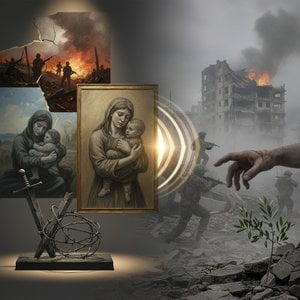
Leslie Cole (1910–1976): British War Artist Documenting WWII’s Realities
Leslie James Cole, born in Swindon, United Kingdom, in 1910, was an artist whose life became inextricably linked with the tumultuous events of the Second World War. Though his name may not be as instantly recognizable as some of his contemporaries, Cole’s contribution to documenting the realities of conflict – and its devastating aftermath – is profoundly significant. His work stands as a powerful testament to human resilience in the face of unimaginable horror, offering a visual record that continues to resonate with viewers today. Cole's artistic journey began with formal training at Swindon Art School from 1927 to 1932, followed by studies at Birmingham College of Art and culminating in a diploma from the Royal College of Art in 1937, where he specialized in mural decoration, fabric painting, and lithography. This diverse foundation equipped him with a versatile skillset that would prove invaluable during his time as an official war artist. Even before the outbreak of war, Cole demonstrated a commitment to both artistic practice and education, beginning his teaching career at Hull College of Art – a dedication he would continue throughout his life.Early Life & Artistic Foundations
Cole’s formative years were marked by a passion for visual arts instilled early on. Studying lithography and murals at Swindon Art School provided him with foundational techniques that would inform his later work, emphasizing precision and textural richness. Birmingham College of Art broadened his artistic horizons, introducing him to new styles and approaches alongside Harold Holden. Crucially, his enrollment at the Royal College of Art in 1937 cemented his specialization in mural decoration, fabric painting, and lithography—skills that would prove indispensable when he embarked on his career as an official war artist. His involvement with the Senefelder Club showcased his dedication to printmaking and fostered connections within the artistic community. Notably, Cole’s early exhibitions demonstrated a burgeoning talent for capturing psychological depth within portraiture and landscape alike. This comprehensive training ensured he possessed both technical mastery and an understanding of artistic expression—qualities that would serve him well during the challenging years ahead.A Soldier Artist: Serving During WWII
The Second World War irrevocably altered Cole’s artistic trajectory, propelling him into a role far beyond the studio walls. Initially disheartened by his discharge from the RAF due to medical concerns, he refused to abandon his ambition to contribute to the war effort. Despite initial rejection by Sir Kenneth Clark and the War Artists' Advisory Committee (WAAC), Cole proactively pursued opportunities for engagement—taking leave of Hull College of Art to accompany a trawler involved in coastal minesweeper work and serving aboard a destroyer on Gibraltar convoy duties. These self-initiated projects underscored his unwavering determination and showcased his artistic talent, ultimately securing him a commission from the WAAC in 1943. This pivotal moment marked the commencement of an extraordinary period wherein Cole documented pivotal moments of WWII—from Malta during the siege to Normandy alongside the Royal Marines—capturing scenes of both heroism and suffering with unflinching realism. His meticulous attention to detail, combined with his ability to convey emotional intensity, resulted in paintings that powerfully communicated the human experience of conflict.Documenting Trauma: Bergen-Belsen & Beyond
Cole’s most enduring legacy resides in his harrowing depictions of Bergen-Belsen concentration camp—a testament to his courage and artistic integrity. Assigned to record the liberation of this infamous site, Cole undertook a monumental task—capturing the devastating consequences of Nazi barbarism with profound sensitivity and unwavering honesty. His panoramic oil paintings meticulously documented the suffering endured by survivors, British troops, and captured German guards—images that remain profoundly disturbing yet undeniably vital for understanding the horrors inflicted upon humanity during WWII. These works exemplify Cole’s commitment to confronting difficult truths and conveying the emotional weight of historical events—a characteristic that distinguished him from many of his contemporaries. The WAAC recognized Cole's ability to convey psychological depth within visual narratives, validating his artistic vision as essential for documenting wartime realities.Legacy & Recognition
Following the war, Leslie Cole established a studio in Fulham, London, continuing his teaching career at institutions such as Hull College of Art and Brighton College of Art—a testament to his lifelong devotion to artistic education. Renewed interest in Cole’s contributions emerged in 1985 with an exhibition titled "To the Front Line" at the Imperial War Museum, and again in 2009 when two of his paintings appeared on Antiques Roadshow. Today, Cole’s artworks are held by numerous public collections across Britain—ensuring that his powerful depictions of WWII continue to inspire reflection and remembrance. His art stands as a poignant reminder of the sacrifices made during the conflict and serves as an enduring tribute to those impacted by its devastating consequences. Leslie Cole's legacy is not merely one of artistic skill but of courageous documentation, offering a profound and lasting record of humanity’s darkest chapter.Вопросы и ответы
Из какой страны Лесли Коул?
Лесли Коул родился в Великобритания.
Как мне найти работы Лесли Коул на определенную тему?
Чтобы найти работы Лесли Коул на определенную тему, воспользуйтесь страницей По ключевым словам, где произведения художника сгруппированы по ключевым словам.
Сколько произведений искусства Лесли Коул доступно для просмотра?
Вы можете просмотреть 65 произведений искусства работ художника Лесли Коул на странице Все произведения искусства.