A Chronicler of Berlin’s Soul: The Life and Art of Heinrich Zille
Rudolf Heinrich Zille, affectionately known as “Pinselheinrich” – Brush Heinrich – to the people of Berlin, was far more than just an artist; he was a visual historian, a compassionate observer deeply attuned to the rhythms of urban life, and a satirical chronicler of a city undergoing profound and often turbulent change. Born in 1858 in Radeburg, Germany, Zille’s life mirrored the rapid industrialization and social upheaval that defined late 19th and early 20th-century Berlin. His family's relocation to the capital in 1867 proved a pivotal moment, plunging him directly into a world of stark contrasts – the glittering promise of burgeoning wealth juxtaposed against the grinding reality of widespread poverty. This fundamental duality became the very core of his artistic vision, informing every line and shadow he captured on paper. Initially apprenticed as a lithographer in 1872, Zille’s early training instilled within him an exceptional command of line and form – a foundational skill that would underpin his later, immensely successful work. His father, envisioning a more conventional trade perhaps involving butchery, initially held different aspirations for young Heinrich, but the boy's undeniable passion for draughtsmanship, nurtured by a supportive teacher who recognized his burgeoning talent, ultimately prevailed. This dedication to art wasn’t immediate; it evolved organically after losing his job in 1910, fueled by the encouragement of Max Liebermann, allowing him to fully embrace his artistic calling and dedicate himself entirely to documenting the city he loved.The “Milljöh” and a City Revealed
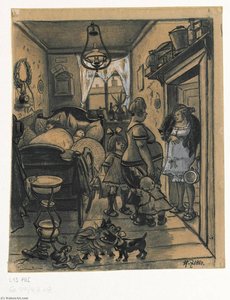
Zille's enduring legacy rests upon his extraordinary ability to capture the essence of Berlin’s "Milljöh" – a uniquely German term encapsulating the everyday life, atmosphere, and social fabric of the city, particularly within its densely populated working-class neighborhoods. He deliberately avoided romanticizing or idealizing; instead, he presented an unvarnished, brutally honest portrayal of tenement buildings ("Mietskaserne") crammed with families, crowded streets teeming with humanity, and the struggles faced by those desperately trying to survive within them. His drawings weren’t merely depictions of poverty – they were deeply empathetic studies of human resilience, humor, and dignity in the face of overwhelming hardship. Beggars, prostitutes, laborers, children working long hours, and their families populated his world, rendered with a keen eye for detail and an often-biting wit. He depicted recognizable stereotypes, yes, but always imbued with a sense of understanding and compassion, avoiding caricature that descended into cruelty or judgment. Zille’s preferred mediums – lithography, pencil sketches, and occasional woodcuts – lent themselves perfectly to this intimate style, allowing him to convey texture, depth, and a palpable sense of atmosphere in his monochromatic works, drawing the viewer directly into the heart of Berlin's underbelly. The subtle gradations of tone, the precise rendering of wrinkles and worn clothing, all contributed to a powerful emotional resonance.Early Influences and Artistic Development
Zille’s artistic journey wasn’t entirely solitary. His early training as a lithographer provided him with invaluable technical skills, but he was also profoundly influenced by the work of artists like Gustave Courbet and Honoré Daumier – masters of realism who depicted social realities without sentimentality. He absorbed their techniques for capturing everyday life and conveying social commentary, adapting them to his own unique style. The encouragement of Max Liebermann proved crucial, providing Zille with a platform to exhibit his work and fostering a collaborative spirit within the Berlin art scene. This period marked a significant shift in Zille’s artistic focus, moving beyond mere technical proficiency towards a more deliberate exploration of social themes. He began to actively seek out subjects from the streets – observing the interactions between different classes, documenting the effects of industrialization on urban life, and capturing the spirit of Berlin's diverse population. His early sketches were often quick impressions, capturing fleeting moments of human interaction; as his skills developed, he became increasingly adept at creating detailed and nuanced portraits of individuals and scenes.Recognition and a Lasting Legacy
For years, Zille’s work found its audience primarily through publications like *Simplicissimus*, a prestigious German satirical weekly that championed innovative artistic styles and social commentary. This exposure gradually brought him wider recognition within the art world and beyond. In 1903, he was invited to join the Berlin Secession – a group of artists challenging traditional artistic norms – marking a significant milestone in his career. The Secession provided a platform for Zille’s work and solidified his position as a leading voice in contemporary German art. The years following World War I saw a surge in public appreciation for Zille's unique perspective, culminating in the National Gallery purchasing several of his drawings in 1921 – a powerful validation of his artistic merit. In 1924, at the suggestion of Max Liebermann, Zille was appointed professor at the Academy of the Arts, cementing his status as a respected figure within the German art community. Even after his death in 1929, Berlin honored Zille’s memory through the creation of parks and statues dedicated to his work – ensuring that his legacy continues to resonate with generations of city dwellers. His drawings remain a poignant and enduring testament to the human spirit and a vital record of a rapidly changing urban landscape.Beyond the Surface: A Complex Legacy
While primarily known for his social realism, Zille’s artistic output also included a lesser-known collection of erotic drawings depicting everyday life within Berlin's working-class communities. These works, now housed in the Beate Uhse Erotic Museum in Berlin, offer a fascinating glimpse into a more private and playful side of the artist – demonstrating his willingness to explore the full spectrum of human experience with honesty and sensitivity. Despite their subject matter, these drawings are imbued with the same meticulous detail and empathetic observation that characterize Zille’s social commentary, revealing a complex and multifaceted artistic personality.- Social Commentary: Zille's work served as a potent form of social commentary, exposing the harsh realities of urban poverty and inequality.
- Artistic Influence: His distinctive style influenced subsequent generations of artists interested in depicting everyday life and social issues.
- Historical Documentation: Zille’s drawings provide invaluable historical documentation of Berlin during a period of rapid transformation.
- Cultural Icon: He remains a beloved cultural icon in Berlin, celebrated for his ability to capture the city's unique character and spirit.