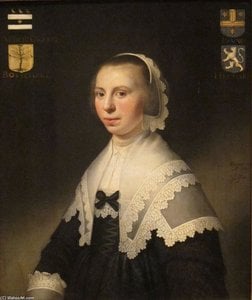
A Delft Master of Baroque Portraiture
Willem Jacobsz Delff, whose life spanned the vibrant years between 1580 and 1638, remains a luminous figure within the tapestry of the Dutch Golden Age. To encounter his work is to step into an era where portraiture transcended mere likeness; it became a carefully orchestrated performance of status, emotion, and enduring dignity. Born in Delft, this artistic crucible nurtured a talent that was both technically brilliant and deeply resonant with human experience.
His early life was steeped in the very atmosphere of artistic patronage. He did not emerge into art as an isolated genius, but rather as part of a vibrant, creative lineage. The shadow and guidance of his father, Jacob Willemsz. Delff I—a respected portraitist in Delft—provided him with an invaluable apprenticeship in capturing the subtle nuances of familial connection and individual character. This immersion within a family steeped in artistic endeavor, further bolstered by the talents of his brothers, established a profound foundation for his own mastery.
The Craftsmanship of Line and Light
Delff’s early professional renown was built upon an extraordinary command of engraving. He possessed a gift for translating the richness of oil paint into the stark, precise beauty of monochrome print. These engravings reveal a meticulous eye, capable of rendering texture—be it velvet, lace, or polished metal—with astonishing fidelity. Yet, while his prints speak to his technical prowess as a draftsman, it is his paintings that truly capture the sweep of his artistic ambition.
His mature style is undeniably marked by the grandeur and drama inherent in Baroque art. Delff understood how light could sculpt a sitter’s face, how deep shadows could suggest untold narratives, and how opulent composition could elevate a mere portrait into an emblem of power. Whether depicting members of royalty or the affluent merchant class, his subjects are never simply observed; they are presented under a spotlight of historical significance.
Capturing Nobility and Psychological Depth
The subject matter that most defines Delff’s legacy is the portrayal of the elite—the nobility and those who held significant sway in Dutch society. His portraits are not merely flattering records; they are psychological studies veiled in finery. He had a remarkable ability to imbue his sitters with an aura of inherent dignity, making the viewer feel privy to a moment of quiet, powerful contemplation.
The symbolism woven into these works is subtle but pervasive.
A particular glance might suggest political acumen; the richness of the fabrics speaks to accumulated wealth. Delff mastered the art of suggestion, allowing the sitter’s own bearing and the artist's masterful handling of light to do much of the narrative heavy lifting for him. His commitment to realism never sacrificed the necessary theatricality required by the Baroque aesthetic.
Historical Resonance and Enduring Legacy
Willem Jacobsz Delff stands as a vital bridge between the intimate portraiture traditions of his father and the grand, dramatic statements of high Baroque art. His career serves as a testament to the enduring power of the family workshop in sustaining artistic excellence during periods of intense cultural flourishing. Though he passed away in 1638, his contribution to the visual record of the Dutch Golden Age remains indelible.
For the modern admirer of art,
exploring Delff’s oeuvre is an invitation into a world where technical mastery meets profound human observation. His work invites us not just to admire the paint, but to contemplate the weight of history held within a single, exquisitely rendered gaze.
Вопросы и ответы
Где можно найти работы Willem Jacobsz Delff, распределенные по темам?
Работы Willem Jacobsz Delff можно изучать по темам на странице Атлас сюжетов художника.
Какие работы Willem Jacobsz Delff просматривают чаще всего?
Статистика работ Willem Jacobsz Delff доступна на странице Статистика художника.
Где я могу увидеть цветовую палитру работ Willem Jacobsz Delff?
Использование цвета в работах Willem Jacobsz Delff, представленных на этот сайт, можно изучить на странице Геном палитры художника.