Теодор Жерико, 1791 – 1824

The 100 Most Famous Paintings by Теодор Жерико

The painting that made Теодор Жерико famous is Раф Медузы (1818); it hangs in the Лувр, Париж. Nymph and Satyr (Jupiter and Antiope) (1820) and The Oath of Brutus after the Death of Lucretia (1815) follow it in the hearts of collectors and museum visitors. Of the 183 works by Теодор Жерико in our catalogue, these 100 are the most admired, each presented with its date, its museum and what sets it apart.

Рейтинг основан на нашем показателе популярности, который учитывает количество поисковых запросов, посещений и заказов для каждой работы. Обновлено Октябрь 2026. Every masterpiece on this page can be ordered as a museum-quality, hand-painted oil reproduction or a fine art print, at the size you choose.

Портрет Теодор Жерико
Теодор Жерико · 1791 – 1824
Дата рождения · дата смерти
1791 – 1824, Руан
Направление
Romantic painting
Работы в нашем каталоге
183
Самые известные
Раф Медузы (1818)
Больше всего работ в
Лувр

Теодор Жерико: the ten masterpieces

Раф Медузы (1818) работы Теодор Жерико
1

Раф Медузы

1818 · Масло на холсте · Лувр, Париж

Гéricault и Рафт Мёдузы: Символ Страдания и Человеческой Силы Райт Théodore Géricault – имя, которое звучит с духом французского романтизма. Родился он в Руане во Франции в 1791 году среди эхо революции и восходящей волны наполеоновской амбиций. Хотя наследил комфортное существование через бизнес семейные предприятия — включая табачную фирму Hôtel de Long, его судьбой был мир художественного выражения. Его раннее обучение у Карла Вернета, мастера английского спортивного искусства, заложило в…

Nymph and Satyr (Jupiter and Antiope) (1820) работы Теодор Жерико
2

Nymph and Satyr (Jupiter and Antiope)

1820 · Acrylic On Canvas · Musée des Beaux-Arts et de la Céramique, Руан

The Allure of the Divine Encounter: Géricault’s *Nymph and Satyr* Jean-Louis André Théodore Géricault's *Nymph and Satyr*, painted in 1819, isn’t merely a depiction of a mythological scene; it’s a profound exploration of desire, transgression, and the inherent tension between innocence and primal instinct. Born amidst the tumultuous backdrop of post-revolutionary France, Géricault, already recognized for his dramatic intensity, sought to capture not just a narrative but an emotional truth—a…

Lions in a Mountainous Landscape (1818) работы Теодор Жерико
4

Lions in a Mountainous Landscape

1818 · Acrylic On Canvas · Метрополитен-музей, Нью-Йорк

This vigorous painting of six lions in a remote, spectrally illuminated lair—possibly intended to evoke the Atlas Mountains of Morocco—is an extraordinary example of Gericault’s spontaneous handling of paint. Rather than applying finishing touches to make a polished cabinet picture, the artist left the painting in a state known as an esquisse, or sketch, a work prized by fellow artists for its strength of directly capturing a subject or effect.…

The Kiss (1822) работы Теодор Жерико
5

The Kiss

1822 · Acrylic On Canvas · Музей Тиссен-Борнмиса, Мадрид

Théodore Géricault's "The Kiss," painted in 1816, isn’t merely a depiction of lovers entwined; it’s a visceral embodiment of the burgeoning Romantic movement’s fascination with raw emotion, dramatic intensity, and the sublime. This arresting work, housed within the Thyssen-Bornemisza Museum in Madrid, transcends simple representation to become a profound meditation on passion, vulnerability, and the very essence of human connection. Géricault, already a figure known for his unflinching portrayals of…

Wounded Soldiers Retrating from Russia (1814) работы Теодор Жерико
6

Wounded Soldiers Retrating from Russia

1814 · Acrylic On Canvas · Musée des Beaux-Arts, Руан

A Symphony of Suffering: Géricault’s “Wounded Soldiers Retrating from Russia” Jean-Louis André Théodore Géricault's "Wounded Soldiers Retrating from Russia" is not merely a painting; it’s a visceral embodiment of the horrors and human cost of war, rendered with an unprecedented level of realism and emotional intensity for its time. Completed in 1814, this monumental canvas—measuring a commanding 250 x 206 cm—captures a pivotal moment during Napoleon's disastrous invasion of Russia,…

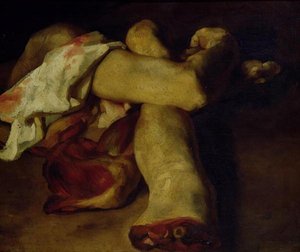
Study of Feet and Hands (1818) работы Теодор Жерико
7

Study of Feet and Hands

1818 · Oil On Canvas · Musée Fabre, Монпелье

Jean-Louis André Théodore Géricault's "Study of Feet and Hands," painted in 1818, isn’t a grand statement of Romantic drama like his monumental “The Raft of the Medusa.” Instead, it offers a profoundly intimate glimpse into the artist’s meticulous process and a poignant meditation on the human form. This unassuming oil painting—measuring a modest 52 x 64 cm—is far more than just a preparatory sketch; it's a concentrated distillation of Géricault’s…

The Raft of the Medusa (detail) (1818) работы Теодор Жерико
8

The Raft of the Medusa (detail)

1818 · Oil On Canvas · Лувр, Париж

Jean-Louis André Théodore Géricault's "The Raft of the Medusa," a monumental detail from his 1818 painting, isn’t merely a depiction of shipwreck; it’s a visceral plunge into the depths of human suffering and political indictment. The scene, rendered with a dramatic intensity characteristic of Romanticism, captures the harrowing aftermath of the French frigate *Medusa*'s wreck off the coast of Mauritania in 1816. This disaster, largely attributed to the incompetence and…

The Wreck (1821) работы Теодор Жерико
10

The Wreck

1821 · Oil On Canvas · Лувр, Париж

Théodore Géricault's "The Wreck," painted in 1821, isn’t merely a seascape; it’s a visceral confrontation with the sublime—a raw depiction of humanity’s vulnerability against the overwhelming force of nature. Born amidst the turbulent currents of post-revolutionary France, Géricault, a figure both lauded and controversial within the burgeoning Romantic movement, channeled his own anxieties and the era's fascination with dramatic events into this monumental canvas. The painting immediately commands attention not…

More Теодор Жерико masterpieces, 11 to 100

The Horse Race (1816) работы Теодор Жерико
#11

The Horse Race

1816 · Музей Тиссен-Борнмиса

Jean-Louis André Théodore Géricault's "The Horse Race," painted in 1816, isn’t merely a depiction of a sporting event; it’s a visceral embodiment of Romanticism’s core tenets – passion,…

Bring it home →
Swiss Guard and Wounded Veteran (1819) работы Теодор Жерико
#12

Swiss Guard and Wounded Veteran

1819 · Лувр

Jean-Louis André Théodore Géricault's "Swiss Guard and Wounded Veteran," painted in 1819, is not merely a historical depiction; it’s a profound meditation on duty, sacrifice, and the lingering…

Order a reproduction →
Mazeppa (1823) работы Теодор Жерико
#13

Mazeppa

1823 · Шатле де Шантильи

Théodore Géricault's "Mazeppa," painted in 1823, isn’t merely a depiction of a dramatic legend; it’s a visceral embodiment of Romantic turmoil—a raw exploration of suffering, resilience, and the…

Bring it home →
Two Horses (1809) работы Теодор Жерико
#14

Two Horses

1809 · The Phillips Collection

Jean-Louis André Théodore Géricault's "Two Horses," painted in 1808-1809, isn’t merely a depiction of two magnificent animals; it’s a visceral exploration of movement, power, and the fleeting nature…

Bring it home →
A Turk (Mustapha) (1820) работы Теодор Жерико
#15

A Turk (Mustapha)

1820 · Лувр

Jean-Louis André Théodore Géricault's "A Turk (Mustapha)," painted in 1820, is not merely a portrait; it’s a carefully constructed tableau of exoticism, melancholy, and the burgeoning Romantic sensibility…

Order a reproduction →
A Carabinier with his Horse (1814) работы Теодор Жерико
#16

A Carabinier with his Horse

1814 · Musée des Beaux-Arts

In the quiet intensity of Jean-Louis André Théodore Géricault’s 1814 masterpiece, "A Carabinier with His Horse," we encounter more than a mere military portrait; we witness a profound…

Order a reproduction →
Скачки без всадников (деталь) (1817) работы Теодор Жерико
#17

Скачки без всадников (деталь)

1817 · Лувр

Мгновение, застывшее во времени: «Скачки без всадников» Герико «Скачки без всадников (деталь)» Жана-Луи Андре Теодора Герико — это не просто изображение спортивного состязания; это висцеральное исследование человеческой драмы,…

Bring it home →
Boxers (1818) работы Теодор Жерико
#18

Boxers

1818 · Шатле де Шантильи

A Tempestuous Vision: Géricault’s “Boxers” Jean-Louis André Théodore Géricault's "Boxers," completed in 1818, isn’t merely a depiction of a boxing match; it’s a visceral embodiment of Romanticism’s fascination…

Order a reproduction →
The Epsom Derby (1821) работы Теодор Жерико
#20

The Epsom Derby

1821 · Лувр

Jean-Louis André Théodore Géricault's "The Epsom Derby," painted in 1821, isn’t merely a depiction of horse racing; it’s a visceral embodiment of Romanticism’s fascination with drama, movement, and…

Bring it home →
Three Lovers (1817) работы Теодор Жерико
#22

Three Lovers

1817 · Музей Дж. Пола Гетти

Théodore Géricault captured a private, feverish moment in Three Lovers. This small oil sketch, created about 1817–1820, offers a rare glimpse into the artist's more intimate preoccupations. It…

Order a reproduction →
Lion devouring a horse работы Теодор Жерико
#26

Lion devouring a horse

Шатле де Шантильи

Théodore Géricault's "Lion Devouring a Horse," painted in 1819, isn’t merely a depiction of predatory action; it’s a visceral exploration of power, mortality, and the primal instincts that…

Bring it home →
Untitled (ARJCHM) работы Теодор Жерико
#28

Untitled (ARJCHM)

Лувр

In the annals of art history, few works command the room with such visceral intensity as Théodore Géricault’s The Raft of the Medusa. This monumental oil on canvas…

Bring it home →
Portrait of a Young Man (1818) работы Теодор Жерико
#32

Portrait of a Young Man

1818 · Minneapolis Institute of Art

A young man emerges from a deep, indistinct darkness, his presence felt through the sudden, sharp clarity of light hitting his features. He sits in a quiet, intimate…

Order a reproduction →
A study for a nude. (1801) работы Теодор Жерико
#33

A study for a nude.

1801 · Национальный музей в Варшаве

A study for a nude. emerges from the shadows as a powerful presence by Théodore Géricault. Created about 1801, this oil on canvas captures a singular moment of…

Bring it home →
Study of a Model (1818) работы Теодор Жерико
#34

Study of a Model

1818 · Музей Дж. Пола Гетти

This oil on canvas portrait study presents a close-up, three-quarter view of a Black man's head and shoulders. The subject is positioned slightly off-center, looking toward the viewer…

Commission a hand-painted copy →
The Martyrdom of Saint Peter (1814) работы Теодор Жерико
#35

The Martyrdom of Saint Peter

1814 · Кунстхаус Базель

The Martyrdom of Saint Peter is an oil on canvas by Théodore Géricault. Created about 1814, the work captures a moment of profound tension. The physical presence of…

Bring it home →
The Wreck (1824) работы Теодор Жерико
#36

The Wreck

1824 · Лувр

In the annals of French Romanticism, few works command the visceral attention of Théodore Géricault’s The Wreck as profoundly as this haunting seascape. Painted in 1824, a year…

Commission a hand-painted copy →
Mater dolorosa, Copy after Ribera (1811) работы Теодор Жерико
#38

Mater dolorosa, Copy after Ribera

1811 · Кунстхаус Базель

Mater dolorosa, Copy after Ribera is a religious oil painting by the French artist Théodore Géricault. Created about 1811–1815, the work reflects the artist's engagement with the traditions…

Bring it home →
Lion in Repose работы Теодор Жерико
#39

Lion in Repose

Walters Art Museum

Jean-Louis André Théodore Géricault’s “Lion in Repose,” painted circa 1820-1823, isn’t merely a depiction of an animal; it’s a profound meditation on power, vulnerability, and the very nature…

Order a reproduction →
Portrait of a Negro (1800) работы Теодор Жерико
#71

Portrait of a Negro

1800 · Palácio Nacional da Ajuda

Dating from 1800, Jean-Louis André Théodore Géricault’s “Portrait of a Negro” is more than just a depiction of an individual; it’s a poignant statement born from the turbulent…

Bring it home →
Portrait d'homme (1825) работы Теодор Жерико
#73

Portrait d'homme

1825 · Musée Fabre

Portrait d'homme is an oil on canvas work attributed to the French Romantic painter Théodore Géricault. While historically categorized under various titles, including a mistaken identification as a…

Commission a hand-painted copy →
Horses of the Auvergne (1822) работы Теодор Жерико
#76

Horses of the Auvergne

1822 · University of Michigan Museum of Art

In the quiet, monochromatic depths of Théodore Géricault’s 1822 lithograph, Horses of the Auvergne, we are transported to a rugged, mist-shrouded corner of France. This evocative work serves…

Commission a hand-painted copy →
A Prancing Grey Horse (1812) работы Теодор Жерико
#77

A Prancing Grey Horse

1812 · Burrell Collection

A single light grey horse occupies the center of this oil painting, captured in a rearing pose. The animal's body is angled vertically, its muscular flanks and neck…

Bring it home →
Sheet of Figure Studies (1818) работы Теодор Жерико
#78

Sheet of Figure Studies

1818 · Галерея Куртуальда

To gaze upon Jean-Louis André Théodore Géricault’s "Sheet of Figure Studies" is not merely to look at painted forms; it is to witness the very act of human…

Bring it home →
Study of a nude man работы Теодор Жерико
#81

Study of a nude man

Национальный музей в Варшаве

The oil on canvas known as Study of a nude man emerges from the shadows, a powerful presence that commands the viewer's immediate attention. This work, created by…

Commission a hand-painted copy →
The Plaster Kiln (1823) работы Теодор Жерико
#82

The Plaster Kiln

1823 · Лувр

In the quiet, brooding landscapes of nineteenth-century France, few works capture the raw, unvarnished essence of pastoral life as poignantly as Théodore Géricault’s “The Plaster Kiln.” Completed in…

Order a reproduction →

Теодор Жерико's paintings by period

The subjects Теодор Жерико painted most

The four subjects that return most often among these masterpieces, with the finest example of each.

Where to see Теодор Жерико's paintings

8 музеев, в которых находится большинство картин со страницы.

Музей Город Работы Теодор Жерико Картины из этого списка
Лувр, ПарижЛувр Париж 20 Раф Медузы, The Raft of the Medusa (detail), Leda and the Swan
Шатле де Шантильи, ШантиллиШатле де Шантильи Шантилли 6 Mazeppa, Boxers, Lion devouring a horse
Музей Дж. Пола Гетти, Лос-АнджелесМузей Дж. Пола Гетти Лос-Анджелес 3 Three Lovers, Study of a Model, The Race of the Riderless Horses
Национальный музей в Варшаве, ВаршаваНациональный музей в Варшаве Варшава 3 Equestrian portrait of Wincenty Krasiński., A study for a nude., Study of a nude man
Burrell Collection, ГлазгоBurrell Collection Глазго 8 The Trumpeter of the Lancers of the Guard, A Prancing Grey Horse
Musée Fabre, МонпельеMusée Fabre Монпелье 4 Study of Feet and Hands, Portrait d'homme
Petit Palais, ПарижPetit Palais Париж 3 The Scotsman, Italian Landscape with Tomb
Музей Тиссен-Борнмиса, МадридМузей Тиссен-Борнмиса Мадрид 2 The Kiss, The Horse Race

Теодор Жерико, decade by decade: the defining painting of each

  1. 1800s
    Two Horses (1809) работы Теодор Жерико
    Rank 14 / 100

    Two Horses

    Возраст 9 – 18 · The Phillips Collection

    Jean-Louis André Théodore Géricault's "Two Horses," painted in 1808-1809, isn’t merely a depiction of two magnificent animals; it’s a visceral exploration of movement, power, and the fleeting nature…

  2. 1810s
    Раф Медузы (1818) работы Теодор Жерико
    No. 1 of 100

    Раф Медузы

    Возраст 19 – 28 · Лувр

    Гéricault и Рафт Мёдузы: Символ Страдания и Человеческой Силы Райт Théodore Géricault – имя, которое звучит с духом французского романтизма. Родился он в Руане во Франции в 1791…

  3. 1820s
    Nymph and Satyr (Jupiter and Antiope) (1820) работы Теодор Жерико
    #2 of 100

    Nymph and Satyr (Jupiter and Antiope)

    Возраст 29 – 33 · Musée des Beaux-Arts et de la Céramique

    The Allure of the Divine Encounter: Géricault’s *Nymph and Satyr* Jean-Louis André Théodore Géricault's *Nymph and Satyr*, painted in 1819, isn’t merely a depiction of a mythological scene;…

Теодор Жерико's masterpieces: questions and answers

Which painting is Теодор Жерико best known for?Show the answer

Раф Медузы (1818), Лувр, Париж. Next come Nymph and Satyr (Jupiter and Antiope) (1820) and The Oath of Brutus after the Death of Lucretia (1815).

How old was Теодор Жерико when painting Раф Медузы?Show the answer

27 years old: Раф Медузы dates from 1818 and Теодор Жерико was born in 1791.

What are Теодор Жерико's ten greatest paintings?Show the answer

Раф Медузы, Nymph and Satyr (Jupiter and Antiope), The Oath of Brutus after the Death of Lucretia, Lions in a Mountainous Landscape, The Kiss, Wounded Soldiers Retrating from Russia, Study of Feet and Hands, The Raft of the Medusa (detail), Leda and the Swan и The Wreck. The ranking above gives the year and the museum of each.

How many works did Теодор Жерико paint?Show the answer

Our catalogue lists 183 works by Теодор Жерико, dated from 1800 to 1824.

In which museums can I see Теодор Жерико's masterpieces?Show the answer

Most of them are in Лувр (Париж), Шатле де Шантильи (Шантилли) и Музей Дж. Пола Гетти (Лос-Анджелес). The table above lists the museums one by one.

When did Теодор Жерико paint the masterpieces?Show the answer

In 1810s: 67 of the 100 works on this page date from then, among them Раф Медузы.

What are the first and last famous paintings of Теодор Жерико?Show the answer

The earliest on this page is Portrait of a Negro (1800), the latest The Wreck (1824).

What were Теодор Жерико's favourite subjects?Show the answer

Man (12), Portrait (9) и Horse (8), among the 100 works on this page.

Which technique did Теодор Жерико favour?Show the answer

Oil On Canvas: 25 of the 100 works on this page.

What art movement is Теодор Жерико part of?Show the answer

Romantic painting, as the paintings on this page show.

Which masterpieces by Теодор Жерико hang at the Лувр?Show the answer

Раф Медузы, The Raft of the Medusa (detail) и Leda and the Swan are among the 14 works on this page held by the Лувр, Париж.

Can I own a reproduction of a Теодор Жерико masterpiece?Show the answer

Yes. Every painting on this page can be ordered as a museum-quality, hand-painted oil reproduction or a fine art print, in the size you choose, from the painting's own page.

The life of Теодор Жерико

A Life Forged in Romantic Fire

Jean-Louis André Théodore Géricault, a name that echoes through the halls of French art history, was born into a world poised on the precipice of profound change. Emerging from the bustling port city of Rouen in 1791, his early years unfolded amidst the lingering tremors of revolution and the burgeoning ambitions of Napoleon’s empire. Though inheriting a comfortable existence through his family's legal and business ventures – notably a thriving tobacco enterprise – Géricault’s destiny wasn’t one of law or commerce, but rather within the vibrant realm of artistic expression. His initial training under Carle Vernet, a master of English sporting art, instilled in him a keen eye for anatomy and movement, particularly evident in his depictions of powerful horses in motion. However, this early foundation soon led him to seek deeper knowledge independently, immersing himself within the hallowed halls of the Louvre, transforming it into his own personal academy.

The Louvre as Academy: A Dialogue with Masters

From 1810 to 1815, the Louvre became Géricault’s true classroom and source of inspiration. He didn't merely copy the works of the Old Masters – Rubens, Titian, Velázquez, and Rembrandt – but engaged in a profound dialogue with their artistic philosophies. This period wasn’t about replication; it was about absorbing the very essence of these masters, internalizing their approaches to light, shadow, composition, and the portrayal of human emotion. He studied not just technique, but also the underlying motivations and narratives behind each masterpiece. This self-directed education fostered a unique artistic voice, one that would soon challenge the prevailing Neoclassical conventions, favoring dramatic intensity and emotional truth over rigid formality. His early works, such as *The Charging Chasseur* (1812), already hinted at this emerging sensibility – a boldness of execution, a fascination with movement, and a willingness to depict contemporary subjects with unprecedented realism. He continued to refine his skills in equestrian art, mastering the portrayal of power, grace, and the raw energy of horses, a subject that would remain a recurring theme throughout his career.

The Raft of the Medusa: A Monument to Human Suffering

Géricault’s name is inextricably linked with *The Raft of the Medusa* (1818-1819), a monumental canvas that transcends mere historical depiction and becomes a searing indictment of human fallibility and societal injustice. Inspired by the harrowing true story of the shipwreck of the French frigate Méduse in 1816, where negligence and incompetence led to unimaginable suffering for its passengers, the painting is a visceral portrayal of desperation, hope, and despair. Géricault undertook meticulous research, interviewing survivors, studying corpses at hospitals, and even constructing a scale model of the raft itself to ensure accuracy. He sought not just to record an event, but to convey the profound emotional impact on those who endured it. The resulting work is not simply a depiction of tragedy; it’s an immersive experience that confronts viewers with the raw reality of human suffering. The composition, built around two pyramidal structures – one representing despair and death, the other embodying hope and potential rescue – creates a dynamic tension that draws the eye across the canvas, mirroring the struggle for survival amidst overwhelming odds. *The Raft of the Medusa* was initially met with controversy at its exhibition in 1819, sparking intense political debate and firmly establishing Géricault’s reputation as a daring and unconventional artist. The painting's impact extended far beyond the art world, becoming a potent symbol of governmental incompetence and the resilience of the human spirit in the face of unimaginable hardship.

Beyond Tragedy: Military Themes and Artistic Legacy

While *The Raft of the Medusa* remains his most celebrated achievement, Géricault’s artistic output encompassed a broader range of subjects. He continually returned to military themes, evident in works like *Wounded Cuirassier* (1814) and *The Derby of Epsom* (1821), demonstrating a fascination with drama, conflict, and the psychological toll of warfare. These paintings reveal his continued exploration of human emotion under duress – fear, pain, courage, and vulnerability – often focusing on the physical and emotional consequences of battle. He also ventured into portraiture and lithography, further expanding his artistic repertoire and experimenting with new techniques. Tragically, Géricault’s life was cut short by illness at the age of 32 in 1824, following years of suffering from riding accidents and a chronic tubercular infection. His premature death robbed the art world of a prodigious talent, but his influence on subsequent generations of artists – particularly Eugène Delacroix – was profound. He is remembered as a pioneer of Romanticism, an artist who dared to confront difficult truths, imbue his work with a powerful emotional resonance, and challenge the established norms of artistic expression. His bronze figure reclines, brush in hand, on his tomb at Père Lachaise Cemetery in Paris, above a low-relief panel depicting the harrowing scene from *The Raft of the Medusa* – a fitting tribute to an artist who dedicated his life to capturing the complexities and contradictions of the human condition.

Key Characteristics & Influences

  • Romanticism: Géricault is considered one of the first French Romantic painters, moving away from Neoclassical ideals towards emotional intensity and dramatic expression.
  • Dramatic Composition: His paintings are known for their dynamic compositions, often utilizing diagonal lines and contrasting light and shadow to create a sense of movement and tension.
  • Realism & Research: Géricault was committed to realism, conducting extensive research – including studying corpses and interviewing survivors – to ensure the accuracy and emotional impact of his work.
  • Influence of Old Masters: He drew inspiration from Baroque masters like Rubens, Titian, and Velázquez, adopting their techniques for dramatic lighting and expressive brushwork.
  • Focus on Human Suffering: His art often depicts scenes of tragedy, despair, and the darker aspects of human experience, reflecting a Romantic fascination with intense emotions.

Все 183 работ Теодор Жерико →