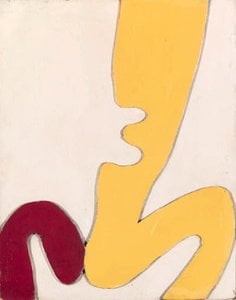
Жан Арп, 1886 – 1966

Жан Арп: 100 самых известных картин

Human Concretion (1935) — самая известная картина Жан Арп, которая находится в Музей современного искусства (MoMA) в городе Нью-Йорк. Forest и Head with mustache (1926) — следующие две самые известные работы в мире. Из 156 работ Жан Арп в нашем каталоге мы выбрали 100 самых популярных среди коллекционеров и посетителей музеев — с указанием года, музея и истории каждого произведения.

Рейтинг основан на нашем показателе популярности, который учитывает количество поисковых запросов, посещений и заказов для каждой работы. Обновлено Октябрь 2026.

Портрет Жан Арп
Жан Арп · 1886 – 1966
Дата рождения · дата смерти
1886 – 1966, Страсбург
Направление
Dadaism
Работы в нашем каталоге
156
Самые известные
Human Concretion (1935)
Больше всего работ в
Израильский музей

Топ-10: самые известные картины Жан Арп

Human Concretion (1935) работы Жан Арп
1

Human Concretion

In the hauntingly beautiful photograph "Human Concretion," we are invited into a monochromatic dreamscape where the boundaries between the physical and the abstract dissolve. Captured in 1935, this work serves as a profound meditation on the human essence, stripped of its individual identity to reveal something more primal and universal. The composition centers upon a series of smooth, rounded forms that suggest the presence of heads or torsos, yet they…

Остальные места в рейтинге Жан Арп, с 11 по 100

Birds in an Aquarium (1920) работы Жан Арп
#12

Birds in an Aquarium

1920 · Музей современного искусства (MoMA)

Jean Baptiste Le Vieux’s “Birds in an Aquarium,” painted circa 1920, presents a striking visual paradox—a figure resembling a bird-like human suspended within a stylized aquatic environment. This…

Sculpture de Silence, Corneille работы Жан Арп
#32

Sculpture de Silence, Corneille

Galleria Civica di Arte Moderna e Contemporanea Torino

Jean Arp's "Sculpture de Silence, Corneille," a remarkable piece from 1942 crafted in rose-colored limestone, transcends the boundaries of traditional sculpture. It isn’t merely an object occupying space;…

Солнце Перерожденное (1966) работы Жан Арп
#37

Солнце Перерожденное

1966 · Израильский музей

О творчестве Жана Баптиста Ле Вье и картине «Солнце Перерожденное» Жан Баптист Ле Вье – имя окутанное тайной, художник чьи биографические данные остаются загадкой для искусствоведов. Родился он…

Constellation работы Жан Арп
#38

Constellation

A Celestial Dance: Exploring Jean (Hans) Arp’s *Constellation* This captivating artwork, *Constellation*, by Jean (Hans) Arp is a prime example of his pioneering contribution to abstract art. Executed…

Alou with Talons работы Жан Арп
#39

Alou with Talons

Ca' Pesaro - International Gallery of Modern Art

Jean Arp’s “Alou with Talons,” created in 1942 during the tumultuous years of World War II, is more than just a sculpture; it's a distilled embodiment of the…

Сюжеты, которые чаще всего писал Жан Арп

Четыре темы, которые чаще всего встречаются в этих шедеврах, с лучшими примерами каждой из них.

Где можно увидеть картины Жан Арп

7 музеев, в которых находится большинство картин со страницы.

Музей Город Работы Жан Арп Картины из этого списка
Израильский музей, ИерусалимИзраильский музей Иерусалим 5 Meeting in the Egg (Rencontre dans l'oeuf), Untitled Project (for a rug or tapestry), Untitled Project
Тейт Модерн, ЛондонТейт Модерн Лондон 5 Moustaches, Constellation According to the Laws of Chance, According to the Laws of Chance
Музей современного искусства (MoMA), Нью-ЙоркМузей современного искусства (MoMA) Нью-Йорк 2 Human Concretion, Birds in an Aquarium
Musée d'Art Moderne et Contemporain de Strasbourg, StrasbourgMusée d'Art Moderne et Contemporain de Strasbourg Strasbourg 1 Cravates et tête ou Configuration au chef perdu
Galleria Civica di Arte Moderna e Contemporanea Torino, ТуринGalleria Civica di Arte Moderna e Contemporanea Torino Турин 1 Sculpture de Silence, Corneille
Ca' Pesaro - International Gallery of Modern Art, ВенецияCa' Pesaro - International Gallery of Modern Art Венеция 1 Alou with Talons
Statens Museum For Kunst, КопенгагенStatens Museum For Kunst Копенгаген 1 Untitled (198)

Жан Арп сквозь десятилетия: по одному шедевру на каждое десятилетие

  1. 1910s
  2. 1920s
  3. 1930s
    Human Concretion (1935) работы Жан Арп
    № 1 из 100

    Human Concretion

    Возраст 44 – 53 · Музей современного искусства (MoMA)

    In the hauntingly beautiful photograph "Human Concretion," we are invited into a monochromatic dreamscape where the boundaries between the physical and the abstract dissolve. Captured in 1935, this…

  4. 1950s
  5. 1960s

Картины художника Жан Арп: часто задаваемые вопросы

Какая картина Жан Арп является самой известной?Показать ответ

Human Concretion (1935), Музей современного искусства (MoMA), Нью-Йорк. Далее следуют Forest и Head with mustache (1926).

В каком возрасте Жан Арп написал Human Concretion?Показать ответ

49 лет: Human Concretion датируется 1935 годом, а Жан Арп родился в 1886.

Какие 10 самых известных картин написал Жан Арп?Показать ответ

Human Concretion, Forest, Head with mustache, Meeting in the Egg (Rencontre dans l'oeuf), Untitled Project (for a rug or tapestry), Untitled Project, Human Concretion 2, Column of dream, Cut No. 10. Shadow Cloud и Nadir. В рейтинге выше указаны год создания и музей для каждой работы.

Сколько картин написал Жан Арп?Показать ответ

В нашем каталоге представлено 156 работ Жан Арп, созданных в период с 1914 по 1966.

Где я могу увидеть самые известные картины Жан Арп?Показать ответ

Большинство из них находятся в Израильский музей (Иерусалим), Тейт Модерн (Лондон) и Музей современного искусства (MoMA) (Нью-Йорк). В таблице выше музеи перечислены по порядку.

В какой период Жан Арп создал свои самые известные работы?Показать ответ

За 1920s: 6 из 100 работ на этой странице относятся к этому периоду, в том числе Head with mustache.

Какая самая ранняя и самая поздняя известные картины Жан Арп?Показать ответ

Самая ранняя работа на этой странице датирована Before my Birth (1914), самая поздняя — The Sun Recircled (1966).

Какие сюжеты писал Жан Арп?Показать ответ

Animals (6), Abstract sculpture (5) и Men (4) из 100 работ на этой странице.

К какому направлению относится искусство Жан Арп?Показать ответ

Dadaism, как показывают картины на этой странице.

Какие картины Жан Арп хранятся в Израильский музей?Показать ответ

Meeting in the Egg (Rencontre dans l'oeuf), Untitled Project (for a rug or tapestry) и Untitled Project — одни из 5 работ на этой странице, хранящихся в Израильский музей, Иерусалим.

Жан Арп: биография

A Life Forged Between Worlds: The Early Years of Jean Arp

Jean Arp’s story begins in a place defined by uncertainty – Strasbourg, a city caught between the ambitions of France and Germany, a microcosm reflecting Europe's turbulent early 20th century. Born Hans Peter Wilhelm Arp in 1886, he carried within him a unique duality, shaped by his Alsatian heritage and the shifting political landscape. His parents, a French mother and a German father, unknowingly instilled in him a sensibility that would profoundly influence his artistic vision – a questioning of fixed boundaries and an inherent awareness of displacement. Early studies at the École des Arts et Métiers in Strasbourg provided a foundational education, but it was the encouragement of his uncle, Carl Arp, a landscape painter, who truly ignited his passion for art. This early exposure to nature’s beauty and form would become a cornerstone of his later work. A move to Paris in 1908, attending the Académie Julian, opened his eyes to the vibrant currents of the avant-garde – Cubism, Fauvism, and the burgeoning ideas challenging traditional artistic conventions. Yet, Strasbourg remained a powerful memory—a city steeped in history, a symbol of cultural tension that would continually inform his art. This early period wasn’t simply about acquiring technical skills; it was about absorbing the complexities of identity, belonging, and the ever-present awareness of living on the edge of two worlds.

Embracing Chaos: Dada and the Birth of Biomorphic Forms

The First World War shattered Europe's stability, unleashing a wave of disillusionment and rage that found expression in the radical movement known as Dada. Arp, deeply affected by the senseless violence and the perceived failures of reason, was drawn to Dada’s rejection of established norms and its embrace of chaos. He joined the Zurich Dada group in 1916, alongside figures like Hugo Ball, Tristan Tzara, and Marcel Janco – artists and intellectuals united by a desire to dismantle traditional artistic values. This wasn't merely an aesthetic choice; it was a profound act of rebellion against the established order. Arp’s participation in the Zurich Dada movement led him to experiment with chance operations—a technique that involved creating art through random processes, rejecting conscious control in favor of unpredictable outcomes. His “chance collages,” created by dropping paper fragments onto a surface and adhering them where they fell, were revolutionary – an audacious attempt to strip away artistic intention and embrace the inherent randomness of existence. Simultaneously, he began exploring biomorphic forms—abstract shapes resembling organic life—which would become a defining characteristic of his work. These weren’t simply abstract designs; they hinted at hidden energies, the fundamental building blocks of existence, and a subconscious connection to nature. This exploration was significantly influenced by his profound artistic partnership with Sophie Taeuber-Arp, whom he married in 1922. Their collaborative projects were innovative and mutually inspiring, pushing the boundaries of both their practices.

Surrealist Visions and Sculptural Explorations

As Dada began to dissipate, Arp’s artistic trajectory led him towards Surrealism. His work was featured in the first surrealist exhibition at the Galerie Pierre in Paris in 1925, solidifying his connection to this movement that delved into the realm of dreams and the subconscious. However, Arp didn't simply adopt Surrealism wholesale; he infused it with his own unique sensibility. He began a significant transition from relief sculptures to three-dimensional works, exploring organic abstraction in freestanding forms. The “Human Concretion” series emerged during this period – smooth, rounded sculptures that evoked ambiguous references to both the human form and natural objects. Arp’s material exploration was equally important. He experimented with marble, bronze, glass, and wood, each medium offering different textures and effects, allowing him to further refine his vision of organic abstraction. His biomorphic forms profoundly influenced the development of Surrealism, particularly its fascination with automatism and subconscious imagery. Arp wasn't interested in depicting recognizable objects; he sought to capture the essence of life itself – its growth, its fluidity, its inherent mystery.

Major Achievements and Lasting Influence

Throughout the 1930s and beyond, Jean Arp continued to push the boundaries of his art, experimenting with new materials and techniques while maintaining his core aesthetic principles. He became a member of the French artists’ groups ‘Cercle et Carré’ and ‘Abstraction Création’, which promoted concrete art—a movement focused on non-illusionistic forms. Notable works like *Trousse d'un dada*, the *Dada Heads* series, *Human Concretion without Oval Bowl*, *Le Soleil recerclé*, and *The Three Graces* stand as testaments to his versatility and artistic vision. Arp received increasing recognition in the post-World War II era, culminating in the Grand Prize for Sculpture at the Venice Biennale in 1954, and major retrospective exhibitions at the Museum of Modern Art in New York (1958) and the Musée National d’Art Moderne in Paris (1962). His creation of a relief sculpture for the Harvard Graduate Center stands as a testament to his enduring legacy. Arp's emphasis on organic forms resonated with subsequent generations of artists, influencing movements like Abstract Expressionism and beyond. His embrace of chance operations continues to inspire those exploring randomness and unconventional creative methods. The collaborative work he shared with Sophie Taeuber-Arp is now recognized as some of the most significant contributions to the Dada movement, highlighting the power of artistic partnership. Jean Arp’s innovative approach, his willingness to challenge convention, and his unwavering commitment to exploring the fundamental forces of life ensure that his art will continue to inspire and provoke for generations to come.

Все 156 работ Жан Арп →