

Saint Louis Forgiving Pierre de Bretagne (1817) is the most famous painting by Georges Rouget, held by the Musée des Beaux-Arts de Quimper in Quimper. Sketch for the church Saint Gervais "Ecce Homo" (1819) and Jean-Nicolas Houchard (1835) are the next two works the world knows best. From the 39 works of Georges Rouget in our catalogue, here are the 39 that collectors and museum visitors look at most, with the year, the museum and the story of each.
Рейтинг основан на нашем показателе популярности, который учитывает количество поисковых запросов, посещений и заказов для каждой работы. Обновлено Октябрь 2026. Every masterpiece on this page can be ordered as a museum-quality, hand-painted oil reproduction or a fine art print, at the size you choose.


A middle-aged man sits in a moment of profound stillness, his gaze drifting toward the upper right as if caught by a sudden, unspoken thought. He is draped in the heavy, dark navy blue of a jacket that absorbs the light, contrasting sharply against the crisp, creamy white of his cravat. The light strikes the left side of his face with a deliberate intensity, sculpting the sharp lines of his…


The canvas before you presents not merely a likeness, but an embodiment of the 19th century’s fascination with portraiture – a meticulously rendered study in dignity and quiet authority. Painted by Georges Rouget between 1803 and 1857, this depiction of Jean Pierre Thenot is more than just a representation; it's a window into a specific moment in French history, imbued with the formal elegance and restrained emotion characteristic of his…


Georges Rouget's "Mesdemoiselles Mollien," painted in 1811, is more than just a portrait; it’s a window into the refined world of early 19th-century French society and a testament…
Order a reproduction →
Введение в мир искусства: Портрет Франсуа Шэсселоу Лаубата и гения Георга Ругета Франсуа Шэсселоу Лаубат, имя известное историкам военного искусства и архитектуры XIX века, был человеком выдающихся заслуг.…
Commission a hand-painted copy →
This striking portrait depicts Emmanuel de Grouchy, Colonel du 2e Dragon in 1792. Painted by Georges Rouget, a neoclassical French painter known for his historical scenes and association…
Order a reproduction →The four subjects that return most often among these masterpieces, with the finest example of each.
8 музеев, в которых находится большинство картин со страницы.
| Музей | Город | Работы Georges Rouget | Картины из этого списка |
|---|---|---|---|
 Opera House |
Versailles | 6 | Achille Alexandre Alphonse, Viscount de Cailleux (1788-1876), Director of the Musées royaux, ALEXANDRE FRANCOIS MARIE, VICOMTE DE BEAUHARNAIS, GENERAL EN CHEF DE L'ARMEE DU RHIN (1760 1794), VICTOR GUY BARON DUPERRE, MATELOT EN 1792 (1775 1846) |
 Лувр |
Париж | 2 | JEAN PIERRE THENOT (1803 1857), MESDEMOISELLES MOLLIEN |
 Musée des Beaux-Arts de Quimper |
Quimper | 1 | Saint Louis Forgiving Pierre de Bretagne |
 Petit Palais |
Париж | 1 | Sketch for the church Saint Gervais "Ecce Homo" |
 Музе́й Армей, Париж |
Париж | 1 | Jean-Nicolas Houchard |
 Баварские государственные живописные коллекции |
Мюнхен | 1 | Jacques-Louis David |
 Музей Феш |
Акс-ан-Прованс | 1 | The King of Rome in the Tuileries Garden |
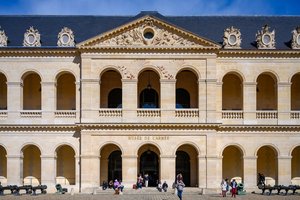 Министерство национальной обороны |
Париж | 1 | ФРАНКОИС ЧАССЕЛЬЮП ЛАУБАТ, GÉNÉRAL ДЕ ВИЗИОН (1754 1833) |


Saint Louis Forgiving Pierre de Bretagne (1817), Musée des Beaux-Arts de Quimper, Quimper. Next come Sketch for the church Saint Gervais "Ecce Homo" (1819) and Jean-Nicolas Houchard (1835).
34 years old: Saint Louis Forgiving Pierre de Bretagne dates from 1817 and Georges Rouget was born in 1783.
Saint Louis Forgiving Pierre de Bretagne, Sketch for the church Saint Gervais "Ecce Homo", Jean-Nicolas Houchard, Jacques-Louis David, Achille Alexandre Alphonse, Viscount de Cailleux (1788-1876), Director of the Musées royaux, The King of Rome in the Tuileries Garden, JEAN PIERRE THENOT (1803 1857), DEBARQUEMENT DE SAINT LOUIS EN EGYPTE.4 JUIN 1249, ALEXANDRE FRANCOIS MARIE, VICOMTE DE BEAUHARNAIS, GENERAL EN CHEF DE L'ARMEE DU RHIN (1760 1794) и FRANCOIS CHRISTOPHE KELLERMAN, GENERAL EN CHEF DE L'ARMEE DE LA MOSELLE EN 1792 (1735 1820). The ranking above gives the year and the museum of each.
Our catalogue lists 39 works by Georges Rouget, dated from 1817 to 1850.
Most of them are in Opera House (Versailles), Лувр (Париж) и Musée des Beaux-Arts de Quimper (Quimper). The table above lists the museums one by one.
In 1810s: 2 of the 39 works on this page date from then, among them Saint Louis Forgiving Pierre de Bretagne.
The earliest on this page is Saint Louis Forgiving Pierre de Bretagne (1817), the latest The King of Rome in the Tuileries Garden (1850).
Portrait (4), Dignified (3) и Formal (2), among the 39 works on this page.
Oil On Canvas: 3 of the 39 works on this page.
Neoclassicism, as the paintings on this page show.
Achille Alexandre Alphonse, Viscount de Cailleux (1788-1876), Director of the Musées royaux, ALEXANDRE FRANCOIS MARIE, VICOMTE DE BEAUHARNAIS, GENERAL EN CHEF DE L'ARMEE DU RHIN (1760 1794) и VICTOR GUY BARON DUPERRE, MATELOT EN 1792 (1775 1846) are among the 6 works on this page held by the Opera House, Versailles.
Yes. Every painting on this page can be ordered as a museum-quality, hand-painted oil reproduction or a fine art print, in the size you choose, from the painting's own page.

