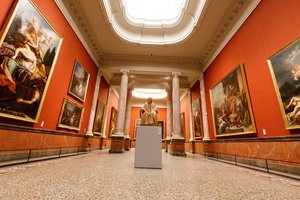
Фредерик Базиль, 1841 – 1870

The 88 Most Famous Paintings by Фредерик Базиль

The painting that made Фредерик Базиль famous is Ба́ттеры (Летний пейзаж) (1869); it hangs in the Fogg Art Museum, Кембридж. Семья (1867) and The Pink Dress (1864) follow it in the hearts of collectors and museum visitors. Of the 88 works by Фредерик Базиль in our catalogue, these 88 are the most admired, each presented with its date, its museum and what sets it apart.

Рейтинг основан на нашем показателе популярности, который учитывает количество поисковых запросов, посещений и заказов для каждой работы. Обновлено Октябрь 2026. Every masterpiece on this page can be ordered as a museum-quality, hand-painted oil reproduction or a fine art print, at the size you choose.

Портрет Фредерик Базиль
Фредерик Базиль · 1841 – 1870
Дата рождения · дата смерти
1841 – 1870, Монпелье
Направление
Impressionistic landscape
Работы в нашем каталоге
88
Самые известные
Ба́ттеры (Летний пейзаж) (1869)
Больше всего работ в
Musée Fabre

Фредерик Базиль: the ten masterpieces

Ба́ттеры (Летний пейзаж) (1869) работы Фредерик Базиль
1

Ба́ттеры (Летний пейзаж)

1869 · Масло на холсте · Fogg Art Museum, Кембридж

Jean Frédéric Bazille и Шедевр Лета: Бэттеры (Сцена Летнего Пруда) Бэттеры (Сцена Летнего Пруда) Жана Фредерика Базилля – это не просто картина; это импульс эпохи импрессионизма, запечатленный в ярких красках и динамичной манерой письма. Созданная в 1869 году, эта работа стала одним из самых значимых произведений искусства своего времени и продолжает вдохновлять художников и ценителей сегодня. Базиль, молодой врач и художник одновременно, сумел передать ощущение жизни и красоты природы с…

Семья (1867) работы Фредерик Базиль
2

Семья

1867 · Масло на холсте · Музей Орсе, Париж

Картина Жана Фредерика Базиля «Семейное воссоединение» — это яркое и детальное воплощение светского общения на лоне природы. Созданное в 1867 году, это полотно запечатлело живую сцену под сенью раскидистого дерева, где группа людей предается беседам и неспешному отдыху. Композиция поражает своим богатством: тончайшие узоры и текстуры буквально вдыхают жизнь в изображенное мгновение.

The Pink Dress (1864) работы Фредерик Базиль
3

The Pink Dress

1864 · Acrylic On Canvas · Музей Орсе, Париж

Marilyn Monroe’s “Pink Dress,” designed by William Travilla for Howard Hawks’ 1953 film *Gentlemen Prefer Blondes*, transcends mere costume; it embodies an enduring symbol of glamour, ambition, and the seductive allure of Hollywood. The dress itself—a shocking pink silk satin gown adorned with black satin lining and a large bow—represents more than just fabric and embellishments; it encapsulates a pivotal moment in cinematic history and continues to fascinate audiences today.

La Toilette (1870) работы Фредерик Базиль
4

La Toilette

1870 · Acrylic On Canvas · Musée Fabre, Монпелье

The Painting's Significance and Context La Toilette, an oil-on-canvas painting by Jean Frédéric Bazille, is a remarkable work of art that showcases the artist's skill in capturing intimate moments. Created in 1869-1870, this painting is one of Bazille's last works before his untimely death in the Franco-Prussian War. Composition and Symbolism The painting depicts three women in a room, with one woman lying on a bed while the other two…

Landscape on the Shore of Lez (1870) работы Фредерик Базиль
5

Landscape on the Shore of Lez

1870 · Oil

Landscape on the Shore of Lez is a significant work by Frédéric Bazille, an artist whose life was marked by a brief but intense period of creativity. Born in 1841, Bazille’s career was tragically cut short when he died in 1870. This particular painting, completed in June 1870, represents one of his final artistic statements. It is a large landscape that the artist himself described as an eclogue, a term…

The Family Gathering (1867) работы Фредерик Базиль
6

The Family Gathering

1867 · Oil On Canvas · Музей Орсе, Париж

To stand before The Family Gathering is to step directly into a sun-dappled afternoon of pure, unscripted joy. This painting by Jean Frédéric Bazille captures more than just a social assembly; it arrests the very essence of conviviality. One feels the gentle warmth emanating from the canvas, as if the viewer has stumbled upon this private moment in time. The composition is masterfully arranged beneath the generous canopy of a…

Portrait of an Unknown Sitter as a Troubadour (1875) работы Фредерик Базиль
10

Portrait of an Unknown Sitter as a Troubadour

1875 · Oil On Canvas · Далласский музей искусств, Даллас

In this intimate oil portrait, we find ourselves drawn into a quiet, private moment with a young man. The composition is a close-up, bust-length study that pushes the subject toward the viewer through a dramatic use of chiaroscuro. A deep, nearly black background provides a void from which the sitter emerges, illuminated by a highly directional light source. This light catches the contours of his face, leaving the other side…

More Фредерик Базиль masterpieces, 11 to 88

View of the Village (1868) работы Фредерик Базиль
#18

View of the Village

1868 · Musée Fabre

Jean Frédéric Bazille’s “View of the Village,” painted in 1868, stands as a quintessential example of the Impressionist spirit—a movement that sought to capture fleeting impressions of light…

Order a reproduction →
Portrait of Renoir (1867) работы Фредерик Базиль
#20

Portrait of Renoir

1867 · Музей Орсе

Jean Frédéric Bazille's “Portrait of Renoir” stands as a testament to the burgeoning Impressionist movement, capturing not merely an likeness but also a palpable sense of contemplative emotion.…

Order a reproduction →
The Studio on the Rue La Condamine (1870) работы Фредерик Базиль
#21

The Studio on the Rue La Condamine

1870 · Музей Орсе

Jean Frédéric Bazille’s “The Studio on the Rue La Condamine” isn't merely a snapshot of a Parisian artist’s workspace; it’s a vibrant tableau brimming with intellectual energy, artistic…

Bring it home →
Portrait of Edmond Maitre (1869) работы Фредерик Базиль
#22

Portrait of Edmond Maitre

1869 · Национальная галерея искусств

In the quiet corners of art history, certain works possess the power to halt time, offering a window into a moment of profound stillness. Jean Frédéric Bazille’s “Portrait…

Commission a hand-painted copy →
Reclining Nude (1864) работы Фредерик Базиль
#23

Reclining Nude

1864 · Musée Fabre

Jean Frédéric Bazille's 'Reclining Nude,' painted in 1864, is more than just a depiction of the human form; it’s a carefully constructed evocation of serenity and sensual grace,…

Bring it home →
Fontainebleau forest (1865) работы Фредерик Базиль
#24

Fontainebleau forest

1865 · Музей Орсе

In this 1865 oil on canvas, we find ourselves standing at the edge of the Fontainebleau forest. The composition is asymmetrical, drawing the eye toward a dense, dark…

Order a reproduction →
Portrait of Edouard Blau (1866) работы Фредерик Базиль
#25

Portrait of Edouard Blau

1866 · Национальная галерея искусств

“Portrait of Édouard Blau,” painted by Jean Frédéric Bazille in 1866, stands as a testament to the burgeoning Impressionist movement's fascination with capturing fleeting moments of light and…

Bring it home →
Self Portrait (1870) работы Фредерик Базиль
#26

Self Portrait

1870

In this poignant Self Portrait, painted in 1870, we encounter Frédéric Bazille not merely as a painter, but as a man caught in the delicate transition between youthful…

Bring it home →
Self-Portrait (1867) работы Фредерик Базиль
#28

Self-Portrait

1867 · Minneapolis Institute of Art

Self-Portrait is an oil on canvas painting by the artist Frédéric Bazille. Created in France, this work belongs to the Impressionism movement. The subject of the painting is…

Order a reproduction →
Queens Gate at Aigues-Mortes (1867) работы Фредерик Базиль
#63

Queens Gate at Aigues-Mortes

1867 · Метрополитен-музей

Jean Frédéric Bazille's "Queens Gate at Aigues-Mortes," painted in 1867, isn’t merely a depiction of a medieval fortification; it’s an exquisite distillation of Impressionist philosophy and a poignant…

Order a reproduction →
Landscape at Chailly (1865) работы Фредерик Базиль
#65

Landscape at Chailly

1865 · Институт искусств Чикаго

Jean Frédéric Bazille’s “Landscape at Chailly,” painted in 1865, isn't merely a depiction of a Swiss hillside; it’s a distilled essence of Impressionist philosophy—a fleeting capture of light,…

Order a reproduction →
Toilet (1870) работы Фредерик Базиль
#70

Toilet

1870 · Musée Fabre

Painted in 1870, tragically just months before Jean Frédéric Bazille's untimely death at the age of twenty-nine, *Toilet* (La Toilette) is a pivotal work within the burgeoning Impressionist…

Commission a hand-painted copy →
The Fisherman with a Net (1868) работы Фредерик Базиль
#71

The Fisherman with a Net

1868 · Arp Museum Bahnhof Rolandseck

The painting The Fisherman with a Net by Jean Frederic Bazille, created in 1868, is an exemplary work of the Impressionist movement. This oil on canvas piece showcases…

Order a reproduction →
Summer Scene (Bathers) работы Фредерик Базиль
#72

Summer Scene (Bathers)

Fogg Museum

Jean Frédéric Bazille's “Summer Scene (Bathers)” captures a quintessential moment of leisure and joy, transporting the viewer to the sun-drenched landscapes of Provence. Painted in 1873, just months…

Commission a hand-painted copy →
Self Portrait with Palette (1865) работы Фредерик Базиль
#80

Self Portrait with Palette

1865 · Институт искусств Чикаго

Jean Frédéric Bazille's "Self Portrait with Palette," painted in 1865, is more than just a depiction of an artist; it’s a poignant snapshot of ambition, vulnerability, and the…

Bring it home →
Portrait of Renoir (1867) работы Фредерик Базиль
#82

Portrait of Renoir

1867 · Кливлендский музей искусств

The Portrait of Renoir is an oil on canvas figure portrait created by the artist Frédéric Bazille. Executed in 1867, this work depicts Pierre-Auguste Renoir, who was a…

Bring it home →
Edouard Blau (1869) работы Фредерик Базиль
#83

Edouard Blau

1869 · Национальная галерея искусств

This oil on canvas work, titled Edouard Blau, was executed by the French artist Frédéric Bazille. It offers a quiet study of the sitter, a French dramatist, critic,…

Commission a hand-painted copy →
The Western Ramparts at Aigues-Mortes (1867) работы Фредерик Базиль
#87

The Western Ramparts at Aigues-Mortes

1867 · Национальная галерея искусств

In his evocative masterpiece, The Western Ramparts at Aigues-Mortes, Frédéric Bazille invites the viewer to step onto a warm, sandy shore and gaze across a tranquil expanse of…

Order a reproduction →
Young Woman with Peonies (1870) работы Фредерик Базиль
#88

Young Woman with Peonies

1870 · Национальная галерея искусств

Holding a bunch of peonies in one hand, a woman with brown skin leans forward, toward us from behind a large basket holding dozens of flowers in this…

Bring it home →

Фредерик Базиль's paintings by period

The subjects Фредерик Базиль painted most

The four subjects that return most often among these masterpieces, with the finest example of each.

Where to see Фредерик Базиль's paintings

8 музеев, в которых находится большинство картин со страницы.

Музей Город Работы Фредерик Базиль Картины из этого списка
Musée Fabre, МонпельеMusée Fabre Монпелье 23 La Toilette, The Scoter, Petite Italienne chanteuse des rues
Музей Орсе, ПарижМузей Орсе Париж 8 Семья, The Pink Dress, The Family Gathering
Национальная галерея искусств, ВашингтонНациональная галерея искусств Вашингтон 6 Portrait of Edmond Maitre, Portrait of Edouard Blau, Edmond Maître
Minneapolis Institute of Art, МиннеаполисMinneapolis Institute of Art Миннеаполис 2 Self-Portrait, The Banks of the Lez
Институт искусств Чикаго, ЧикагоИнститут искусств Чикаго Чикаго 2 Landscape at Chailly, Self Portrait with Palette
Fogg Art Museum, КембриджFogg Art Museum Кембридж 1 Ба́ттеры (Летний пейзаж)
Музей изящных искусств Хьюстона, ХьюстонМузей изящных искусств Хьюстона Хьюстон 1 Le petit jardinier, ca Museum of Fine Arts,
Далласский музей искусств, ДалласДалласский музей искусств Даллас 1 Portrait of an Unknown Sitter as a Troubadour

Фредерик Базиль, decade by decade: the defining painting of each

  1. 1850s
  2. 1860s
    Ба́ттеры (Летний пейзаж) (1869) работы Фредерик Базиль
    No. 1 of 88

    Ба́ттеры (Летний пейзаж)

    Возраст 19 – 28 · Fogg Art Museum

    Jean Frédéric Bazille и Шедевр Лета: Бэттеры (Сцена Летнего Пруда) Бэттеры (Сцена Летнего Пруда) Жана Фредерика Базилля – это не просто картина; это импульс эпохи импрессионизма, запечатленный в…

  3. 1870s
    La Toilette (1870) работы Фредерик Базиль
    No. 4 of 88

    La Toilette

    Возраст 29 · Musée Fabre

    The Painting's Significance and Context La Toilette, an oil-on-canvas painting by Jean Frédéric Bazille, is a remarkable work of art that showcases the artist's skill in capturing intimate…

Фредерик Базиль's masterpieces: questions and answers

Which painting is Фредерик Базиль best known for?Show the answer

Ба́ттеры (Летний пейзаж) (1869), Fogg Art Museum, Кембридж. Next come Семья (1867) and The Pink Dress (1864).

How old was Фредерик Базиль when painting Ба́ттеры (Летний пейзаж)?Show the answer

28 years old: Ба́ттеры (Летний пейзаж) dates from 1869 and Фредерик Базиль was born in 1841.

What are Фредерик Базиль's ten greatest paintings?Show the answer

Ба́ттеры (Летний пейзаж), Семья, The Pink Dress, La Toilette, Landscape on the Shore of Lez, The Family Gathering, The Scoter, Le petit jardinier, ca Museum of Fine Arts,, Saint-Saveur и Portrait of an Unknown Sitter as a Troubadour. The ranking above gives the year and the museum of each.

How many works did Фредерик Базиль paint?Show the answer

Our catalogue lists 88 works by Фредерик Базиль, dated from 1859 to 1870.

In which museums can I see Фредерик Базиль's masterpieces?Show the answer

Most of them are in Musée Fabre (Монпелье), Музей Орсе (Париж) и Национальная галерея искусств (Вашингтон). The table above lists the museums one by one.

When did Фредерик Базиль paint the masterpieces?Show the answer

In 1860s: 54 of the 88 works on this page date from then, among them Ба́ттеры (Летний пейзаж).

What are the first and last famous paintings of Фредерик Базиль?Show the answer

The earliest on this page is Mystic marriage of Saint Catherine (1859), the latest La Toilette (1870).

What were Фредерик Базиль's favourite subjects?Show the answer

French painting (6), Portraits (6) и Men (6), among the 88 works on this page.

Which technique did Фредерик Базиль favour?Show the answer

Oil On Canvas: 22 of the 88 works on this page.

What art movement is Фредерик Базиль part of?Show the answer

Impressionistic landscape, as the paintings on this page show.

Which masterpieces by Фредерик Базиль hang at the Musée Fabre?Show the answer

La Toilette, The Scoter и Petite Italienne chanteuse des rues are among the 23 works on this page held by the Musée Fabre, Монпелье.

Can I own a reproduction of a Фредерик Базиль masterpiece?Show the answer

Yes. Every painting on this page can be ordered as a museum-quality, hand-painted oil reproduction or a fine art print, in the size you choose, from the painting's own page.

The life of Фредерик Базиль

Jean Frédéric Bazille: A Fleeting Radiance of Impressionism

Jean Frédéric Bazille’s story is one of breathtaking potential tragically cut short, a brief but intensely vibrant chapter in the burgeoning world of Impressionism. Born in Montpellier, France, on December 6, 1841, into a prosperous Protestant family deeply rooted in the wine trade – a lineage that instilled both a connection to the land and a certain artistic sensibility – Bazille initially seemed destined for a life far removed from the easel. His parents, while supportive of his creative inclinations, recognized the practical realities of their social standing and encouraged him to pursue a career in medicine alongside his art. This dual path shaped his early years, demanding a careful balancing act between the rigorous study of anatomy and the irresistible allure of capturing light and color. However, it was within the dynamic atmosphere of Paris, where he relocated in 1862, that Bazille’s artistic journey truly ignited – transforming him from a promising medical student into a pivotal figure in the revolutionary movement reshaping French painting.

The Crucible of Parisian Art

Paris proved to be an extraordinary crucible for young Bazille. He swiftly immersed himself within a circle of artists who would become synonymous with Impressionism: Claude Monet, Pierre-Auguste Renoir, Alfred Sisley, and others. Studying under Charles Gleyre provided him with foundational training in traditional techniques, but it was the shared passion, radical ideas, and unwavering camaraderie forged amongst these friends that truly fueled his artistic vision. Bazille’s family circumstances – a fortunate contrast to the often precarious existence of many artists – afforded him a unique position of stability. He generously supported his companions, providing studio space, materials, and a vital sense of community. This generosity wasn't merely practical; it stemmed from a deep-seated belief in their collective potential and a genuine affection for these fellow creatives. He became a central hub within this burgeoning group, fostering an environment of experimentation, debate, and mutual encouragement – a breeding ground for the innovative spirit that would define Impressionism. Early works like *The Pink Dress* (c. 1864) already demonstrate his keen eye for capturing fleeting moments, the ephemeral effects of light, and the subtle nuances of color – hallmarks that would become integral to his distinctive style. Importantly, Bazille wasn’t simply mimicking established artistic conventions; he was actively participating in the creation of something entirely new, pushing beyond traditional boundaries and embracing a radically modern approach to painting.

A Style Rooted in Light and Friendship

Bazille's artistic style, while developing rapidly, possessed a unique character within the broader Impressionist aesthetic. While sharing their fascination with *plein air* painting – working directly outdoors to capture the immediacy of natural light – his compositions often exhibited a more structured quality than Monet’s or Renoir’s sometimes seemingly spontaneous approach. He frequently combined figure painting with landscape, placing his subjects thoughtfully within their environment, as vividly illustrated in masterpieces such as *Family Reunion* (1867-1868). This work transcends a simple depiction of a familial gathering; it's an exploration of light filtering through the trees, animating the scene and imbuing it with a palpable sense of warmth, intimacy, and a profound connection to nature. Bazille’s paintings weren’t merely about *what* he saw, but *how* he perceived it – capturing the emotional resonance evoked by color, form, and light. He was profoundly influenced by Eugène Delacroix, whose masterful use of color and dramatic compositions resonated deeply within him, yet he moved beyond academic conventions to embrace a more modern sensibility, prioritizing observation and direct experience over rigid adherence to traditional rules.

A Life Cut Short: Legacy and Remembrance

The blossoming career of Jean Frédéric Bazille was tragically cut short by the Franco-Prussian War in 1870. Driven by a sense of patriotic duty, he enlisted in a Zouave regiment just months after the conflict erupted. Tragically, he was killed in action on November 28, 1870, at the young age of 28, near Beaune-la-Rolande. His untimely death sent shockwaves through the artistic community, robbing them of a talented friend and generous benefactor. For many years, Bazille’s work remained relatively unknown, overshadowed by the more prominent figures within the Impressionist movement. However, in recent decades, his contributions have been increasingly recognized and celebrated, with scholars and art historians meticulously examining his oeuvre and highlighting its unique qualities. Today, his paintings are proudly displayed in prestigious museums such as the Musée d'Orsay in Paris, and reproductions allow art lovers worldwide to experience the beauty and innovation of his vision. Bazille’s legacy extends far beyond his artistic output; he embodies the spirit of youthful idealism, unwavering dedication, and the enduring power of friendship – a poignant reminder of the potential lost but also a testament to the lasting impact of a brief yet brilliant career. His story serves as an inspiration, demonstrating that even within the whirlwind of revolutionary movements, individual brilliance can leave an indelible mark on art history.

Key Works

* *The Pink Dress* (c. 1864) – A quintessential example of Bazille’s early style, capturing fleeting light and color with remarkable sensitivity. * *Family Reunion* (1867-1868) – Demonstrates his ability to integrate figures within a richly detailed landscape, creating a harmonious composition that evokes a sense of warmth and intimacy. * *Studio in Rue de Furstenberg* - A study of light and shadow within an urban setting, showcasing Bazille’s attention to detail and his exploration of modern subject matter.

Все 88 работ Фредерик Базиль →