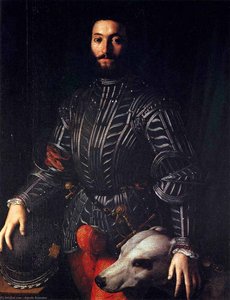
Аньоло Бронзино, 1503 – 1572

Картины художника Аньоло Бронзино: 100 самых известных работ в рейтинге

Самая известная картина Аньоло Бронзино — это Венера, Купидон и Время (Аллюзия на похоть) (1540), которая находится в Национальная галерея, Лондон. Вместе с Portrait of Eleonora da Toledo (1555) и Venus, Cupido and Satyr они образуют триптих из произведений, узнаваемых каждым. В нашем каталоге представлено 189 работ Аньоло Бронзино; ниже перечислены 100 самых известных произведений с указанием года создания, музея, где они хранятся, и причин их значимости.

Рейтинг основан на нашем показателе популярности, который учитывает количество поисковых запросов, посещений и заказов для каждой работы. Обновлено Октябрь 2026. Каждое произведение на этой странице можно заказать как высококачественную масляную репродукцию ручной работы или художественную печать в любом выбранном вами размере.

Портрет Аньоло Бронзино
Аньоло Бронзино · 1503 – 1572
Дата рождения · дата смерти
1503 – 1572, Флоренция
Направление
Маньеризм
Работы в нашем каталоге
189
Самые известные
Венера, Купидон и Время (Аллюзия на похоть) (1540)
Больше всего работ в
Галерея Уффици

10 самых известных картин Аньоло Бронзино

Венера, Купидон и Время (Аллюзия на похоть) (1540) работы Аньоло Бронзино
1

Венера, Купидон и Время (Аллюзия на похоть)

1540 · Масло на холсте · Национальная галерея, Лондон

Погрузитесь в завораживающий мир «Венеры, Купидона и Времени (Аллегория похоти)» – выдающегося произведения Агноло Бронзино, созданного в XVI веке. Эта картина, словно живая иллюстрация мифологической истории, сочетает в себе захватывающую повесть, новаторские художественные приемы и глубокий символизм, делая ее поистине вневременным шедевром для ценителей искусства и тех, кто стремится украсить свой дом изысканным произведением. Бронзино, мастер флорентийской школы эпохи маньеризма, создал произведение, которое не просто изображает мифологическую сцену, но и…

Portrait of Eleonora da Toledo (1555) работы Аньоло Бронзино
2

Portrait of Eleonora da Toledo

1555 · Oil On Panel

To gaze upon Agnolo Bronzino's Portrait of Eleonora da Toledo is to step directly into the rarefied atmosphere of High Renaissance Florence. This painting, executed in 1555, transcends a mere likeness; it is a carefully constructed monument to status, power, and exquisite refinement. The subject, Eleonora da Toledo, radiates an almost palpable aura of aristocratic dignity. Bronzino captures her not just as a woman, but as a symbol of Medici…

Venus, Cupido and Satyr работы Аньоло Бронзино
3

Venus, Cupido and Satyr

Oil

A pale, reclining figure occupies the center of the frame, her skin possessing the cool, polished sheen of marble. This is Venus, the goddess of love, draped in a way that emphasizes the tension between soft flesh and the hard edges of the composition. Beside her, Cupid clings to her form, a small, fleshy presence that embodies the sudden, sharp sting of passion. Their limbs are elongated, stretching toward one…

Portrait of Andrea Doria as Neptune (1550) работы Аньоло Бронзино
4

Portrait of Andrea Doria as Neptune

1550 · Oil On Canvas · Пинакотека Брера, Милан

In the grand theater of the Italian Mannerist period, few images command the eye with such authoritative grace as Agnolo Bronzino’s Portrait of Andrea Doria as Neptune. This is not merely a portrait of a man, but a profound exercise in political allegory and divine projection. The subject, the legendary Genoese admiral Andrea Doria, is stripped of the heavy silks and velvet doublets typical of sixteenth-century aristocratic portraiture. Instead, Bronzino…

St. John the Baptist (1542) работы Аньоло Бронзино
5

St. John the Baptist

1542 · Oil On Panel · Музей Дж. Пола Гетти, Лос-Анджелес

The figure of St. John the Baptist emerges from the shadows, rendered with a muscular intensity by the Florentine master Bronzino. This depiction captures the patron saint of Florence in a moment of profound spiritual tension. Created about 1542 - 1545, the work possesses a striking verticality that speaks to its original purpose. It does not exist in isolation but remains a fragment of a larger sacred narrative, having once…

Deposition (1565) работы Аньоло Бронзино
6

Deposition

1565 · Oil On Canvas · Галерея Академии, Флоренция

“Deposition,” painted in 1565 by the Florentine master Agnolo Bronzino, is not merely a religious scene; it's a meticulously crafted tableau of restrained emotion and profound psychological depth. Commissioned for the Observant Monastery in Cosmopoli, this work transcends simple narrative to become a meditation on grief, loss, and the delicate balance between earthly sorrow and divine grace. Bronzino, renowned for his “reserved elegance,” achieved this through an almost unnervingly controlled…

Portrait of a Young Man (1555) работы Аньоло Бронзино
7

Portrait of a Young Man

1555 · Oil On Canvas · Музей искусств Нельсона-Аткинса, Канзас-Сити

To gaze upon this portrait is to step directly into the rarefied atmosphere of mid-sixteenth-century Florence, a world governed by the subtle power plays and exquisite tastes of the Medici court. Agnolo Bronzino, the master chronicler of such elite circles, captured not merely a likeness, but an entire social stratum. The sitter, though anonymous to us today, embodies the controlled elegance expected of those who moved within the gilded cage…

Cosimo de Medici in Armour (1545) работы Аньоло Бронзино
8

Cosimo de Medici in Armour

1545 · Oil On Panel · Музей Тиссен-Борнмиса, Мадрид

The gaze of the Grand Duke of Tuscany, Cosimo I de' Medici, meets the viewer through the work titled Cosimo de Medici in Armour. Created by the Florentine artist Bronzino, this portrait captures the ruler in a moment of poised authority. The image emerges from the mid-16th century, dated about 1545, and presents a commanding presence through its structured composition. It exists as a significant version of the painting held…

Portrait of Cosimo I de' Medici as Orpheus (1537) работы Аньоло Бронзино
9

Portrait of Cosimo I de' Medici as Orpheus

1537 · Oil On Panel · Филадельфийский музей искусства, Филадельфия

In this portrait, we encounter Cosimo I de' Medici, not merely as a ruler, but as the mythological musician Orpheus. He is positioned in a three-quarter view from behind, turning his gaze back toward us with a sense of psychological alertness. His body, rendered with a polished, marble-like texture, possesses an idealized beauty that speaks to the High Mannerist style. A single splash of crimson red drapery provides a sharp…

Portrait of Eleonora of Toledo and Her Son, Francesco de'Medici (1549) работы Аньоло Бронзино
10

Portrait of Eleonora of Toledo and Her Son, Francesco de'Medici

1549 · Oil On Panel · Художественный музей Цинциннати, Цинциннати

In this vertical half-length portrait, we encounter the Duchess of Florence, Eleonora of Toledo, and her son, Francesco de' Medici. The composition is defined by a controlled, almost sculptural stillness. Eleonora stands slightly behind the young boy, her hand resting upon his shoulder in a gesture that is both protective and formal. There is a certain aristocratic detachment in their expressions, a cool composure that characterizes the Florentine Mannerist style.…

Аньоло Бронзино, картины с 11 по 100

Eleonora di Toledo (1560) работы Аньоло Бронзино
#12

Eleonora di Toledo

1560 · Национальная галерея искусств

A woman stands in a red dress, her hand resting upon her hip with a quiet, unyielding confidence. The fabric of her gown is a heavy, structured thing,…

Заберите её домой →
Venus cupid time работы Аньоло Бронзино
#13

Venus cupid time

Национальная галерея

The painting depicts a bedroom setting centered on two naked figures, Venus and Cupid. One woman lies down while another stands over her; they are holding hands and…

Заберите её домой →
Pierantonio Bandini (1555) работы Аньоло Бронзино
#14

Pierantonio Bandini

1555 · Национальная галерея Канады

Agnolo Bronzino’s “Portrait of Pierantonio Bandini,” painted circa 1550-1555, is not merely a likeness; it's an exquisitely crafted distillation of Renaissance ideals – a study in dignified composure…

Заказать ручную копию →
Holy Family (1540) работы Аньоло Бронзино
#16

Holy Family

1540 · Галерея Уффици

Agnolo Bronzino's "Holy Family," painted around 1540, isn’t merely a depiction of a biblical scene; it’s a carefully constructed tableau of serenity and profound familial love. Emerging from…

Заказать ручную копию →
Pope Leo X (1555) работы Аньоло Бронзино
#22

Pope Leo X

1555 · Галерея Уффици

To gaze upon this portrait of Pope Leo X is to encounter a moment suspended in the opulent grandeur of the Italian Renaissance. Agnolo Bronzino, master chronicler of…

Заберите её домой →
Saint Sebastian (1533) работы Аньоло Бронзино
#23

Saint Sebastian

1533 · Музей Сальвадора Дали

To stand before Agnolo Bronzino's depiction of Saint Sebastian is to encounter an embodiment of refined restraint—a hallmark of the High Renaissance transitioning into the sophisticated drama of…

Заказать ручную копию →
Venus, Cupid and Jealousy (1550) работы Аньоло Бронзино
#24

Venus, Cupid and Jealousy

1550 · Музей изящных искусств Будапешта

The world of Renaissance Florence was a crucible of artistic innovation, yet within its vibrant heart resided a figure renowned for his profound restraint – Agnolo di Cosimo,…

Заберите её домой →
Eleonora da Toledo (1543) работы Аньоло Бронзино
#28

Eleonora da Toledo

1543 · Национальная галерея в Праге

To gaze upon Agnolo Bronzino's depiction of Eleonora da Toledo is to encounter a moment suspended in the rarefied air of Renaissance aristocracy. This portrait, executed in 1543,…

Заказать ручную копию →
Miracle of the Brazen Serpent (1542) работы Аньоло Бронзино
#30

Miracle of the Brazen Serpent

1542 · Палаццо Ве́ччио

In the heart of Florence’s Palazzo Vecchio, tucked within the sacred stillness of the Cappella di Eleonora, resides one of the most arresting spectacles of the Mannerist era:…

Martyrdom of St Lawrence (1569) работы Аньоло Бронзино
#33

Martyrdom of St Lawrence

1569 · Базилика Сан Лоренцо

Agnolo Bronzino’s “Martyrdom of St. Lawrence,” painted in 1569, isn't merely a depiction of a historical event; it’s a profound meditation on faith, suffering, and the enduring spirit…

Crossing of the Red Sea (1542) работы Аньоло Бронзино
#42

Crossing of the Red Sea

1542 · Палаццо Ве́ччио

The fresco titled Crossing of the Red Sea was executed by the Florentine artist Agnolo Bronzino. This work, completed around 1542, utilizes the fresco technique to depict a…

View of the Chapel of Eleonora da Toledo (1440) работы Аньоло Бронзино
#64

View of the Chapel of Eleonora da Toledo

1440 · Палаццо Ве́ччио

The painting presents a view of a chapel featuring a fresco that depicts the life of Christ. Within this sacred setting, the scene is populated by numerous figures,…

Moses strikes water from the wall rocks (1544) работы Аньоло Бронзино
#75

Moses strikes water from the wall rocks

1544

The air feels heavy with anticipation as Moses raises his staff against the rugged, unyielding face of the rock. In this mid-sixteenth century fresco, a sudden, life-giving force…

Altarpiece (1540) работы Аньоло Бронзино
#76

Altarpiece

1540 · Палаццо Ве́ччио

The year is 1540, and Florence pulses with the ambition of the Medici court. Within the private chapel of Eleonora di Toledo, Duchess of Florence, a masterpiece emerges…

Заберите её домой →
Venus, Cupid and Envy (1548) работы Аньоло Бронзино
#78

Venus, Cupid and Envy

1548 · Музей изящных искусств Будапешта

Painted in 1548 by the Florentine master Agnolo Bronzino, *Venus, Cupid and Envy* is a captivating embodiment of Mannerist aesthetics – a style characterized by its deliberate artifice,…

Заказать репродукцию →

Картины Аньоло Бронзино по периодам

Сюжеты, которые чаще всего писал Аньоло Бронзино

Четыре темы, которые чаще всего встречаются в этих шедеврах, с лучшими примерами каждой из них.

Где можно увидеть картины Аньоло Бронзино

8 музеев, в которых находится большинство картин со страницы.

Музей Город Работы Аньоло Бронзино Картины из этого списка
Галерея Уффици, ФлоренцияГалерея Уффици Флоренция 18 Holy Family, Portrait of Lucrezia Panciatichi, Pope Leo X
Палаццо Ве́ччио, ФлоренцияПалаццо Ве́ччио Флоренция 11 Miracle of the Brazen Serpent, The Miracle of the Spring, Gathering of the Manna
Музей изящных искусств Будапешта, БудапештМузей изящных искусств Будапешта Будапешт 8 Venus, Cupid and Jealousy, Adoration of the Shepherds, Venus, Cupid and Envy
Национальная галерея, ЛондонНациональная галерея Лондон 5 Венера, Купидон и Время (Аллюзия на похоть), Venus cupid time, Venus, Cupid and Time (detail)
Национальная галерея искусств, ВашингтонНациональная галерея искусств Вашингтон 4 Eleonora di Toledo, Portrait of Eleanora di Toledo, A Young Woman and Her Little Boy
Институт искусств Детройта, ДетройтИнститут искусств Детройта Детройт 2 Costanza da Sommaia, Madonna and Child with Saint John the Baptist
Walters Art Museum, БалтиморWalters Art Museum Балтимор 2 The Feast Given by Joseph for His Brothers, Portrait of a Baby Boy
Королевская коллекция, ЛондонКоролевская коллекция Лондон 2 Portrait of a Lady in Green, Portrait of a Lady in Green

Самая известная картина Аньоло Бронзино каждого десятилетия

  1. 1520s
    Virgin and Child with the Young Saint John the Baptist (1528) работы Аньоло Бронзино
    #55 из 100

    Virgin and Child with the Young Saint John the Baptist

    Возраст 17 – 26 · Институт искусств Чикаго

    In this Mannerist oil painting, three figures occupy a vertical, tightly cropped arrangement against a dark, near-black background. The Virgin Mary is positioned centrally, her form defined by…

  2. 1530s
    Portrait of Cosimo I de' Medici as Orpheus (1537) работы Аньоло Бронзино
    Место 9 из 100

    Portrait of Cosimo I de' Medici as Orpheus

    Возраст 27 – 36 · Филадельфийский музей искусства

    In this portrait, we encounter Cosimo I de' Medici, not merely as a ruler, but as the mythological musician Orpheus. He is positioned in a three-quarter view from…

  3. 1540s
    Венера, Купидон и Время (Аллюзия на похоть) (1540) работы Аньоло Бронзино
    #1 из 100

    Венера, Купидон и Время (Аллюзия на похоть)

    Возраст 37 – 46 · Национальная галерея

    Погрузитесь в завораживающий мир «Венеры, Купидона и Времени (Аллегория похоти)» – выдающегося произведения Агноло Бронзино, созданного в XVI веке. Эта картина, словно живая иллюстрация мифологической истории, сочетает в…

  4. 1550s
    Portrait of Eleonora da Toledo (1555) работы Аньоло Бронзино
    № 2 из 100

    Portrait of Eleonora da Toledo

    Возраст 47 – 56

    To gaze upon Agnolo Bronzino's Portrait of Eleonora da Toledo is to step directly into the rarefied atmosphere of High Renaissance Florence. This painting, executed in 1555, transcends…

  5. 1560s
    Deposition (1565) работы Аньоло Бронзино
    #6 из 100

    Deposition

    Возраст 57 – 66 · Галерея Академии

    “Deposition,” painted in 1565 by the Florentine master Agnolo Bronzino, is not merely a religious scene; it's a meticulously crafted tableau of restrained emotion and profound psychological depth.…

Вопросы о картинах Аньоло Бронзино

Какая самая известная картина Аньоло Бронзино?Показать ответ

Венера, Купидон и Время (Аллюзия на похоть) (1540), Национальная галерея, Лондон. Далее следуют Portrait of Eleonora da Toledo (1555) и Venus, Cupido and Satyr.

Сколько лет было Аньоло Бронзино, когда была написана работа Венера, Купидон и Время (Аллюзия на похоть)?Показать ответ

37 лет: Венера, Купидон и Время (Аллюзия на похоть) датируется 1540 годом, а Аньоло Бронзино родился в 1503.

Какие 10 лучших картин Аньоло Бронзино?Показать ответ

Венера, Купидон и Время (Аллюзия на похоть), Portrait of Eleonora da Toledo, Venus, Cupido and Satyr, Portrait of Andrea Doria as Neptune, St. John the Baptist, Deposition, Portrait of a Young Man, Cosimo de Medici in Armour, Portrait of Cosimo I de' Medici as Orpheus и Portrait of Eleonora of Toledo and Her Son, Francesco de'Medici. В рейтинге выше указаны год создания и музей для каждой работы.

Сколько картин написал(а) Аньоло Бронзино?Показать ответ

В нашем каталоге представлено 189 работ Аньоло Бронзино, созданных в период с 1525 по 1569.

Где находятся самые известные картины Аньоло Бронзино?Показать ответ

Большинство из них находятся в Галерея Уффици (Флоренция), Палаццо Ве́ччио (Флоренция) и Музей изящных искусств Будапешта (Будапешт). В таблице выше музеи перечислены по порядку.

В какой период Аньоло Бронзино создал свои самые известные работы?Показать ответ

За 1540s: 36 из 100 работ на этой странице относятся к этому периоду, в том числе Венера, Купидон и Время (Аллюзия на похоть).

Какие самые ранние и поздние известные картины принадлежат Аньоло Бронзино?Показать ответ

Самая ранняя работа на этой странице датирована St Matthew (1525), самая поздняя — Martyrdom of St Lawrence (1569).

Что чаще всего писал Аньоло Бронзино?Показать ответ

Renaissance (34), Portrait (16) и Woman (11) из 100 работ на этой странице.

Какая техника чаще всего использовалась у Аньоло Бронзино?Показать ответ

Oil On Panel: 25 из 100 работ на этой странице.

К какому художественному направлению относится Аньоло Бронзино?Показать ответ

Маньеризм, как показывают картины на этой странице.

Какие картины Аньоло Бронзино можно увидеть в Галерея Уффици?Показать ответ

Holy Family, Portrait of Lucrezia Panciatichi и Pope Leo X — одни из 8 работ на этой странице, хранящихся в Галерея Уффици, Флоренция.

Можно ли купить репродукцию картины Аньоло Бронзино?Показать ответ

Да. Каждую картину на этой странице можно заказать как высококачественную масляную репродукцию ручной работы или художественную печать в выбранном вами размере на странице самой картины.

Об Аньоло Бронзино

Agnolo Bronzino: Florentine Master of Reserved Elegance

Agnolo di Cosimo, known to history as Bronzino, emerged from the vibrant artistic landscape of Renaissance Florence in 1503, a period already brimming with genius. Born the son of a butcher, his path diverged sharply from familial trade, guided instead by an innate talent that would see him become one of the most sought-after portraitists of his era and a defining figure of Mannerism. His early training began with Raffaellino del Garbo, but it was under the tutelage of Jacopo da Pontormo that Bronzino’s artistic sensibilities truly took shape. While absorbing Pontormo's innovative style—characterized by expressive emotion and dynamic movement—he ultimately forged his own distinct voice—one characterized by a cool composure and refined detail markedly different from his teacher’s often emotionally charged works. This early period was also influenced by studies with Andrea del Sarto, exposing him to the legacies of Michelangelo and Leonardo da Vinci, foundational influences that would subtly permeate his mature style. The young Bronzino quickly demonstrated an aptitude for capturing not just physical likeness but a certain psychological depth, even in his earliest commissions.

Early Influences and Artistic Formation

Bronzino’s formative years were marked by exposure to the artistic currents of Florence under Pontormo's guidance. Pontormo’s distinctive style—marked by elongated figures, swirling draperies, and an unsettling blend of realism and abstraction—challenged conventional notions of beauty and representation. Bronzino absorbed these lessons diligently, adapting Pontormo’s expressive techniques to his own artistic vision. Simultaneously, he studied the monumental sculptures of Michelangelo and Leonardo da Vinci, absorbing their mastery of anatomy and perspective. These influences instilled in him a profound appreciation for technical precision and intellectual rigor—qualities that would become hallmarks of his oeuvre. His early portraits showcased an uncanny ability to convey inner states through subtle gestures and facial expressions, demonstrating a sensitivity to psychological nuance rarely found among artists of his time.

Ascension at the Medici Court: Patronage and Artistic Output

Bronzino’s career ascended dramatically with the patronage of Cosimo I de’ Medici, Duke of Tuscany. Recognizing Bronzino's exceptional talent, Cosimo appointed him as the official court painter—a position he held until his death in 1572—solidifying his status as one of Florence’s most celebrated artists. This relationship fostered a prolific artistic output, encompassing monumental frescoes for churches and palaces, elaborate decorative schemes, and countless portraits of the Medici family and their associates. Cosimo's wedding to Eleonora di Toledo served as an impetus for Bronzino’s creative endeavors—resulting in opulent decorations that proclaimed Florentine grandeur and dynastic ambition. The Duke commissioned a series of paintings depicting biblical narratives and mythological allegories—demonstrating Bronzino’s versatility as a storyteller and his command of visual symbolism.

The Mannerist Style: Cool Composure and Refined Detail

Bronzino's artistic style is quintessentially Mannerist—a movement that flourished in Italy during the mid-16th century as a reaction against the High Renaissance's emphasis on naturalism and harmonious balance. He embraced elongated forms, stylized poses, and an often cool, detached emotionality. His figures are rarely caught in moments of spontaneous action; instead, they appear carefully posed, almost sculptural in their stillness. This stylistic preference—characterized by deliberate restraint and meticulous attention to detail—contrasted sharply with the expressive dynamism of artists like Pontormo and Raphael. Bronzino’s palette favored muted tones—particularly cool blues and greens—creating an atmosphere of serenity and elegance. He meticulously rendered textures—from velvet drapery to polished marble—enhancing the illusion of realism while simultaneously elevating it beyond mere imitation. His technique involved layering thin glazes over a preparatory underpainting, achieving remarkable luminosity and depth.

Legacy and Influence: Shaping Florentine Art History

Bronzino’s influence extended far beyond his own lifetime, shaping the visual language of aristocratic portraiture throughout Europe for decades to come. He established himself as Florence's foremost artist—a master of Mannerist refinement whose portraits continue to captivate viewers centuries later. His meticulous attention to detail and stylistic control became models for subsequent generations of painters—inspiring them to pursue similar standards of excellence. Bronzino’s legacy resides not only in his impressive artistic output but also in his role as a champion of intellectual rigor and stylistic innovation—a figure who helped redefine the boundaries of artistic expression during a pivotal moment in European art history. His enduring fame testifies to the power of visual artistry to convey profound psychological insight and aesthetic beauty.

Все 189 работ Аньоло Бронзино →