Frans van Mieris the Elder (1635 - 1681): Dutch Golden Age Master of Detail
Frans Jansz. van Mieris, a name synonymous with meticulous detail and refined artistry, stands as one of the most celebrated figures within the Dutch Golden Age—a period characterized by unparalleled artistic innovation and cultural flourishing. Born in Leiden in 1635, his lineage traced back to goldsmithing traditions, yet he forged his own path toward painting, guided by an innate fascination for capturing the nuances of human experience and transforming observation into breathtaking visual representations. His formative years instilled not only technical prowess but also a profound appreciation for narrative complexity and the subtle power of artistic expression—qualities that would define his distinctive style and solidify his legacy as a pivotal contributor to Dutch art history.
Early Training and Influences: The Seeds of Style
Van Mieris’s artistic journey commenced under the tutelage of Abraham van Toorenvliet, a respected Leiden painter known for his mastery of chiaroscuro—the dramatic interplay of light and shadow—a technique that would profoundly influence his subsequent work. However, it was Gerrit Dou, arguably his most influential teacher, who truly shaped his artistic vision. Dou’s meticulous approach to painting, emphasizing realism and psychological insight, instilled in Van Mieris a dedication to capturing the essence of human emotion and portraying subjects with remarkable accuracy. This mentorship fostered an unwavering commitment to detail—a hallmark of what would become known as *fijnschilder*—the Dutch term for “fine painting.” Dou’s influence extended beyond mere technique; he championed a contemplative aesthetic that encouraged artists to delve beneath the surface appearances of their subjects, revealing inner states and conveying unspoken narratives.
The Rise of Fijnschilder: Precision and Atmosphere
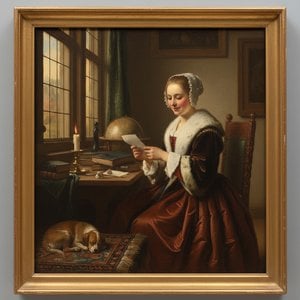
Van Mieris quickly embraced *fijnschilder*, establishing himself as a leader within Leiden’s artistic milieu—a movement distinguished by its unwavering pursuit of realism and its masterful manipulation of light and texture. Unlike earlier Baroque painters who favored grand gestures and theatrical compositions, Van Mieris prioritized subtle nuances and atmospheric effects. His canvases rarely depict sweeping vistas or dramatic confrontations; instead, they focus on intimate scenes—domestic interiors populated by figures engaged in everyday activities—rendered with astonishing precision. The surfaces of his paintings shimmer with life—the lustrous sheen of satin, the delicate texture of velvet, the glint of metal—all achieved through painstaking brushwork and a meticulous attention to detail. He didn’t merely depict objects or people; he recreated entire environments—capturing not only their physical appearance but also the subtle sensations of light, air, and temperature.
Notable Works and Artistic Evolution
Several masterpieces exemplify Van Mieris's distinctive style and artistic development. “Doctor’s Visit” (1657), considered one of his earliest dated works, showcases his burgeoning independence from Dou’s influence while simultaneously demonstrating the enduring impact of Baroque principles. The painting captures a moment of quiet tension—a physician examining a patient—with remarkable realism and psychological depth. Similarly, “Self-Portrait with Cittern” reveals Van Mieris's ability to portray both physical appearance and inner character—a testament to his artistic sensitivity and technical skill. His portraits are particularly noteworthy for their nuanced expressions and subtle gestures—capturing not just likeness but also conveying the sitter’s personality and emotional state. Later in his career, Van Mieris experimented with darker tonal palettes and explored allegorical themes—reflecting a growing maturity and broadening artistic horizons.
Legacy and Influence: Shaping Dutch Artistic Tradition
Frans van Mieris's contribution to Dutch art transcends mere stylistic innovation; he established himself as a pivotal figure within Leiden’s artistic tradition—a legacy that endured through his son Willem (1662–1747) and grandson Frans van Mieris the Younger (1689–1763), who continued the family’s artistic heritage. His meticulous technique, coupled with his profound understanding of human psychology and atmospheric effects, profoundly influenced subsequent generations of painters—solidifying his place as one of the most important artists of the Dutch Golden Age. The enduring fascination for Van Mieris's work underscores its timeless beauty and its ability to convey complex emotions—a testament to his artistic genius and a lasting contribution to European art history. His paintings continue to inspire admiration and scholarly study, ensuring that Frans Jansz. van Mieris’s name will forever resonate within the annals of Dutch artistic achievement.