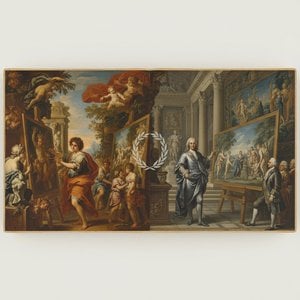
Luigi Valadier: A Master of Baroque Silver and Bronze
Luigi Valadier (1726-1785) stands as a singular figure in the artistic landscape of eighteenth-century Rome, an era defined by opulent grandeur and intellectual ferment. Born into a family renowned for its silversmithing prowess—his father, Andrea Valadier, established a workshop that achieved considerable renown—Luigi inherited not merely a trade but a legacy steeped in tradition and innovation. This blend would ultimately propel him to become one of the most celebrated artisans of his time, shaping the aesthetic sensibilities of papal courts and aristocratic patrons across Europe.
Early Life and Artistic Training
Little is known about Luigi Valadier’s formative years beyond confirmation that he was educated at the Accademia di San Luca, Rome's prestigious artistic institution. This exposure to classical ideals and humanist scholarship undoubtedly instilled in him a deep appreciation for antiquity—a fascination that would permeate his entire oeuvre. While biographical details remain scarce, scholars agree that Valadier possessed an exceptional talent for draughtsmanship and sculptural modeling, skills honed diligently before embarking on his professional career. His father’s guidance ensured he mastered the intricacies of metalworking techniques, establishing a foundation upon which to build his distinctive artistic vision.
The Workshop Legacy and Artistic Style
Andrea Valadier's workshop was already established as a prominent center for decorative arts when Luigi ascended to leadership in 1762. Recognizing the potential for advancement, Andrea meticulously trained his son in every facet of silversmithing—from assaying metals to engraving intricate designs. This comprehensive instruction solidified Luigi’s mastery over various techniques and fostered an unwavering commitment to excellence. Valadier's artistic style evolved from Baroque influences—characterized by dramatic chiaroscuro and exuberant ornamentation—to embrace Rococo elegance and, later, the restrained beauty of Neoclassicism. However, he never abandoned his foundational Baroque sensibilities, blending them seamlessly with innovative approaches to form and composition.
Notable Achievements: Sculpture and Decorative Arts
Luigi Valadier’s artistic reputation extended beyond silverwork into sculpture, where he produced monumental bronze sculptures for churches and public spaces throughout Rome. His most celebrated achievement is undoubtedly the equestrian statue of Pope Clement XIV—a masterpiece that embodies both technical virtuosity and sculptural grandeur. This ambitious undertaking showcased Valadier's ability to capture movement and emotion in stone, cementing his place among Rome’s foremost sculptors. Furthermore, Valadier excelled as a decorative artist, crafting elaborate gilded stuccoes and frescoes for palaces and churches—works that exemplify the splendor of Baroque ornamentation. His meticulous attention to detail and masterful execution elevated Roman art to unparalleled heights.
Influence and Legacy
Valadier's influence resonated far beyond his lifetime. He became a teacher at the Accademia di San Luca, shaping the artistic sensibilities of generations of students who would carry forward his stylistic innovations. More importantly, Valadier’s pioneering approach to archeology—particularly his meticulous reconstruction of ancient Roman monuments—established him as one of the earliest practitioners of modern archeological scholarship. His work on the Milvian Bridge and the Arch of Titus served as models for subsequent restorations, demonstrating a commitment to preserving cultural heritage. Luigi Valadier's legacy continues to inspire artists and scholars alike, ensuring that his contribution to Baroque art history remains firmly enshrined in the annals of Roman culture.