A Legacy Forged in the Streets: The Art of Kalen Ockerman (Mear One)
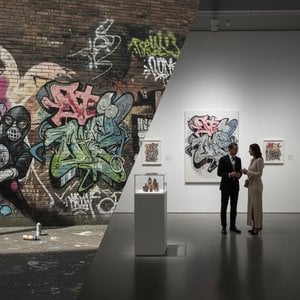
Kalen Ockerman, known globally as Mear One, is more than just a graffiti artist; he’s a visual historian, a philosophical provocateur, and a chronicler of contemporary anxieties. Born in 1971 in Santa Cruz, California, his journey began not within the hallowed halls of art schools but on the vibrant, often unforgiving canvases of Los Angeles' streets. This formative experience instilled in him a unique perspective—one that prioritized direct engagement with the public and a willingness to challenge established norms. From the late 1980s, Ockerman wasn’t simply adding color to the urban landscape; he was building bridges between the underground world of graffiti and the broader art community, becoming a pioneer in legitimizing an often-overlooked form of expression.
From Melrose Walls to Museum Collections
Ockerman's early recognition stemmed from his pivotal role in shaping the Melrose Avenue graffiti scene. He wasn’t merely participating in this movement; he was instrumental in its very creation, establishing a dialogue between street art and fine art that had rarely been attempted before. This willingness to cross boundaries led to groundbreaking exhibitions at galleries like 01 Gallery on Melrose and 33 1/3 Gallery in Silverlake—spaces that would later host the work of Banksy himself, marking a significant shift in the perception of graffiti as a legitimate artistic medium. His ability to translate complex ideas into visually arresting murals quickly garnered attention, attracting collaborations with artists like Skate One, Anger, Yem, and Cisco CBS. This period wasn’t just about aesthetics; it was about building a community and establishing a voice for those often marginalized.
Political Commentary and the Power of Narrative
Mear One's work is deeply rooted in social and political commentary. He doesn’t shy away from confronting difficult truths, tackling issues ranging from war and corruption to conspiracy theories and systemic injustice. His murals aren’t simply statements; they are intricate narratives that demand contemplation. In 2004, he joined forces with Shepard Fairey and Robbie Conal for the “Be the Revolution” campaign, creating a series of powerful anti-war posters that resonated deeply within the art collective *Post Gen*. This collaboration exemplified his commitment to using art as a tool for activism and social change. His pieces often juxtapose philosophical concepts with ancient mythology and modern politics, aiming to inspire a more evolved consciousness in viewers—a call to question the world around them and challenge conventional wisdom.
Beyond Graffiti: Design, Album Covers, and Expanding Horizons
While graffiti remains central to his identity, Mear One’s creative output extends far beyond the streets. He is a versatile graphic designer who has lent his talents to numerous projects, including apparel for brands like Conart and Kaotic, as well as establishing his own label, Reform. Perhaps most notably, he's become highly sought after for his album cover designs, creating iconic artwork for hip-hop luminaries such as Non Phixion, Freestyle Fellowship, Alien Nation, Limp Bizkit, Visionaries (the hip hop group), Busdriver and Daddy Kev. This foray into music allowed him to reach a wider audience and further solidify his reputation as a visual storyteller. His designs aren’t simply promotional materials; they are extensions of the artists' sonic landscapes, reflecting their lyrical themes and artistic vision.
A Lasting Impact: Museums, Collections, and an Enduring Legacy
The recognition of Mear One’s work has extended beyond the streets and galleries into the realm of institutional validation. His art was featured in the landmark 2011 “Art in the Streets” exhibit at the Los Angeles Museum of Contemporary Art (MOCA), alongside other influential figures in the graffiti and street art movement. Today, his artworks reside in the permanent collections of prestigious institutions like the Laguna Fine Art Museum and The Chambers Project, cementing his place within contemporary art history. He continues to create powerful murals that challenge viewers and provoke dialogue, ensuring his legacy as a visionary artist who dared to confront reality head-on—not by escaping it, but by transforming it into something beautiful, thought-provoking, and undeniably impactful.
Вопросы и ответы
Можно ли просматривать работы Kalen Ockerman по настроению?
Работы Kalen Ockerman можно просматривать по настроению на странице Комната настроения, где произведения распределены в соответствии с их эмоциональной окраской.
Существует ли виртуальный 3D-тур по работам Kalen Ockerman?
Возможен виртуальный визит: на странице 3D-музей работы Kalen Ockerman представлены в трехмерной галерее.
В какой исторический период работал(а) Kalen Ockerman?
Kalen Ockerman работал в период Contemporary. Эта эпоха позволяет определить место творчества художника в истории.