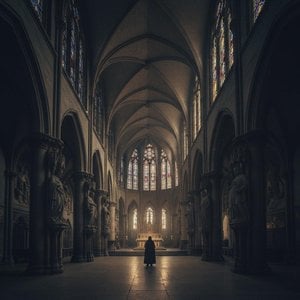
Jean de Beaumetz: A Gothic Visionary Patronized by Philip the Bold
Jean de Beaumetz, born around 1335 in Beauchêne, France, stands as a significant figure within the artistic landscape of the late Middle Ages—a period defined by fervent religious devotion and burgeoning royal patronage. While biographical details remain somewhat sparse, his legacy persists primarily through his stunning murals and frescoes, particularly those adorning the Château de Germolles and the chapel of Saint-Denis in Burgundy, offering invaluable insight into Gothic art’s stylistic nuances and humanist sensibilities. His artistic career blossomed under the watchful eye of Philip the Bold, Duke of Burgundy—a ruler who recognized Beaumetz's talent and employed him as a painter and valet from approximately 1375 until his death in 1396. This association proved pivotal, propelling Beaumetz to prominence within Burgundian court circles and securing commissions for monumental religious artworks that continue to captivate scholars today. The Duke’s ambition to elevate Burgundy's prestige fueled artistic endeavors like these, fostering an environment where innovation thrived alongside tradition. Beaumetz’s style is unmistakably Gothic, characterized by a profound reverence for spiritual themes and masterful execution of color palettes—particularly vibrant reds and blues—that convey emotion and grandeur. He skillfully utilized tempera paint on plaster walls, achieving luminous effects that captured the ethereal beauty of biblical narratives. The Château de Germolles chapel showcases Beaumetz’s prowess in depicting scenes from the Passion of Christ, notably ‘Christ on the Cross with a Carthusian Monk,’ where meticulous detail—including expressive facial expressions and symbolic drapery—demonstrates his commitment to conveying theological concepts through visual representation. This artwork exemplifies the Gothic preoccupation with portraying human emotion alongside divine majesty. His influence extended beyond mere stylistic imitation; he actively participated in shaping artistic trends within Burgundy. He collaborated with Jean Malouel, a fellow artist and courtier, resulting in groundbreaking works reflecting the International Gothic style—a movement that blended Byzantine influences with Northern European aesthetics. Notably, Beaumetz introduced the Limbourg Brothers to Philip the Bold, marking an important step in establishing Burgundian art as a center of innovation. Beaumetz’s contribution to medieval art is undeniable. His murals at Château de Germolles and Saint-Denis stand as enduring testaments to Gothic artistic achievement—expressions of faith and royal ambition that continue to inspire admiration centuries later. He cemented his place in history not merely as a craftsman, but as an artist who embodied the spirit of his time, shaping the visual culture of Burgundy and leaving behind masterpieces that resonate with timeless beauty and spiritual depth.- Key Achievements: Jean de Beaumetz achieved renown for his monumental frescoes at Château Germolles and Saint-Denis, demonstrating unparalleled skill in capturing the grandeur and solemnity of religious iconography.
- Technique: He perfected tempera paint on plaster walls, achieving remarkable luminosity—a technique that ensured his murals radiated an otherworldly glow.
- Influence: Beaumetz’s patronage fostered a vibrant artistic milieu in Burgundy, propelling the Limbourg Brothers to prominence and establishing the duchy as a beacon of Gothic innovation.
Вопросы и ответы
Из какой страны Jean De Beaumetz?
Jean De Beaumetz родился в Франция.
Можно ли изучить работы Jean De Beaumetz по темам?
Атлас сюжетов для Jean De Beaumetz — это страница, на которой произведения художника распределены по темам.
Существует ли виртуальный 3D-тур по работам Jean De Beaumetz?
Возможен виртуальный визит: на странице 3D-музей работы Jean De Beaumetz представлены в трехмерной галерее.
Где и в каком году родился Jean De Beaumetz?
Jean De Beaumetz родился в Beauchêne, 1335 год.
Где я могу найти статистику по работам Jean De Beaumetz?
Для Jean De Beaumetz существует страница Статистика, на которой представлены статистические данные о произведениях этого художника на этот сайт.
В каком городе и стране родился(ась) Jean De Beaumetz?
Jean De Beaumetz родился в городе Beauchêne, страна — Франция.
Где можно найти работы Jean De Beaumetz, сгруппированные по ключевым словам?
Чтобы найти работы Jean De Beaumetz на определенную тему, воспользуйтесь страницей По ключевым словам, где произведения художника сгруппированы по ключевым словам.