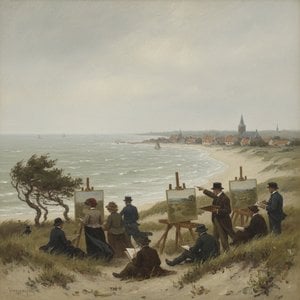
Jan Hendrik Weissenbruch: A Master of Dutch Atmospheric Landscapes
Jan Hendrik Weissenbruch, whose Christian name was Hendrik Johannes, descended from a family steeped in artistic tradition; his father, Johannes Weissenbruch, practiced painting and served as an art collector. This upbringing instilled within him a profound appreciation for visual artistry from a young age. Early exposure to the canvases of Andreas Schelfhout and Bartholomeus van Hove—works amassed by his father—significantly shaped his artistic sensibilities. At sixteen, he embarked on formal drawing instruction with Johannes Low, followed by evening classes at the Hague Academy of Art in 1843 under the tutelage of Bart van Hove.Early Influences and Artistic Style
Weissenbruch’s initial artistic endeavors bore unmistakable marks of Romanticism, mirroring the dramatic compositions and expressive brushwork characteristic of Andreas Schelfhout. However, his gaze soon turned toward Jacob van Ruisdael—a titan of 17th-century landscape painting—whose monumental canvases at the Mauritshuis in The Hague served as a beacon of inspiration. He meticulously studied Ruisdael’s masterful use of light and shadow, striving to emulate his ability to convey profound emotion through atmospheric perspective. This admiration fueled his own artistic vision, propelling him toward increasingly evocative depictions of Dutch landscapes. Over time, Weissenbruch subtly refined his palette, favoring muted tones that harmoniously blended with the prevailing mood of each scene. Simultaneously, he broadened his brushstrokes, achieving a looser and more fluid application of paint—a technique that perfectly captured the ephemeral qualities of light and air.Notable Works and Recognition
Weissenbruch’s debut exhibition at the Exhibition of Living Masters in 1847 marked his formal entry into the artistic community. He swiftly established himself as a respected figure among fellow artists, becoming one of the founders of Pulchri Studio—a prestigious artists' society dedicated to fostering excellence in Dutch painting. Recognition arrived early; in 1849, just two years after his debut, the Teylers Museum acquired “Shipping Canal at Rijswijk”—one of Weissenbruch’s panoramic landscapes—demonstrating immediate acclaim for his artistic prowess. Despite facing periods of relative obscurity during his formative years, Weissenbruch's reputation steadily grew throughout the latter half of the 1880s, culminating in widespread recognition by the late 1890s. Among his most celebrated paintings are “Landscape with Mill near Schiedam,” and "Forest View Near Barbizon," which exemplify his signature style—characterized by delicate brushstrokes and a masterful rendering of atmospheric conditions.Barbizon Influence and Legacy
Inspired by the Barbizon School’s emphasis on plein air painting and its celebration of rural landscapes, Weissenbruch undertook a transformative journey to France in 1900. Accompanied by his friend J. Slagmulder, he visited the Exposition Universelle in Paris and made an excursion to Barbizon—a pilgrimage that solidified his artistic convictions. He meticulously recreated Millet’s humble farmhouse, capturing the essence of rural life with unwavering fidelity. Weissenbruch passed away peacefully in 1903, leaving behind a legacy as one of the foremost exponents of Dutch landscape painting—specifically, the Hague School. His art continues to resonate today, inspiring admiration for its understated beauty and profound sensitivity to the natural world. He remains an enduring symbol of artistic integrity and devotion to capturing the sublime grandeur of the Dutch countryside.Вопросы и ответы
Можно ли изучить работы Jan Weissenbruch по темам?
Работы Jan Weissenbruch можно изучать по темам на странице Атлас сюжетов художника.
Существует ли хронологическая биография Jan Weissenbruch?
Хронологический обзор творчества Jan Weissenbruch представлен на странице Хроника, где произведения сменяют друг друга в порядке их создания, разделенные по главам.
Где и в каком году родился Jan Weissenbruch?
Jan Weissenbruch родился в Хейден, 1824 год.
Из какой страны Jan Weissenbruch?
Jan Weissenbruch родился в Нидерланды.
Где я могу посмотреть все работы Jan Weissenbruch?
Все работы Jan Weissenbruch на этот сайт можно просмотреть на странице Все произведения искусства художника.
Можно ли просматривать работы Jan Weissenbruch по настроению?
На странице Комната настроения представлены работы Jan Weissenbruch, распределенные по настроению.
В каком городе и стране родился(ась) Jan Weissenbruch?
Jan Weissenbruch родился в городе Хейден, страна — Нидерланды.