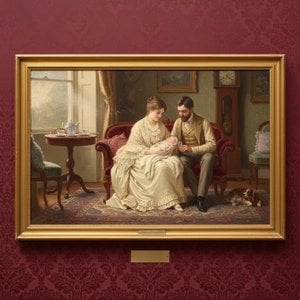
Henry Hetherington Emmerson (1831–1895): A Victorian Painter's Gentle Vision
Henry Hetherington Emmerson (1831-1895) was a British painter who emerged during the Victorian era, leaving behind a legacy of charming genre scenes and evocative portraits—particularly those capturing the innocence of childhood. Though not as widely recognized as some contemporaries like Toulouse-Lautrec or Monet, Emmerson’s work holds considerable interest for scholars studying the artistic landscape of his time and demonstrates a distinctive approach to depicting domestic life and familial bonds.
Born in England, details about Emmerson's early life remain somewhat obscure, contributing to the mystique surrounding this artist. He gained prominence as a founder of the Bewick Club, established in Newcastle upon Tyne in 1867. This club was dedicated to promoting the art of wood engraving—a technique that allowed for meticulous detail and tonal gradation—and Emmerson himself actively participated in its activities, showcasing his artistic sensibilities beyond canvas. His involvement with Bewick Club underscores a broader appreciation for craftsmanship and precision within Victorian artistic circles.
Emmerson’s artistic style is characterized by a remarkable sensitivity to light and color, reflecting the influence of Impressionism but tempering it with a Victorian aesthetic. He skillfully blended tonal harmonies with delicate brushstrokes, creating images imbued with warmth and tranquility. His paintings often depict idyllic landscapes—particularly those featuring children playing outdoors—and intimate domestic interiors bathed in soft illumination. Recurring motifs include animals – horses, dogs, birds – which appear frequently in his compositions, symbolizing vitality and connection to the natural world.
Among Emmerson’s notable achievements were several exhibitions at the Royal Academy in London, where he presented works that garnered critical acclaim for their understated beauty and psychological depth. Particularly noteworthy is “God’s Nursery,” a poignant depiction of a mother tending to her child—a scene emblematic of Victorian ideals concerning motherhood and familial devotion. Similarly, "John Mawson" portrays a father and son engaged in a quiet moment of companionship, capturing the essence of paternal affection. These paintings exemplify Emmerson's ability to convey emotion through subtle visual cues.
Furthermore, Emmerson’s artistic legacy extends beyond individual artworks; he played an important role in fostering the Bewick Club and championing wood engraving as a medium for artistic expression. His contribution to this endeavor solidified his position within Victorian art history—a testament to his dedication to both craftmanship and artistic vision. Though perhaps overshadowed by more flamboyant figures of his era, Henry Hetherington Emmerson’s paintings continue to resonate with viewers today, offering glimpses into the gentle beauty and humanist values that defined the Victorian period.