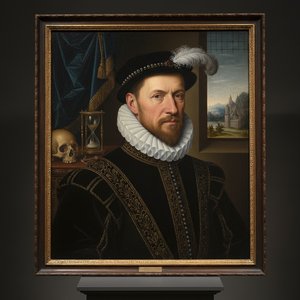
The Soul of the Munich School: The Life and Art of Hugo Wilhelm Kauffmann
In the heart of nineteenth-century German art, few painters captured the quiet dignity of the common man as poignantly as Hugo Wilhelm Kauffmann. Born in Hamburg in 1844, Kauffmann’s journey was one of profound movement—not just across the geographic landscapes of Germany and France, but through a deepening emotional maturity that would eventually define his place within the prestigious Munich School. While his early years were rooted in the traditions of his father, Hermann Kauffmann, it was his rigorous training under masters such as Jakob Becker and Johann Nepomuk Zwerger that provided him with the technical foundation necessary to translate the mundane into the monumental. His artistic evolution was a deliberate departure from the rigid academicism of his era, seeking instead a truth found in the textures of everyday existence.
Kauffmann’s aesthetic sensibility was deeply informed by the atmospheric weight of Romanticism. The haunting, psychological landscapes of Caspar David Friedrich left an indelible mark on his psyche, teaching him that light and shadow could serve as vessels for human emotion. As he moved through the artistic hubs of Düsseldorf and Paris, his style began to coalesce into a unique form of realism. He did not merely observe; he empathized. This empathy became the cornerstone of his genre paintings, where the bustling atmosphere of a Bavarian tavern or the weary posture of a laborer was rendered with a precision that felt both intimate and universal. His brushwork, often described as loose yet remarkably controlled, allowed for a palpable sense of movement and life to breathe within the frame.
A Master of the Mundane and the Magnificent
The true brilliance of Kauffmann lies in his ability to elevate the ordinary. To look upon a Kauffmann painting is to enter a world where the small, often overlooked moments of life are granted eternal significance. He possessed an extraordinary talent for rendering the tactile qualities of his subjects—the rough grain of a wooden table, the heavy fabric of a peasant's tunic, or the soft glow of candlelight reflecting in a glass of beer. This commitment to verisimilitude was not just about visual accuracy; it was about capturing the very essence of the human condition, portraying individuals with all their inherent vulnerability and resilience.
His notable works serve as windows into a bygone era of German social life:
- Besuch Des Schaustellers Dazogard: A poignant exploration of Bavarian peasant life that captures the fleeting magic of a traveling performer's visit.
- The Musicians: A piece that showcases his ability to weave narrative and sound into a visual composition, highlighting the communal joy found in simple melodies.
- Portrait of a Man: Demonstrating his skill in character study, where every line on a face tells a story of lived experience.
Through these works, Kauffmann became a chronicler of the Munich School’s ethos, working alongside contemporaries like Wilhelm Leibl to reject idealized, hollow representations in favor of an unflinching honesty. His legacy is not found in grand historical epics, but in the quiet, enduring strength of the people he painted—the laborers, the villagers, and the dreamers who inhabited the corners of the German landscape.
Вопросы и ответы
На какие периоды делится карьера Hugo Kauffmann?
Творческий путь Hugo Kauffmann представлен на странице Хронология работ в виде хронологической шкалы работ, разделенных на главы по периодам карьеры.
Под какими еще именами известен Hugo Kauffmann?
Hugo Kauffmann также известен под именами Hugo Wilhelm Kauffmann, Kaufmann, H. Kaufmann, Professor Hugo Kauffmann, H. Kaufman.
Где я могу увидеть произведения Hugo Kauffmann в виртуальной 3D-галерее?
Вы можете совершить виртуальную прогулку: на странице Страница художника работы Hugo Kauffmann представлены в трехмерной галерее.