A Fleeting Flame: The Tragic Life and Enduring Legacy of Gilles Hardouyn
Gilles Hardouyn, a name whispered in the annals of 16th-century French art, represents a poignant paradox – an artist whose life was tragically cut short, yet whose work continues to resonate with exquisite beauty and technical mastery. Born in Paris around 1518, Hardouyn’s existence spanned only three years before his untimely death in 1521, leaving behind a remarkably small but profoundly significant body of illuminated manuscripts. Despite the brevity of his career, he established himself as a master of tempera on parchment and leather, a technique demanding both meticulous skill and an intuitive understanding of color and texture – qualities that shine brilliantly through his most celebrated work: the Book of Hours.
Hardouyn’s artistic journey began within the vibrant intellectual and artistic milieu of Renaissance Paris. While specific details about his early training remain elusive, it is believed he was apprenticed to a master illuminator, absorbing the established conventions of the time while simultaneously developing his own distinctive style. The influence of Flemish art, particularly the meticulous detail and rich color palettes favored by artists like Jan van Eyck, can be discerned in his work, alongside the more classically inspired elements prevalent in French manuscript illumination. The prevailing artistic trends of the period—a renewed interest in classical motifs, a fascination with religious symbolism, and an increasing emphasis on realism—all contributed to shaping Hardouyn’s approach.
The Splendor of the Book of Hours
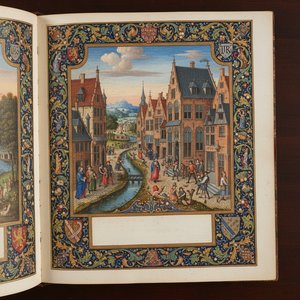
Hardouyn's most enduring achievement is undoubtedly the Book of Hours, created in 1518. This exquisite manuscript, now housed within WahooArt’s collection and available for detailed study through our online database (here), exemplifies the pinnacle of his artistic skill. The work is a testament to the painstaking process of illumination, combining tempera paint with gold leaf to create surfaces of breathtaking luminosity and detail. The scenes depicted—devotional images of the Virgin Mary, saints, and biblical narratives—are rendered with remarkable sensitivity and grace.
What distinguishes Hardouyn’s work is not merely technical proficiency but a profound understanding of the symbolic language inherent in medieval devotional art. Each image is laden with meaning, reflecting the spiritual aspirations of its intended patron. The use of color itself carries significance; blues and greens evoke heaven, while reds and golds represent royalty and divine power. The intricate borders, adorned with floral motifs, geometric patterns, and miniature scenes, further enhance the manuscript’s visual richness and contribute to its overall narrative impact.
Technique and Materials: A Master's Craft
Hardouyn’s mastery lay not only in his artistic vision but also in his technical execution. He skillfully employed tempera paint—a medium known for its slow drying time, allowing for meticulous blending and layering—on parchment, a material prized for its durability and suitability for manuscript production. The application of gold leaf, achieved through a complex process involving thin sheets of gold hammered to an incredibly fine gauge, added a dazzling brilliance to the illustrations and borders. The use of leather binding, often incorporating elaborate tooling and decoration, further elevated the manuscript’s aesthetic value.
- Parchment Preparation: The parchment itself underwent careful preparation—cleaning, sizing (applying a gelatinous coating to prevent ink bleeding), and sometimes even calendaring (pressing to achieve a smooth surface).
- Tempera Pigments: Hardouyn likely utilized a range of pigments derived from minerals, plants, and animal products, carefully ground and mixed with egg yolk—the traditional binder for tempera paint.
- Gold Leaf Application: The application of gold leaf demanded exceptional skill and precision, requiring the use of specialized tools and techniques to ensure its adhesion and prevent wrinkles or imperfections.
A Tragic End and Lasting Significance
The circumstances surrounding Gilles Hardouyn’s death remain shrouded in mystery. He died at a young age, likely due to illness, leaving behind only a handful of manuscripts—the Book of Hours being his most celebrated work. Despite the brevity of his career, Hardouyn's contribution to French manuscript illumination is undeniable. His meticulous technique, profound understanding of symbolism, and exquisite aesthetic sensibility have secured his place as one of the leading artists of his time. His legacy endures through WahooArt’s faithful reproductions, allowing a new generation of art lovers to appreciate the beauty and artistry of this tragically short-lived master.
Explore more about Gilles Hardouyn and his remarkable Book of Hours on our website: Gilles Hardouyn and Book of Hours