Ferdinand Thomas Lee Boyle (1820 – 1906): A Portraitist of Victorian America
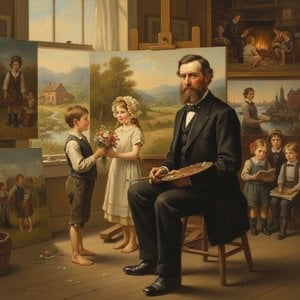
Ferdinand Thomas Lee Boyle, born in London in 1820, was a pivotal figure in the burgeoning American art scene during the Victorian era. His artistic journey began amidst the musical legacy of his father, John Boyle, a celebrated composer who instilled in him an appreciation for beauty and meticulous observation—qualities that would profoundly shape Boyle’s distinctive style. Moving to New York City at the tender age of eight, he immersed himself in the vibrant cultural landscape of the burgeoning metropolis, receiving a robust education at Columbia College Grammar School and subsequently honing his artistic skills under Charles Hawthorne, a prominent instructor at the National Academy of Design. This formative period cemented Boyle's commitment to capturing the essence of human experience through portraiture and genre scenes—genres that would define his oeuvre for decades to come.
Early Influences: Hawthorne’s teachings emphasized realism and tonal harmony, profoundly impacting Boyle’s artistic approach.
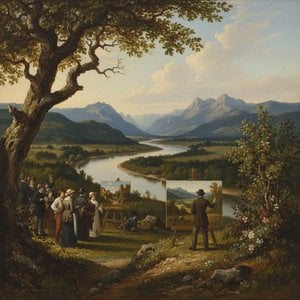
European Travels: Boyle undertook extensive expeditions throughout Europe during the 1860s and 70s, absorbing influences from Impressionism and Academic painting—particularly evident in his landscapes.
Boyle quickly established himself as a respected portraitist, attracting commissions from affluent families and prominent figures of New York society. His canvases frequently depicted individuals engaged in everyday activities, imbued with an understated elegance and psychological depth that distinguished him from many of his contemporaries. He skillfully employed tonal harmony—a technique championed by Hawthorne—to convey mood and emotion, prioritizing atmospheric perspective and subtle gradations of color to create immersive visual experiences. Unlike the flamboyant brushstrokes favored by some Impressionists, Boyle’s style remained grounded in traditional academic principles, reflecting a desire for accuracy and formal control.
Notable Portraits: Among his most celebrated works are portraits of Eliza Greatorex (1861), capturing her serene gaze with remarkable sensitivity—a testament to Boyle's mastery of tonal harmony and psychological realism.
Genre Scenes: Boyle’s genre paintings, such as “Syd” (1873), depict scenes from domestic life with meticulous detail and evocative lighting, demonstrating his ability to convey narrative and emotion through visual storytelling.
Throughout his career, Boyle consistently pursued excellence, refining his technique and expanding his artistic vision. His work gained recognition at the National Academy of Design exhibitions, securing him a place among America’s leading artists of the period. Boyle's legacy extends beyond individual paintings; he served as an influential teacher at Columbia University, nurturing the talents of aspiring painters and fostering a tradition of realism and tonal harmony that would endure for generations. Ferdinand Thomas Lee Boyle remains remembered not merely as a painter but as a champion of artistic integrity—a figure who embodies the spirit of Victorian America’s commitment to beauty and intellectual rigor.
Explore the captivating Victorian genre paintings of Frederick Richard Lee. Discover his life, style, influences & legacy. Expert insights for collectors and art enthusiasts at WahooArt.
Explore the captivating genre paintings of John George Brown, celebrated for his realistic depictions of 19th-century American life. Discover his legacy & find museum-quality reproductions at WahooArt.
Explore the captivating genre scenes of Thomas George Webster, a Victorian painter bridging British traditions with American themes. Discover his style, influences & legacy in 19th-century art history.