Antonio Mancini: A Life Dedicated to Verismo and Observation
Antonio Mancini (1852-1930) was a celebrated Italian painter, renowned for his poignant depictions of everyday life, particularly focusing on the marginalized communities of Naples. Born in Rome, Italy, Mancini displayed remarkable artistic talent from a young age. At just twelve years old, he gained admission to the Institute of Fine Arts in Naples, where he studied under influential figures Domenico Morelli and Filippo Palizzi. These formative experiences profoundly shaped his artistic trajectory, laying the groundwork for his distinctive style rooted in Verismo.
Early Development & Influences: From Naples to Paris
Mancini's early career was marked by rapid development under the tutelage of Morelli, who emphasized dramatic chiaroscuro and vigorous brushwork. Palizzi further honed Mancini’s skills, encouraging a focus on realistic observation. By 1872, he had already exhibited his work at the Paris Salon, demonstrating an emerging talent recognized beyond Italy. His artistic sensibilities were significantly influenced by his encounters with Impressionist painters Edgar Degas and Édouard Manet during his time in Paris. The friendship with John Singer Sargent, who famously declared Mancini to be "the greatest living painter," further solidified his reputation within the European art scene.
The Verismo Style & Signature Subjects
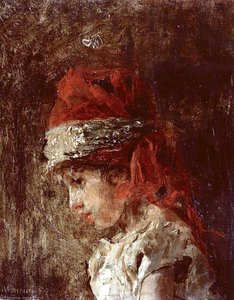
Mancini became a leading figure in the Verismo movement, an Italian response to 19th-century realist aesthetics. This artistic philosophy prioritized depicting life as it was, without idealization or romanticism. Mancini’s subjects were often drawn from the streets of Naples: children of the poor, juvenile circus performers, and musicians. His most famous works, such as *Il Saltimbanco* (1877-78), capture a sense of fragility and vulnerability in his portrayals of marginalized individuals. He employed a striking impasto technique on canvas, creating textured surfaces that added depth and realism to his paintings. His use of pastels was equally masterful, demonstrating a bold command of color and form.
Challenges & Later Years: Resilience and Artistic Serenity
Mancini’s life took a challenging turn in 1881 when he suffered from a debilitating mental illness. He relocated to Rome in 1883 and later to Frascati, where he lived until 1918, often facing periods of destitution and relying on the support of friends and art patrons. Despite these hardships, Mancini continued to paint. Following World War I, his circumstances stabilized, leading to a period of renewed artistic serenity reflected in his later works. He died in Rome in 1930 and was buried in the Basilica Santi Bonifacio e Alessio on the Aventine Hill.
Legacy & Historical Significance
Antonio Mancini’s contribution to Italian art lies in his unwavering commitment to Verismo and his ability to capture the essence of everyday life with remarkable sensitivity and skill. His paintings, including *The Poor Schoolboy* (exhibited at the 1876 Salon and now housed in the Musée d'Orsay), offer a powerful glimpse into the social realities of 19th-century Italy. His work is represented in prestigious collections such as the Galleria Nazionale d’Arte Moderna e Contemporanea in Rome and the Museo Civico-Galleria d’Arte Moderna in Turin. The first U.S. exhibition dedicated solely to his work at the Philadelphia Museum of Art (2007-2008) further cemented his place in art history, introducing his poignant vision to a wider audience.
- Key Works: *Il Saltimbanco*, *The Poor Schoolboy*, *Allegra Canzone*, *Standard Bearer of the Harvest Festival*, *Prevetariello in Preghiera*
- Influences: Domenico Morelli, Filippo Palizzi, Edgar Degas, Édouard Manet
- Movement: Verismo
- Techniques: Impasto, Pastel