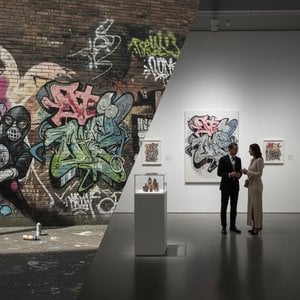
Anthony Lister: A Cartographer of the Psyche
Anthony Lister, born in Brisbane, Australia, in 1979, isn’t merely a street artist; he's a cultural archaeologist, meticulously excavating and reassembling fragments of popular culture – from comic books to advertising, from television to tabloid gossip – into sprawling, hallucinatory murals. His work is a complex meditation on identity, representation, and the seductive power of imagery, often unsettling yet undeniably captivating. Lister’s journey began as a teenager, contributing to the burgeoning street art scene in Brisbane, but his trajectory quickly expanded beyond local boundaries, establishing him as a significant voice within contemporary Australian art and a globally recognized figure.
Lister's formative years were deeply influenced by his grandmother, an amateur opera singer who instilled in him a love for visual arts and a keen appreciation for the narratives embedded within them. This early exposure, combined with a fascination for the vibrant world of comics and pop culture, laid the groundwork for his distinctive style – one characterized by a deliberate juxtaposition of high and low cultural references. He honed his skills studying at the Queensland College of Art, an environment that fostered experimentation and encouraged him to push beyond conventional artistic boundaries. A pivotal moment in his development came with a 2002 trip to New York City, where he was mentored by Max Gimblett, a renowned New Zealand artist known for his exploration of mythology and symbolism. This experience broadened Lister’s perspective, introducing him to new techniques and encouraging him to embrace the inherent contradictions within his subject matter.
The Language of the Street
Lister's artistic practice is inextricably linked to the street. Initially, he began painting directly onto walls in Brisbane, a process that remains central to his creative method. This direct engagement with public space allows him to bypass traditional gallery structures and connect with a wider audience. His murals are not simply decorative; they’re interventions – bold statements delivered directly to the urban landscape. Lister's technique is remarkably diverse, employing charcoal for its gritty texture, acrylics for their vibrancy, spray paint for its immediate impact, and oil paints for their rich depth. He often incorporates lettering, mimicking comic book styles or creating cryptic phrases that invite interpretation. The scale of his murals – frequently enormous – further amplifies their visual power, transforming ordinary cityscapes into immersive environments.
A key element of Lister’s work is the deliberate blurring of boundaries between different cultural registers. He seamlessly blends images from advertising campaigns with characters from superhero comics, snippets of television broadcasts with fragments of tabloid headlines. This juxtaposition creates a sense of disorientation and forces viewers to confront the often-contradictory nature of contemporary culture. As he himself has stated, “The first rule of painting is to take everyone else out of the equation.” This philosophy underscores his desire to create works that are entirely his own, free from the constraints of conventional artistic expectations.
Fusion and Deconstruction
Lister’s work frequently explores themes of identity, representation, and the construction of self. He is particularly interested in how images shape our perceptions and how these images can be manipulated to create false narratives. His murals often depict figures caught in moments of ambiguity or crisis, their faces obscured by layers of paint and symbolism. The recurring presence of female characters – frequently rendered as both victims and aggressors – speaks to the complex dynamics of power and gender within contemporary society. Lister’s use of collage-like techniques further contributes to this sense of fragmentation, suggesting that identity is not a fixed entity but rather a fluid and ever-changing construct.
Furthermore, Lister's work engages with notions of ‘adventure painting,’ as he describes it – a process of creating art that embraces chance, improvisation, and the unexpected. This approach is reflected in his willingness to experiment with different materials and techniques, and in his openness to incorporating elements from diverse sources into his murals. His collaborations with other artists, including Blek le Rat and Nick Cave, demonstrate his commitment to pushing the boundaries of artistic expression and engaging with a wider community.
Legacy and Recognition
Anthony Lister’s influence extends far beyond the street art scene. His work has been exhibited in galleries around the world, including Urban Spree Gallery in Berlin, Lazarides Gallery in London, and New Image Art Gallery in Los Angeles. He is considered one of Australia's most important contemporary artists, and his murals can be found adorning walls across Brisbane, Sydney, Melbourne, and beyond. His work has been featured in prestigious publications such as Juxtapoz, Vogue Australia, and Highsnobiety, solidifying his position as a leading voice in the global art world. In 2017, he released “Have you seen The Listers?”, a documentary exploring his artistic process and personal life. More recently, Lister has faced legal challenges related to allegations of sexual assault, highlighting the complexities and controversies that often surround artists working on the fringes of mainstream culture. Despite these difficulties, his art continues to provoke thought, challenge assumptions, and inspire dialogue.
Вопросы и ответы
Можно ли просматривать работы Anthony Lister по настроению?
На странице Комната настроения представлены работы Anthony Lister, распределенные по настроению.
Можно ли искать работы Anthony Lister по ключевым словам?
Чтобы найти работы Anthony Lister на определенную тему, воспользуйтесь страницей По ключевым словам, где произведения художника сгруппированы по ключевым словам.
Где и в каком году родился Anthony Lister?
Anthony Lister родился в Brisbane, 1980 год.