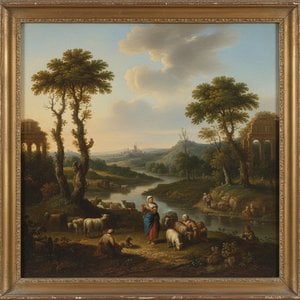
Abraham Rademaker: A Dutch Master of Urban Landscapes and Architectural Prints
Abraham Rademaker (1677 – 1735) occupies a prominent place in the annals of Dutch Golden Age art, celebrated primarily for his exquisitely detailed cityscapes and architectural prints—images that resonated deeply with audiences and served as catalysts for countless reproductions. Born in Lisse, Netherlands, Rademaker’s artistic journey unfolded over several decades during which he honed remarkable skills encompassing Italianate landscapes alongside a prolific output focused on urban panoramas—a genre particularly favored by the aesthetic sensibilities of his time.
Early Life and Artistic Training
Information regarding Rademaker's early years remains scarce, yet archival records indicate that he received formative training in Haarlem, where he established himself as an artist and printmaker. Haarlem’s vibrant printing industry functioned as a fertile breeding ground for artistic collaboration—a circumstance undoubtedly shaping Rademaker’s artistic vision and fostering connections with fellow craftsmen who shared his passion for capturing the beauty of the natural world alongside the grandeur of urban architecture.
Distinctive Style and Technique
Rademaker's artistic style is characterized by unwavering precision and meticulous attention to detail—traits vividly apparent in his cityscapes, which portray iconic structures such as Delft’s Jesuit Church with breathtaking accuracy. He skillfully deployed Renaissance perspective techniques to convey depth and realism, reflecting the enduring influence of humanist ideals on Dutch art during this period. His prints stand as testament to his mastery of engraving and his ability to translate complex architectural designs into visually compelling representations.
Notable Prints and Their Significance
Rademaker’s artistic legacy rests principally upon his prints—remarkable reproductions of architectural drawings that achieved unparalleled fidelity. These images played a crucial role in disseminating knowledge about urban planning initiatives and elevating the appreciation for Dutch cities during the Enlightenment era. Particularly noteworthy is “The Jesuit Church on the Oude Langendijk in Delft,” which exemplifies Rademaker’s unwavering commitment to capturing visual nuance—a characteristic that distinguishes his oeuvre from many of his contemporaries. His prints are invaluable historical documents, offering insights into architectural styles and urban landscapes of the 17th and early 18th centuries.
Influences: Echoes of Caravaggio and Lorrain
Rademaker’s artistic sensibilities were undeniably molded by broader artistic currents prevalent during his lifetime—most notably the dramatic chiaroscuro employed by Michelangelo Merisi da Caravaggio, which conveyed emotion through stark contrasts of light and shadow, and the idealized landscapes championed by Claude Lorrain—a stylistic approach that celebrated serenity and grandeur. These influences infused Rademaker’s work with a sense of theatricality and aesthetic refinement, mirroring the artistic ambitions of his era.
Concluding Reflections: A Legacy Enduring Through Time
Despite producing a comparatively modest body of work compared to some of his peers, Abraham Rademaker's prints continue to captivate scholars and art enthusiasts alike—serving as enduring symbols of Dutch artistic excellence and innovation. His meticulous renderings of Delft’s architectural heritage stand alongside his landscapes as emblems of the Golden Age—a testament to Rademaker’s unwavering dedication to observation, craftsmanship, and conveying the sublime beauty of the natural world through printmaking. Further research into collaborations with artists like Abraham Storck illuminates the interconnectedness of artistic endeavors during this transformative period in Dutch history.