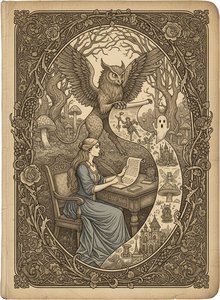
A Vision of Enchantment: Unveiling Frank Barrington Craig’s Goblin Market
In the realm of early twentieth-century British art, few works capture the ethereal tension between innocence and temptation as vividly as Frank Barrington Craig’s Goblin Market. Completed in 1911, this masterpiece serves as a breathtaking visual bridge between the lush, symbolic traditions of the Pre-Raphaelite movement and the refined academic realism of the Edwardian era. The painting transports the viewer into a shadowy, woodland sanctuary where the boundaries between our world and the supernatural dissolve, inviting us to witness a pivotal moment from Christina Rossetti's celebrated poem.
The composition presents a captivating tableau: a young woman stands amidst a dappled, mysterious grove, her attention seemingly ensnared by the allure of goblin offerings. Mischievous goblins surround her, presenting baskets overflowing with luscious, vibrant fruits that glisten with an almost otherworldly light. Behind her, a sense of mounting drama is introduced by her sister, whose presence serves as a silent, watchful warning against succumbing to these seductive charms. It is a scene brimming with symbolic richness, where every element—from the velvety sheen of the fruit skins to the way sunlight filters through the dense canopy—contributes to an atmosphere of palpable suspense and enchantment.
Mastery of Light, Texture, and Technique
Craig’s stylistic approach was deeply rooted in the prestigious teachings of his mentor, Edwin Austin Abbey, at the Royal Academy Schools. This foundation allowed him to achieve a remarkable technical balance; he utilized a meticulous attention to detail and a tonal palette reminiscent of the Impressionists, yet he never lost the expressive fervor characteristic of the Pre-Raphaelites. His brushwork breathes life into the textures of the natural world, rendering the organic complexity of the woodland setting with profound accuracy.
For the discerning collector or interior designer, the technical brilliance of this piece offers a unique sensory experience. The artist’s masterful use of chiaroscuro—the dramatic interplay between light and shadow—creates depth that pulls the eye into the heart of the forest. This creates an immersive quality that makes the painting feel less like a static image and more like a window into a living, breathing myth. Such intricate detail ensures that whether viewed from a distance or in close contemplation, the work reveals new layers of beauty and complexity.
Symbolism and Emotional Resonance
Beyond its aesthetic splendor, Goblin Market carries profound symbolic weight, making it a deeply intellectual piece for any curated collection. Craig faithfully translates Rossetti's intricate allegory concerning female sexuality, temptation, and societal constraints into a visual language. In this woodland drama, the goblins represent the darker, more chaotic impulses of desire, while the fruits serve as potent symbols of forbidden pleasure. The painting captures the very essence of the moral dilemma: the struggle between the sweetness of temptation and the preservation of virtue.
This emotional resonance is what makes a high-quality reproduction of this work so compelling for modern spaces. It brings a sense of narrative depth and storytelling to a room, acting as a conversation piece that evokes wonder and introspection. For those seeking to infuse their interiors with a sense of mystery, history, and classical elegance, Craig’s Goblin Market offers an unparalleled opportunity to possess a fragment of British artistic heritage—a work that remains as hauntingly beautiful today as it was when it first graced the walls of the Royal Academy.



 Предпросмотр
 Купить принт
 Поделиться
 Поделиться
 Детали произведения

 Скачать
 Похожие работы
 Рентгенография
 Слайд-шоу


 Читать далее






































 Вариант со стеклом доступен только для размеров менее 110 см