Early Life and Training
Jacob Henricus Maris was born August 25, 1837, in The Hague, Netherlands—the son of an etcher and lithographer. This familial connection to the printing arts would undoubtedly have instilled a certain appreciation for visual representation from a young age. He began his artistic journey with lessons from J.A.B. Stroebel (1849-1852), laying the foundation for his future career, honing skills that would prove invaluable in mastering the complexities of landscape painting. He formally studied at the Hague Academy of Art from 1850 to 1853, immersing himself in artistic theory and practice alongside fellow aspiring artists. This formative period cultivated a nascent artistic style—one characterized by careful observation and an emerging sensitivity to tonal nuances—that would become a hallmark of his oeuvre. A pivotal moment arrived when an astute art dealer recognized Maris’s talent and skillfully arranged for him to work in the studio of Hubertus van Hove, a figure who profoundly influenced Maris's early artistic development. Van Hove’s guidance instilled in Maris a deep understanding of compositional principles and a commitment to capturing the grandeur of nature with unwavering precision. His brother, Matthijs Maris, receiving a royal subsidy led to them working together—a collaborative partnership that fostered an environment ripe for experimentation and mutual inspiration. This dynamic duo would become synonymous with the Hague School’s artistic vision.Artistic Career and Style
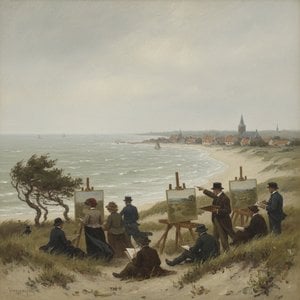
Maris's career unfolded against the backdrop of burgeoning commercial success; sales to discerning collectors in the United States and Scotland demonstrated his growing reputation within the art world, signaling a rising tide of appreciation for his distinctive aesthetic. Recognizing the importance of broadening horizons, Maris embarked on extensive travels through Germany, Switzerland, and France (1861), exposing him to diverse artistic styles—particularly those championed by the Barbizon school—which undeniably enriched his stylistic repertoire. He became renowned for painting landscapes featuring rivers, mills, towpaths, and beach scenes with fishing boats, establishing a signature subject matter that would define his artistic identity. Maris’s technique was marked by broad and larger brushstrokes crafted to generate texture and movement within his canvases—a deliberate choice designed to convey the dynamism of the natural world. Subdued colors contributed to the atmospheric quality of his landscapes, creating an immersive experience for the viewer. Crucially, Maris placed paramount importance on depicting clouds and their effects on the surrounding environment—a stylistic element that became a defining feature of his work. He applied paint thickly, building it up meticulously and adjusting colors with painstaking care to achieve harmonious compositions—a testament to his unwavering dedication to artistic excellence. Comparisons have been drawn between Maris’s work and that of earlier Dutch masters like Jan van Goyen, Jacob van Ruisdael, and Johannes Vermeer—underscoring Maris's connection to the rich tradition of Dutch landscape painting and acknowledging his position as a successor to artistic giants.Major Works and Recognition
Maris achieved considerable acclaim for a series of portraits of the Royal House of Orange undertaken in collaboration with Matthijs Maris—a project that showcased their combined artistic prowess alongside their familial bond. “Schip on the Scheveningen Beach” exemplifies Maris’s ability to capture coastal scenes with remarkable atmospheric depth and detail, transporting viewers to the shores of Holland. He became a member of Pulchri Studio in 1871, signifying his acceptance within the established artistic community—a recognition of his talent and dedication that cemented his place as a leader of the Hague School. From 1885 onwards, Maris experienced widespread recognition in the Netherlands, solidifying his position as a pivotal figure in Dutch art history. His works can be found in prominent collections such as the Rijksmuseum—a lasting testament to their enduring artistic merit and historical significance—guaranteeing that Maris’s vision would continue to inspire generations of artists to come.Historical Significance and Legacy
Maris's contribution to the Hague School is undeniable; he helped define its aesthetic characterized by realistic depictions of Dutch landscapes and an unwavering focus on atmospheric effects—a stylistic approach that resonated deeply with contemporaries and continues to captivate audiences today. His influence extended far beyond his lifetime, inspiring subsequent generations of artists with his distinctive style and meticulous technique—a legacy secured through the enduring beauty and profound observation inherent in his paintings. Maris’s legacy lies in his ability to encapsulate the essence of the Dutch countryside—transforming mere observation into a powerful artistic statement that transcends time.Întrebări și răspunsuri
Unde pot vedea toate operele lui Jacob Maris?
Toate lucrările lui Jacob Maris de pe acest site web pot fi explorate în pagina Toate operele de artă a artistului.
Pot să explorez lucrările lui Jacob Maris în funcție de paleta de culori?
Pagina După paletă de culori grupează operele lui Jacob Maris în funcție de paletele de culori.
Unde pot fi explorate operele lui Jacob Maris, grupate pe teme și cuvinte cheie?
Pagina După cuvinte cheie a lui Jacob Maris grupează operele de artă ale artistului în funcție de cuvintele cheie.