Early Life and Legal Training
George Catlin was born in 1796 in Wilkes-Barre, Pennsylvania, as the fifth of fourteen children. His early environment was shaped by the harsh realities of the American frontier, specifically through the stories of his mother, Polly Sutton. She had survived being captured during an Indian raid, a fact that provided a constant, visceral connection to the indigenous cultures he would later document. This personal history anchored his interest in the West long before he ever picked up a brush for professional purposes.
His path was not initially aimed at the canvas. At age 17, he entered Litchfield Law School to prepare for a legal career, a direction pushed upon him by his parents. He eventually achieved professional standing when he was admitted to the Bar in 1819. However, the legal profession failed to hold his attention. He practiced law for only two years, finding the courtroom a poor substitute for his actual interests. By the time he abandoned his legal books, the impulse to study art and travel had already become his primary driver.
Expeditions and the Indian Gallery
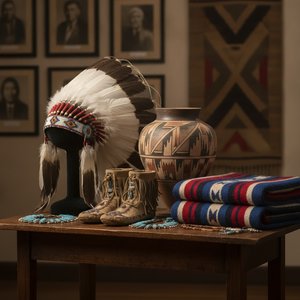
Catlin’s work derives its weight from the sheer scale of his movement across the American West. During the 1830s, he undertook five extensive expeditions, navigating the Missouri River to reach the territories of the Mandan, Sioux, Blackfeet, and Choctaw. These were not mere sightseeing trips. He moved through these lands to document specific tribal lives, collecting both paintings and physical artifacts. This massive accumulation of visual and material evidence eventually formed his Indian Gallery, a collection exceeding 500 paintings.
The scale of this collection is what makes his output historically significant. He did not simply paint from memory; he gathered the results of his travels into a singular, massive assembly. This effort to compile a comprehensive record of the frontier was later expanded by his travels through South and Central America between 1852 and 1857. His focus remained on the ethnographic reality of the people he encountered, prioritizing the documentation of their customs and appearances over mere landscape painting.
- Mó-sho-la-túb-bee, He Who Puts Out and Kills, Chief of the Tribe (1834)
- Ball-play of the Choctaw--Ball Up (1850)
Artistic Style and Documentation
Catlin’s approach was driven by a specific, urgent necessity: the documentation of a way of life he believed was vanishing. He did not settle for mere caricature or the superficial stereotypes common in the 19th century. Instead, he focused on the individual, attempting to capture the specific dignity of tribal leaders and the kinetic energy found in traditional ceremonies. His brushwork prioritized meticulous detail, ensuring that the textures of ceremonial regalia and the specificities of daily life were recorded with ethnographic precision. This was a deliberate attempt to preserve the essence of these cultures before westward expansion irrevocably altered them.
The visual impact of his work relies on a heavy use of color and detailed environmental context. He rarely painted subjects in isolation; instead, he placed them within elaborate backgrounds that provided essential situational information. These settings often included specific landscapes, tipis, or ceremonial objects that grounded his subjects in their actual surroundings. By including these elements, he moved beyond simple portraiture to create a comprehensive visual record of the American frontier. His ability to render the atmosphere of a scene—from the dust of a prairie to the structure of a camp—transformed his paintings into historical evidence rather than mere aesthetic exercises.
- Mó-sho-la-túb-bee, He Who Puts Out and Kills, Chief of the Tribe (1834)
- Ball-play of the Choctaw--Ball Up (1850)
Key Works and Notable Paintings
Catlin’s output functions as a visual record of specific, lived moments rather than mere portraiture. His 1834 depiction of Mó-sho-la-túb-bee, He Who Puts Out and Kills, Chief of the Tribe captures a leader with an unwavering gaze, projecting authority through a direct, unadorned presence. Similarly, Ball-play of the Choctaw moves away from static posing to document the kinetic energy of a traditional game. These works provide the granular detail necessary to understand tribal social structures and communal activities.
The artist also focused on the intersection of people and their environment. Prairie Meadows Burning records a controlled burn alongside accompanying riders, capturing a specific ecological and social practice. His depiction of Pipestone Quarry, Coteau Des Prairies identifies a site of profound spiritual significance for many tribes. Even his more intimate or unusual subjects carry weight; Oó-je-en-á-he-a, Woman Who Lives in a Bear, painted about 1832, offers a glimpse into a specific cultural narrative, while Little Wolf (Shon-ta-ye-ga), executed in 1846, remains a significant piece of his later documentation.
- Mó-sho-la-túb-bee, He Who Puts Out and Kills, Chief of the Tribe (1834)
- Little Wolf (Shon-ta-ye-ga) (1846)
Publications and Touring
Catlin’s efforts to secure a permanent home for his Indian Gallery required more than just visual evidence; they demanded a public presence. He took his collection on tour through major European centers, exhibiting in London, Paris, and Berlin during the 1840s and 50s. These exhibitions were not passive displays. He accompanied his paintings with public lectures, using his personal recollections of life among the American Indians to provide a spoken context to the images. This combination of sight and speech was a calculated attempt to make the realities of the frontier tangible to audiences far removed from the Missouri River.
His written work provided the intellectual framework for his visual documentation. In 1841, he published Manners, Customs, and Condition of the North American Indians, a text that attempted to codify the observations he had gathered during his expeditions. Later, in 1868, he released Last Rambles amongst the Indians of the Rocky Mountains and the Andes. These publications were not merely travelogues; they were attempts to fix a specific, vanishing social order into a permanent historical record. He used the written word to bolster the legitimacy of his paintings, ensuring his observations survived even when his financial stability did not.
Later Years and Death
Financial instability defined Catlin’s final decades. Despite his efforts to secure a national legacy for his collection, the artist spent much of his later life struggling to recoup his investments. In a pragmatic attempt to recover funds, he recreated over 400 paintings into a smaller "cartoon collection." This was a calculated move to monetize his life's work, yet it failed to provide the substantial returns he required for stability.
The struggle for solvency continued until his death. George Catlin died on December 23, 1872, in Jersey City, New Jersey. He was buried in Green-Wood Cemetery, Brooklyn. His passing marked the end of a life spent documenting a frontier that was rapidly being replaced by the very expansion he had predicted.
Legacy and Historical Significance
Catlin’s importance lies in his role as a primary visual source. He was the first white man to depict Plains Indians within their native territory, providing a direct record of life before the full impact of westward expansion. His paintings offer a glimpse into cultures that were frequently misrepresented or ignored by the mainstream narratives of the nineteenth century. Rather than relying on secondhand accounts, his work captures the specificities of tribal customs and social structures through direct observation.
The historical value of his output is concrete. His documentation provides insights into religious beliefs and ceremonial traditions that might otherwise have been lost to history. This archival quality has earned him significant recognition in later years. He was inducted into the National Rivers Hall of Fame in 2001 and the Luzerne County Arts & Entertainment Hall of Fame in 2023. These honors acknowledge the weight of his contribution to American historical and cultural records.
Where to See the Works Today
Catlin’s visual record is scattered across several major institutions, making a comprehensive study of his output a matter of visiting specific collections. The most significant concentration of his work resides in Washington, D.C. The Smithsonian American Art Museum holds 25 of his paintings, providing the most substantial look at his ethnographic documentation. Nearby, the National Gallery of Art in Washington also maintains one of his works in its collection.
Beyond the capital, his presence is felt in other regional museums that hold individual pieces. The Denver Art Museum contains one work, while the Virginia Museum of Fine Arts in Richmond holds another. These dispersed holdings reflect the fragmented nature of his original Indian Gallery and the difficulty he faced in securing a single permanent home for his collection during his lifetime.
- On sáw kie, The Sauk, in the Act of Praying (about 1830)
- Mó-sho-la-túb-bee, He Who Puts Out and Kills, Chief of the Tribe (1834)
- Ball-play of the Choctaw--Ball Up (1850)
Întrebări și răspunsuri
Ce culori a folosit cel mai des George Catlin?
Modul în care George Catlin utilizează culoarea în lucrările enumerate pe acest site web poate fi explorat pe pagina Genoma Paletei a artistului.
Din ce epocă face parte George Catlin?
George Catlin a activat în perioada Secolul al XIX-lea. Această perioadă situează activitatea artistului în context istoric.
Pot vizita un muzeu virtual al lucrărilor lui George Catlin?
Pagina Galerie 3D a lui George Catlin prezintă operele de artă ale artistului într-o galerie virtuală tridimensională.