A Visionary of Polish Modernism: The Life and Art of Stanisław Ignacy Witkiewicz
Stanisław Ignacy Witkiewicz, universally known as Witkacy, remains a profoundly enigmatic yet pivotal figure within the trajectory of 20th-century art. Born in Warsaw in 1885 into an artistic lineage—his father, Stanisław Witkiewicz, was a celebrated painter, architect, and theorist—the younger Witkiewicz inherited not only a creative heritage but also a stimulating intellectual environment that profoundly shaped his multifaceted career. He wasn’t simply a painter; he was a philosopher, playwright, novelist, photographer, and art theorist, a true polymath whose work reflected the turbulent currents of interwar Poland and anticipated many of the artistic concerns that would define the latter half of the century. His life, tragically curtailed in 1939 with the outbreak of World War II, was dedicated to exploring the boundaries of form, perception, and the very essence of reality itself.Early Influences and Artistic Development
Witkiewicz’s formative artistic training commenced within the familial sphere, absorbing his father's aesthetic principles and a deep engagement with Polish Romantic traditions. However, he swiftly diverged from conventional paths. A particularly significant experience was an anthropological expedition to Australia in 1914 alongside Bronisław Malinowski. Though abruptly interrupted by the onset of World War I, this journey exposed him to radically different cultures and visual languages, sparking a fervent fascination with primitive art and non-Western aesthetics—a fascination that would deeply inform his later work. The subsequent upheaval of war—his experiences as a reserve officer in the Russian Army during the Revolution—left an indelible mark, fostering a sense of disillusionment and premonition regarding the fragility of civilization. This feeling permeated much of his subsequent oeuvre, manifesting as a profound catastrophism that viewed modern society hurtling towards inevitable collapse. Returning to Poland after the war, he settled in Zakopane, a mountain resort town already renowned for its artistic vitality thanks to his father’s pioneering “Zakopane Style” architecture—a synthesis of local traditions and Art Nouveau influences.A Synthesis of Styles: Painting, Theory, and the Theatre
Witkiewicz's artistic output is remarkably diverse, defying easy categorization. Initially influenced by Symbolism and Expressionism, his paintings evolved into a unique blend of abstraction and figuration. His portraits, in particular, are striking for their distorted forms, vibrant colors, and psychological intensity—often portraying subjects as fragmented or alienated figures grappling with existential anxieties. He developed what he termed “Pure Form” in painting, a theoretical approach that emphasized the autonomy of artistic elements—line, color, composition—over representational accuracy. This pursuit of pure form extended to his theatrical theories, meticulously outlined in *Introduction to the Theory of Pure Form in the Theatre* (1921). He envisioned a theatre that rejected psychological realism and embraced artificiality, grotesque exaggeration, and deliberate disruption of conventional dramatic structures – ideas that presaged the later development of the Theatre of the Absurd. His plays, frequently characterized by their bizarre plots, illogical dialogues, and unsettling atmosphere, were intended to shock audiences out of complacency and confront them with the absurdity of existence.Major Works and Lasting Legacy
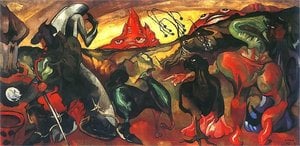
Among Witkiewicz’s most celebrated works are paintings like *Fight* (1922), a dynamic depiction of a man battling animals that embodies his sense of existential struggle, and *Creating the World* (c. 1930), a vibrant and chaotic composition reflecting his philosophical explorations. His numerous portraits, including *Portrait of Helena Białynicka-Birula*, showcase his mastery of pastel and oil techniques while revealing his unique psychological insight. He also created the “Portrait Company,” a series of photographs where he would photograph people in various poses and expressions, creating composite portraits that captured multiple facets of their personality. Witkiewicz’s influence on Polish art and theatre is undeniable. His theoretical writings continue to be studied by artists and scholars, and his plays are still performed internationally. He anticipated many of the key concerns of modernism—the alienation of the individual, the breakdown of traditional values, the search for new forms of expression—making him a remarkably prescient figure whose work resonates powerfully with contemporary audiences. His tragic death in 1939, upon learning of the Soviet invasion of Poland, cemented his status as a symbol of artistic integrity and resistance against oppressive forces.Exploring Witkacy Further
- Museum Collections: His works are prominently displayed in numerous Polish museums, notably the Muzeum Narodowe w Warszawie (National Museum in Warsaw), which houses an extensive collection of European paintings.
- Online Resources: WahooArt.com and WahooArt.com offer high-quality reproductions and detailed information about his artworks.
- Further Reading: Explore resources like Britannica and Culture.pl for comprehensive biographical details and critical analyses of his work.
Perguntas e Respostas
Qual é o local e o ano de nascimento de Witkacy?
Witkacy nasceu em Varsóvia, em 1885.
Como a arte de Witkacy evoluiu ao longo do tempo?
Um relato cronológico da obra de Witkacy está disponível na página Crônica do artista, onde as obras de arte passam em ordem de criação, capítulo por capítulo.
Como posso encontrar obras de Witkacy sobre um tema específico?
As obras de Witkacy podem ser exploradas por palavra-chave na página de Por Palavras-chave do artista. Cada palavra-chave agrupa as obras relacionadas.