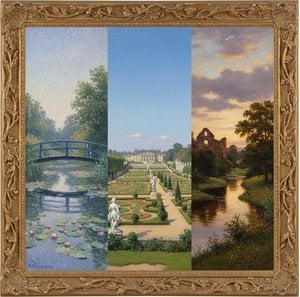
The Serene Vision of William Townsend
In the quiet corners of the English countryside, where the morning mist clings to the rolling hills of Kent and the sunlight filters through the lush canopy of hop gardens, lies the soul of William Townsend’s artistry. Born in 1909 in Worcestershire, Townsend emerged as a painter of profound tranquility, a master capable of distilling the fleeting essence of the British landscape into enduring moments of peace. His work does not merely document the terrain; it breathes with the rhythm of the seasons, capturing a sense of timelessness that invites the viewer into a state of quiet contemplation. Through his eyes, the rural landscapes of England are transformed into poetic studies of light, color, and atmosphere, establishing him as a significant voice in twentieth-century British landscape painting.
Townsend’s artistic journey began with a disciplined foundation at the Worcester School of Art & Design between 1928 and 1930. It was here that he honed his technical prowess in both watercolor and oil, developing a meticulous approach to observation that would remain a hallmark of his career. While his early explorations often turned toward the intimate—capturing the subtle interplay of light within domestic interiors—his true passion lay in the expansive beauty of the outdoors. This transition from the private sphere to the public landscape allowed him to explore the relationship between man and nature, particularly through his celebrated depictions of the Kentish countryside and the industrious yet beautiful hop gardens that define the region.
A Tapestry of Influence and Technique
The evolution of Townsend’s style was deeply informed by the giants of European art. He drew significant inspiration from the Impressionist movement, particularly the works of Claude Monet and Pierre Auguste Renoir. From them, he learned the art of capturing atmospheric conditions—the way a smoke-filled sky might shroud a townscape or how the morning light softens the edges of a distant church. This focus on the subjective experience of light allowed his work to transcend mere realism, moving toward a more emotive representation of the world. Furthermore, the expressive energy of Post-Impressionism, notably the textured brushwork of Vincent van Gogh, left an indelible mark on his technique. In many of his later works, one can observe a bold use of color and a tactile quality to the paint that lends a vibrant, living pulse to his landscapes.
His technical mastery is perhaps most evident in his ability to balance realism with impressionistic flair. In masterpieces such as Early Morning at Tovil, Kent, Townsend utilizes a dramatic backdrop of sky and architecture to create depth, while simultaneously employing soft, blended tones to evoke the damp, cool air of a Kentish dawn. His approach to still life, seen in works like Dahlias, mirrors this sensitivity; even when focused on a singular subject, he employs a rich palette and thoughtful composition to imbue the floral arrangement with a sense of vitality and grace.
Legacy and Lasting Impression
Throughout his career, Townsend achieved a level of recognition that placed him among the notable landscape artists of his era. His works found homes in prestigious institutions, including the Tate collection and the Arts Council Collection, ensuring that his vision of a serene, pastoral England would be preserved for future generations. Whether depicting the industrious beauty of The Hop Garden or the tranquil waters of a river view in Kent, his paintings serve as a testament to the enduring allure of the natural world.
The historical significance of William Townsend lies in his ability to capture a specific, vanishing era of British rural life with both accuracy and affection. As the landscape of England underwent profound changes during the mid-twentieth century, Townsend’s canvases remained steadfast sanctuaries of peace. His legacy is not found merely in the pigments on canvas, but in the emotional resonance of his scenes—a lasting gift of beauty that continues to offer solace and wonder to all who encounter his work.
Perguntas e Respostas
Onde posso encontrar estatísticas sobre as obras de William Townsend?
Existe uma página de Estatísticas para William Townsend, apresentando estatísticas sobre as obras do artista no este site.
A qual período histórico pertence a obra de William Townsend?
William Townsend atuou no período Modern. Este período situa a atividade do artista na história.
Onde as obras de William Townsend estão agrupadas por movimento artístico?
A página Todos os Movimentos agrupa as obras de William Townsend por movimento artístico.