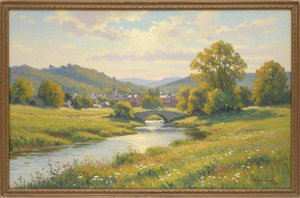
William P. Rayner (Billy Kornbluth): A Painter of American Landscapes
Born in New York City in 1930 and passing away in 2018, William P. Rayner – often known as Billy Kornbluth – was a quietly compelling figure in the landscape painting world. His work, characterized by a deep reverence for nature and a subtle yet powerful sense of place, reflects a life spent observing and translating the beauty of the American countryside, particularly the coastal regions of East Hampton, New York, where he established himself as a resident artist. While not always commanding widespread public attention, Rayner’s paintings possess a quiet dignity and an understated emotional resonance that speaks to the enduring appeal of capturing the essence of a specific time and place.
Kornbluth's artistic journey began with a fascination for travel writing, a passion that inextricably linked his visual art with his desire to document and share experiences. This dual pursuit shaped his approach to painting – he wasn’t simply rendering landscapes; he was conveying the feeling of being *there*, imbuing each canvas with the memory of light, air, and atmosphere. His subjects ranged from expansive coastal views to intimate glimpses of woodland scenes, always rendered with a meticulous attention to detail and a masterful understanding of color theory. He frequently employed a muted palette, favoring earthy tones and subtle gradations of blue and green, creating an effect that is both calming and deeply evocative.
Early Life and Influences
William P. Rayner’s early life remains somewhat shrouded in detail, though his upbringing in New York City undoubtedly instilled a deep appreciation for urban landscapes – a contrast to the natural world he would later dedicate much of his career to portraying. Information suggests he was married to Katharine Ann Johnson, also known as Kathy Rayner, from 1984 until his death in 2018. This marriage brought a significant influence to his life and work; Mrs. Rayner’s own considerable wealth and philanthropic endeavors provided stability and support, allowing him the freedom to pursue his artistic passions without financial constraints. Interestingly, Katharine Rayner herself was a prominent figure in American society, demonstrating an appreciation for art and culture that likely resonated with her husband.
While specific formal training is not widely documented, it’s clear that Rayner developed his skills through years of dedicated observation and practice. His work demonstrates a strong understanding of traditional landscape painting techniques – careful composition, precise rendering of textures, and an acute awareness of light and shadow. It's speculated he may have been influenced by the Hudson River School painters, whose romantic depictions of American wilderness landscapes laid the groundwork for subsequent generations of artists.
Style and Technique
Rayner’s style is best described as understated realism with a distinctly atmospheric quality. He avoided dramatic brushstrokes or overtly expressive gestures, instead favoring a smooth, almost velvety surface achieved through meticulous layering of paint. His compositions are typically balanced and harmonious, drawing the viewer's eye across the canvas in a slow, deliberate manner. He was particularly adept at capturing the subtle shifts in light and color that define the changing seasons – the golden hues of autumn, the cool blues of winter, and the vibrant greens of spring.
A key element of his technique involved working *en plein air* (outdoors), directly from nature. This allowed him to capture the immediacy of a scene and translate its essence onto canvas with remarkable accuracy. His paintings are not simply representations of landscapes; they are intimate portraits of specific moments in time, imbued with a sense of quiet contemplation.
Legacy and Significance
William P. Rayner’s contribution to American landscape painting may not be widely celebrated, but his work holds a quiet significance. He represents a generation of artists who sought to capture the beauty of the American countryside without resorting to grand gestures or sentimental clichés. His paintings offer a glimpse into a slower pace of life, a reverence for nature, and a deep appreciation for the simple pleasures of observation. His focus on coastal scenes, particularly those around East Hampton, provides a valuable record of this unique region’s evolving landscape.
Rayner's legacy is perhaps best understood through the quiet beauty of his paintings – works that invite viewers to pause, reflect, and reconnect with the natural world. His art serves as a reminder of the enduring power of observation and the profound impact that landscapes can have on our sense of place and identity.