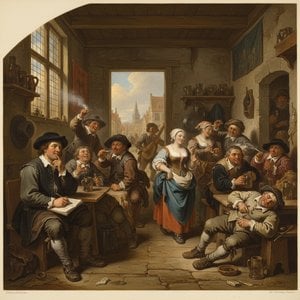
Willem van Herp (1614 - 1677)
Willem van Herp the Elder, a name perhaps less immediately recognizable than those of his celebrated contemporaries like Rubens or Van Dyck, nevertheless occupies an important and fascinating niche within the vibrant artistic landscape of 17th-century Flanders. Born around 1614 in Antwerp, a city then pulsating with commercial energy and artistic innovation, van Herp dedicated his life to capturing scenes both sacred and secular, often imbued with a distinctly Baroque flair. While initial assumptions placed him firmly within Peter Paul Rubens’s workshop, scholarly research has revealed this to be inaccurate; however, the influence of the master is undeniable, manifesting in van Herp's dynamic compositions and expressive figures.
A Pupil Shaped by Genius: The Rubensesque Connection
For a long time Willem van Herp was believed to have been a pupil of Peter Paul Rubens. This association fueled speculation about his artistic trajectory, prompting researchers to meticulously examine stylistic similarities between his works and those of Rubens. Despite lacking direct evidence of formal instruction under the renowned maestro, Van Herp’s oeuvre undeniably bears the unmistakable imprint of Rubens’s aesthetic principles—particularly in terms of dramatic lighting, dynamic movement, and a penchant for monumental scale. The pervasive use of Rubensian motifs and compositional techniques suggests that van Herp absorbed artistic knowledge through observation and emulation, establishing him as a student deeply attuned to the prevailing artistic currents of Antwerp.
Early Training and Artistic Foundations
Van Herp’s formative years were marked by intensive training under Damiaan Wortelmans II and Hans Biermans—artists who honed his technical skills and instilled in him a foundational understanding of Baroque painting techniques. These mentors imparted invaluable knowledge regarding disegno (drawing), chiaroscuro (light and shadow), and color theory, equipping van Herp with the tools necessary to execute his ambitious artistic vision.
A Master's Recognition: Guild Membership and Independence
In 1637, Willem van Herp registered as an independent master in the Guild of St. Luke—a pivotal moment signifying his formal acceptance into Antwerp’s artistic community and marking the commencement of his professional career. This decision underscored his commitment to upholding guild standards and pursuing creative autonomy, establishing him as a respected artist recognized by his peers.
Genre Scenes and Religious Narratives: The Dual Pillars of His Art
Van Herp’s artistic output was characterized by two primary avenues of exploration—religious paintings and “low-life” genre scenes. These weren’t depictions of grand historical events or aristocratic portraiture, but rather intimate glimpses into the everyday lives of ordinary people. His genre scenes, such as "A Poor Company at Table in a Rustic Kitchen," offer compelling snapshots of humble settings and characters, revealing a keen observational skill and an empathetic understanding of human experience. Simultaneously, van Herp produced numerous religious compositions, including striking interpretations of stories like “Daniel in the Lion’s Den,” demonstrating his versatility and ability to navigate both earthly realism and spiritual narrative.
Influence and Artistic Synthesis: Embracing Tradition and Innovation
To fully appreciate van Herp’s artistic achievements, one must acknowledge his masterful ability to synthesize influences from a diverse range of artistic sources. He wasn't afraid to draw upon, copy, or adapt compositions by prominent Antwerp painters—Rubens, Anthony van Dyck, Jacob Jordaens, Gerard Seghers, Jan Boeckhorst, Hendrick van Balen, Erasmus Quellinus the Younger, Gaspar de Crayer and Artus Wolffort all served as points of departure. This wasn’t simply imitation; rather, it was a process of artistic digestion and reinterpretation. He also looked to Italian masters like Raphael and Guido Reni for inspiration, demonstrating a broad cultural awareness and a willingness to engage with the wider European art scene.
International Reach and Legacy: Copper Paintings and Beyond
Van Herp’s artistic impact extended far beyond the borders of Antwerp. He frequently collaborated with fellow artists like Jan van Kessel the Elder, Lambert de Hondt the elder, and Guillam Forchondt, often contributing figures to landscape paintings—a common practice that allowed for specialization and efficient production. His involvement in creating “paradise landscapes,” idyllic depictions of the Garden of Eden teeming with animals, further demonstrates his versatility and responsiveness to popular demand. Crucially, many of his smaller works, particularly those executed on copper—a medium prized for its durability and glossy finish—were specifically intended for export, especially to Spain. This strategic focus contributed significantly to the dissemination of Flemish Baroque style internationally and influenced copper painting techniques in Mexico. He was also father to Norbertus en Willem (II) van Herp, both painters.
Concluding Remarks
Willem van Herp the Elder died in 1677, leaving behind a substantial body of work and a legacy as a skilled craftsman who helped to spread the Flemish Baroque aesthetic across Europe and beyond. While perhaps not achieving the same level of renown as some of his more celebrated peers, his prolific output and international reach solidify his place as an important figure in the history of 17th-century art—a testament to the enduring power of artistic synthesis and a celebration of Antwerp’s contribution to European cultural heritage.