Théodore Géricault, 1791 – 1824

The 100 Most Famous Paintings by Théodore Géricault

The painting that made Théodore Géricault famous is O Naufrágio da Médusa (1818); it hangs in the Museu do Louvre, Paris. Nymph and Satyr (Jupiter and Antiope) (1820) and The Oath of Brutus after the Death of Lucretia (1815) follow it in the hearts of collectors and museum visitors. Of the 183 works by Théodore Géricault in our catalogue, these 100 are the most admired, each presented with its date, its museum and what sets it apart.

Ranked by our popularity score, which combines the searches, visits and orders for each work. Updated Outubro 2026. Every masterpiece on this page can be ordered as a museum-quality, hand-painted oil reproduction or a fine art print, at the size you choose.

Portrait of Théodore Géricault
Théodore Géricault · 1791 – 1824
Born · died
1791 – 1824, Ruão
Movement
Romantic painting
Works in our catalogue
183
Most famous
O Naufrágio da Médusa (1818)
Most works at
Museu do Louvre

Théodore Géricault: the ten masterpieces

O Naufrágio da Médusa (1818) by Théodore Géricault
1

O Naufrágio da Médusa

1818 · Óleo sobre tela · Museu do Louvre, Paris

A obra-prima monumental de Jean-Louis André Théodore Géricault é muito mais do que uma mera representação de um desastre marítimo; é uma exploração visceral do desespero humano, do escândalo político e do poder sublime da natureza. Concluída em 1819, esta tela de dimensões grandiosas (491 x 716 cm) imortaliza o terrível desfecho do naufrágio de 1816 da fragata francesa Méduse, uma tragédia nascida da incompetência e da corrupção que chocou…

Nymph and Satyr (Jupiter and Antiope) (1820) by Théodore Géricault
2

Nymph and Satyr (Jupiter and Antiope)

1820 · Acrylic On Canvas · Musée des Beaux-Arts et de la Céramique, Rouen

The Allure of the Divine Encounter: Géricault’s *Nymph and Satyr* Jean-Louis André Théodore Géricault's *Nymph and Satyr*, painted in 1819, isn’t merely a depiction of a mythological scene; it’s a profound exploration of desire, transgression, and the inherent tension between innocence and primal instinct. Born amidst the tumultuous backdrop of post-revolutionary France, Géricault, already recognized for his dramatic intensity, sought to capture not just a narrative but an emotional truth—a…

Lions in a Mountainous Landscape (1818) by Théodore Géricault
4

Lions in a Mountainous Landscape

1818 · Acrylic On Canvas · Metropolitan Museum of Art, Nova York

This vigorous painting of six lions in a remote, spectrally illuminated lair—possibly intended to evoke the Atlas Mountains of Morocco—is an extraordinary example of Gericault’s spontaneous handling of paint. Rather than applying finishing touches to make a polished cabinet picture, the artist left the painting in a state known as an esquisse, or sketch, a work prized by fellow artists for its strength of directly capturing a subject or effect.…

The Kiss (1822) by Théodore Géricault
5

The Kiss

1822 · Acrylic On Canvas · Museu Thyssen-Bornemisza, Madrid

Théodore Géricault's "The Kiss," painted in 1816, isn’t merely a depiction of lovers entwined; it’s a visceral embodiment of the burgeoning Romantic movement’s fascination with raw emotion, dramatic intensity, and the sublime. This arresting work, housed within the Thyssen-Bornemisza Museum in Madrid, transcends simple representation to become a profound meditation on passion, vulnerability, and the very essence of human connection. Géricault, already a figure known for his unflinching portrayals of…

Wounded Soldiers Retrating from Russia (1814) by Théodore Géricault
6

Wounded Soldiers Retrating from Russia

1814 · Acrylic On Canvas · Musée des Beaux-Arts, Rouen

A Symphony of Suffering: Géricault’s “Wounded Soldiers Retrating from Russia” Jean-Louis André Théodore Géricault's "Wounded Soldiers Retrating from Russia" is not merely a painting; it’s a visceral embodiment of the horrors and human cost of war, rendered with an unprecedented level of realism and emotional intensity for its time. Completed in 1814, this monumental canvas—measuring a commanding 250 x 206 cm—captures a pivotal moment during Napoleon's disastrous invasion of Russia,…

Study of Feet and Hands (1818) by Théodore Géricault
7

Study of Feet and Hands

1818 · Oil On Canvas · Musée Fabre, Montpellier

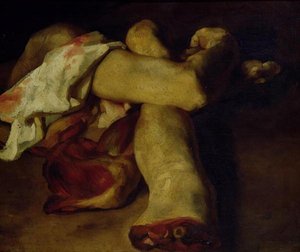
Jean-Louis André Théodore Géricault's "Study of Feet and Hands," painted in 1818, isn’t a grand statement of Romantic drama like his monumental “The Raft of the Medusa.” Instead, it offers a profoundly intimate glimpse into the artist’s meticulous process and a poignant meditation on the human form. This unassuming oil painting—measuring a modest 52 x 64 cm—is far more than just a preparatory sketch; it's a concentrated distillation of Géricault’s…

The Raft of the Medusa (detail) (1818) by Théodore Géricault
8

The Raft of the Medusa (detail)

1818 · Oil On Canvas · Museu do Louvre, Paris

Jean-Louis André Théodore Géricault's "The Raft of the Medusa," a monumental detail from his 1818 painting, isn’t merely a depiction of shipwreck; it’s a visceral plunge into the depths of human suffering and political indictment. The scene, rendered with a dramatic intensity characteristic of Romanticism, captures the harrowing aftermath of the French frigate *Medusa*'s wreck off the coast of Mauritania in 1816. This disaster, largely attributed to the incompetence and…

The Wreck (1821) by Théodore Géricault
10

The Wreck

1821 · Oil On Canvas · Museu do Louvre, Paris

Théodore Géricault's "The Wreck," painted in 1821, isn’t merely a seascape; it’s a visceral confrontation with the sublime—a raw depiction of humanity’s vulnerability against the overwhelming force of nature. Born amidst the turbulent currents of post-revolutionary France, Géricault, a figure both lauded and controversial within the burgeoning Romantic movement, channeled his own anxieties and the era's fascination with dramatic events into this monumental canvas. The painting immediately commands attention not…

More Théodore Géricault masterpieces, 11 to 100

The Horse Race (1816) by Théodore Géricault
#11

The Horse Race

1816 · Museu Thyssen-Bornemisza

Jean-Louis André Théodore Géricault's "The Horse Race," painted in 1816, isn’t merely a depiction of a sporting event; it’s a visceral embodiment of Romanticism’s core tenets – passion,…

Bring it home →
Swiss Guard and Wounded Veteran (1819) by Théodore Géricault
#12

Swiss Guard and Wounded Veteran

1819 · Museu do Louvre

Jean-Louis André Théodore Géricault's "Swiss Guard and Wounded Veteran," painted in 1819, is not merely a historical depiction; it’s a profound meditation on duty, sacrifice, and the lingering…

Order a reproduction →
Mazeppa (1823) by Théodore Géricault
#13

Mazeppa

1823 · Château de Chantilly

Théodore Géricault's "Mazeppa," painted in 1823, isn’t merely a depiction of a dramatic legend; it’s a visceral embodiment of Romantic turmoil—a raw exploration of suffering, resilience, and the…

Bring it home →
Two Horses (1809) by Théodore Géricault
#14

Two Horses

1809 · The Phillips Collection

Jean-Louis André Théodore Géricault's "Two Horses," painted in 1808-1809, isn’t merely a depiction of two magnificent animals; it’s a visceral exploration of movement, power, and the fleeting nature…

Bring it home →
A Turk (Mustapha) (1820) by Théodore Géricault
#15

A Turk (Mustapha)

1820 · Museu do Louvre

Jean-Louis André Théodore Géricault's "A Turk (Mustapha)," painted in 1820, is not merely a portrait; it’s a carefully constructed tableau of exoticism, melancholy, and the burgeoning Romantic sensibility…

Order a reproduction →
A Carabinier with his Horse (1814) by Théodore Géricault
#16

A Carabinier with his Horse

1814 · Musée des Beaux-Arts

In the quiet intensity of Jean-Louis André Théodore Géricault’s 1814 masterpiece, "A Carabinier with His Horse," we encounter more than a mere military portrait; we witness a profound…

Order a reproduction →
Riderless Horse Races (detail) (1817) by Théodore Géricault
#17

Riderless Horse Races (detail)

1817 · Museu do Louvre

A Moment Frozen in Time: Géricault’s “Riderless Horse Races” Jean-Louis André Théodore Géricault's "Riderless Horse Races (detail)" is not merely a depiction of a sporting event; it’s a…

Bring it home →
Boxers (1818) by Théodore Géricault
#18

Boxers

1818 · Château de Chantilly

A Tempestuous Vision: Géricault’s “Boxers” Jean-Louis André Théodore Géricault's "Boxers," completed in 1818, isn’t merely a depiction of a boxing match; it’s a visceral embodiment of Romanticism’s fascination…

Order a reproduction →
The Epsom Derby (1821) by Théodore Géricault
#20

The Epsom Derby

1821 · Museu do Louvre

Jean-Louis André Théodore Géricault's "The Epsom Derby," painted in 1821, isn’t merely a depiction of horse racing; it’s a visceral embodiment of Romanticism’s fascination with drama, movement, and…

Bring it home →
Three Lovers (1817) by Théodore Géricault
#22

Three Lovers

1817 · J. Paul Getty Museum

Théodore Géricault captured a private, feverish moment in Three Lovers. This small oil sketch, created about 1817–1820, offers a rare glimpse into the artist's more intimate preoccupations. It…

Order a reproduction →
Lion devouring a horse by Théodore Géricault
#26

Lion devouring a horse

Château de Chantilly

Théodore Géricault's "Lion Devouring a Horse," painted in 1819, isn’t merely a depiction of predatory action; it’s a visceral exploration of power, mortality, and the primal instincts that…

Bring it home →
Untitled (ARJCHM) by Théodore Géricault
#28

Untitled (ARJCHM)

Museu do Louvre

In the annals of art history, few works command the room with such visceral intensity as Théodore Géricault’s The Raft of the Medusa. This monumental oil on canvas…

Bring it home →
Portrait of a Young Man (1818) by Théodore Géricault
#32

Portrait of a Young Man

1818 · Minneapolis Institute of Art

A young man emerges from a deep, indistinct darkness, his presence felt through the sudden, sharp clarity of light hitting his features. He sits in a quiet, intimate…

Order a reproduction →
A study for a nude. (1801) by Théodore Géricault
#33

A study for a nude.

1801 · Museu Nacional de Varsóvia

A study for a nude. emerges from the shadows as a powerful presence by Théodore Géricault. Created about 1801, this oil on canvas captures a singular moment of…

Bring it home →
Study of a Model (1818) by Théodore Géricault
#34

Study of a Model

1818 · J. Paul Getty Museum

This oil on canvas portrait study presents a close-up, three-quarter view of a Black man's head and shoulders. The subject is positioned slightly off-center, looking toward the viewer…

Commission a hand-painted copy →
The Martyrdom of Saint Peter (1814) by Théodore Géricault
#35

The Martyrdom of Saint Peter

1814 · Kunstmuseum Basel

The Martyrdom of Saint Peter is an oil on canvas by Théodore Géricault. Created about 1814, the work captures a moment of profound tension. The physical presence of…

Bring it home →
The Wreck (1824) by Théodore Géricault
#36

The Wreck

1824 · Museu do Louvre

In the annals of French Romanticism, few works command the visceral attention of Théodore Géricault’s The Wreck as profoundly as this haunting seascape. Painted in 1824, a year…

Commission a hand-painted copy →
Mater dolorosa, Copy after Ribera (1811) by Théodore Géricault
#38

Mater dolorosa, Copy after Ribera

1811 · Kunstmuseum Basel

Mater dolorosa, Copy after Ribera is a religious oil painting by the French artist Théodore Géricault. Created about 1811–1815, the work reflects the artist's engagement with the traditions…

Bring it home →
Lion in Repose by Théodore Géricault
#39

Lion in Repose

Walters Art Museum

Jean-Louis André Théodore Géricault’s “Lion in Repose,” painted circa 1820-1823, isn’t merely a depiction of an animal; it’s a profound meditation on power, vulnerability, and the very nature…

Order a reproduction →
Portrait of a Negro (1800) by Théodore Géricault
#71

Portrait of a Negro

1800 · Palácio Nacional da Ajuda

Dating from 1800, Jean-Louis André Théodore Géricault’s “Portrait of a Negro” is more than just a depiction of an individual; it’s a poignant statement born from the turbulent…

Bring it home →
Portrait d'homme (1825) by Théodore Géricault
#73

Portrait d'homme

1825 · Musée Fabre

Portrait d'homme is an oil on canvas work attributed to the French Romantic painter Théodore Géricault. While historically categorized under various titles, including a mistaken identification as a…

Commission a hand-painted copy →
Horses of the Auvergne (1822) by Théodore Géricault
#76

Horses of the Auvergne

1822 · University of Michigan Museum of Art

In the quiet, monochromatic depths of Théodore Géricault’s 1822 lithograph, Horses of the Auvergne, we are transported to a rugged, mist-shrouded corner of France. This evocative work serves…

Commission a hand-painted copy →
A Prancing Grey Horse (1812) by Théodore Géricault
#77

A Prancing Grey Horse

1812 · Burrell Collection

A single light grey horse occupies the center of this oil painting, captured in a rearing pose. The animal's body is angled vertically, its muscular flanks and neck…

Bring it home →
Sheet of Figure Studies (1818) by Théodore Géricault
#78

Sheet of Figure Studies

1818 · Courtauld Gallery

To gaze upon Jean-Louis André Théodore Géricault’s "Sheet of Figure Studies" is not merely to look at painted forms; it is to witness the very act of human…

Bring it home →
Portrait of an Artist in His Studio (1820) by Théodore Géricault
#79

Portrait of an Artist in His Studio

1820 · Museu do Louvre

Jean-Louis André Théodore Géricault's “Portrait of an Artist in His Studio,” completed in 1820, is more than a simple depiction of a young man seated before his easel;…

Bring it home →
The Plaster Kiln (1823) by Théodore Géricault
#82

The Plaster Kiln

1823 · Museu do Louvre

In the quiet, brooding landscapes of nineteenth-century France, few works capture the raw, unvarnished essence of pastoral life as poignantly as Théodore Géricault’s “The Plaster Kiln.” Completed in…

Order a reproduction →

Théodore Géricault's paintings by period

The subjects Théodore Géricault painted most

The four subjects that return most often among these masterpieces, with the finest example of each.

Where to see Théodore Géricault's paintings

The 8 museums that hold the most of the paintings on this page.

Museum City Works by Théodore Géricault Paintings from this list
Museu do Louvre, ParisMuseu do Louvre Paris 20 O Naufrágio da Médusa, The Raft of the Medusa (detail), Leda and the Swan
Château de Chantilly, ChantillyChâteau de Chantilly Chantilly 6 Mazeppa, Boxers, Lion devouring a horse
J. Paul Getty Museum, Los AngelesJ. Paul Getty Museum Los Angeles 3 Three Lovers, Study of a Model, The Race of the Riderless Horses
Museu Nacional de Varsóvia, VarsóviaMuseu Nacional de Varsóvia Varsóvia 3 Equestrian portrait of Wincenty Krasiński., A study for a nude., Study of a nude man
Burrell Collection, GlasgowBurrell Collection Glasgow 8 The Trumpeter of the Lancers of the Guard, A Prancing Grey Horse
Musée Fabre, MontpellierMusée Fabre Montpellier 4 Study of Feet and Hands, Portrait d'homme
Petit Palais, ParisPetit Palais Paris 3 The Scotsman, Italian Landscape with Tomb
Museu Thyssen-Bornemisza, MadridMuseu Thyssen-Bornemisza Madrid 2 The Kiss, The Horse Race

Théodore Géricault, decade by decade: the defining painting of each

  1. 1800s
    Two Horses (1809) by Théodore Géricault
    Rank 14 / 100

    Two Horses

    Age 9 – 18 · The Phillips Collection

    Jean-Louis André Théodore Géricault's "Two Horses," painted in 1808-1809, isn’t merely a depiction of two magnificent animals; it’s a visceral exploration of movement, power, and the fleeting nature…

  2. 1810s
    O Naufrágio da Médusa (1818) by Théodore Géricault
    No. 1 of 100

    O Naufrágio da Médusa

    Age 19 – 28 · Museu do Louvre

    A obra-prima monumental de Jean-Louis André Théodore Géricault é muito mais do que uma mera representação de um desastre marítimo; é uma exploração visceral do desespero humano, do…

  3. 1820s
    Nymph and Satyr (Jupiter and Antiope) (1820) by Théodore Géricault
    #2 of 100

    Nymph and Satyr (Jupiter and Antiope)

    Age 29 – 33 · Musée des Beaux-Arts et de la Céramique

    The Allure of the Divine Encounter: Géricault’s *Nymph and Satyr* Jean-Louis André Théodore Géricault's *Nymph and Satyr*, painted in 1819, isn’t merely a depiction of a mythological scene;…

Théodore Géricault's masterpieces: questions and answers

Which painting is Théodore Géricault best known for?Show the answer

O Naufrágio da Médusa (1818), Museu do Louvre, Paris. Next come Nymph and Satyr (Jupiter and Antiope) (1820) and The Oath of Brutus after the Death of Lucretia (1815).

How old was Théodore Géricault when painting O Naufrágio da Médusa?Show the answer

27 years old: O Naufrágio da Médusa dates from 1818 and Théodore Géricault was born in 1791.

What are Théodore Géricault's ten greatest paintings?Show the answer

O Naufrágio da Médusa, Nymph and Satyr (Jupiter and Antiope), The Oath of Brutus after the Death of Lucretia, Lions in a Mountainous Landscape, The Kiss, Wounded Soldiers Retrating from Russia, Study of Feet and Hands, The Raft of the Medusa (detail), Leda and the Swan and The Wreck. The ranking above gives the year and the museum of each.

How many works did Théodore Géricault paint?Show the answer

Our catalogue lists 183 works by Théodore Géricault, dated from 1800 to 1824.

In which museums can I see Théodore Géricault's masterpieces?Show the answer

Most of them are in Museu do Louvre (Paris), Château de Chantilly (Chantilly) and J. Paul Getty Museum (Los Angeles). The table above lists the museums one by one.

When did Théodore Géricault paint the masterpieces?Show the answer

In 1810s: 67 of the 100 works on this page date from then, among them O Naufrágio da Médusa.

What are the first and last famous paintings of Théodore Géricault?Show the answer

The earliest on this page is Portrait of a Negro (1800), the latest The Wreck (1824).

What were Théodore Géricault's favourite subjects?Show the answer

Man (12), Portrait (9) and Horse (8), among the 100 works on this page.

Which technique did Théodore Géricault favour?Show the answer

Oil On Canvas: 25 of the 100 works on this page.

What art movement is Théodore Géricault part of?Show the answer

Romantic painting, as the paintings on this page show.

Which masterpieces by Théodore Géricault hang at the Museu do Louvre?Show the answer

O Naufrágio da Médusa, The Raft of the Medusa (detail) and Leda and the Swan are among the 14 works on this page held by the Museu do Louvre, Paris.

Can I own a reproduction of a Théodore Géricault masterpiece?Show the answer

Yes. Every painting on this page can be ordered as a museum-quality, hand-painted oil reproduction or a fine art print, in the size you choose, from the painting's own page.

The life of Théodore Géricault

A Vida e a Arte de um Pioneiro Romântico: Théodore Géricault

Jean-Louis André Théodore Géricault, um nome que ecoa com a alma vibrante do Romantismo francês, nasceu em Rouen, na França, em 26 de setembro de 1791. Sua trajetória, desde os primeiros anos até o trágico fim, foi marcada por uma busca incessante pela expressão artística e uma profunda sensibilidade para as angústias da humanidade. Embora tenha herdado uma posição confortável através dos negócios familiares – incluindo um próspero empreendimento de tabaco –, Géricault sentiu que seu destino residia não nos cálculos financeiros ou nas leis, mas na arte, no poder transformador da pintura. Sua formação inicial, sob a tutela do pintor Carle Vernet, mestre na arte esportiva inglesa, despertou em si um olhar aguçado para a anatomia e o movimento, elementos que se manifestariam com força em suas representações de cavalos, animais que sempre exerceram uma fascinação particular sobre ele. Contudo, foi sua subsequente jornada de estudos sob a orientação de Pierre-Narcisse Guérin que lhe forneceu as bases da composição clássica, embora sua natureza inquieta o levasse a buscar conhecimento por conta própria nas imponentes salas do Louvre.

O Louvre como Academia: Um Diálogo com os Mestres

A partir de 1810 até 1815, o Louvre se tornou para Géricault não apenas um museu, mas uma verdadeira academia. Ele mergulhou nos trabalhos dos grandes mestres – Rubens, Tician, Velázquez e Rembrandt – não apenas copiando suas técnicas, mas estabelecendo um diálogo profundo com suas filosofias artísticas. Este período foi crucial na formação de seu estilo singular, caracterizado por um claroscuro dramático, composições dinâmicas e uma intensidade emocional que o distinguia de seus contemporâneos. Ele não se limitava a reproduzir; absorvia a essência desses mestres, internalizando suas abordagens à luz, sombra e forma humana. Essa educação autodirigida fomentou uma voz artística única, que logo desafiaria as convenções neoclássicas predominantes. Suas primeiras obras, como *O Caçador Carregando* (1812), já prenunciavam essa sensibilidade emergente, exibindo uma ousadia na execução e uma fascinação pelo movimento que ecoavam a energia vibrante das telas de Rubens. Ele continuou a explorar temas equestres, refinando suas habilidades na representação da força e da graça dos cavalos – um assunto que se tornaria uma constante em sua obra.

O Naufrágio da Médua: Um Monumento à Sofrimento Humano

A obra que consagrou Géricault como um dos principais artistas do Romantismo francês é, sem dúvida, *O Naufrágio da Médusa* (1818-1819). Inspirada pela terrível e verdadeira história do naufrágio da fragata francesa Méduse em 1816, causado por negligência e incompetência que resultaram em sofrimento inimaginável para seus passageiros, a pintura transcende a mera representação histórica e se torna um denúncie pungente da falibilidade humana e da injustiça social. Géricault dedicou-se a uma pesquisa meticulosa, entrevistando sobreviventes, estudando cadáveres em hospitais e até mesmo construindo um modelo em escala da jangada para garantir a precisão e o impacto emocional. O resultado é uma obra que não se limita a retratar a tragédia; ela oferece uma experiência imersiva que confronta os espectadores com a realidade crua do sofrimento humano. A composição, construída em torno de duas estruturas piramidais – uma representando o desespero e a morte, a outra a esperança e o potencial de resgate – cria uma tensão dinâmica que atrai o olhar por toda a tela. *O Naufrágio da Médusa* foi controverso quando exibido no Salão de 1819, provocando um debate político e consolidando a reputação de Géricault como um artista ousado e não convencional. O impacto da pintura se estendeu além do mundo da arte, tornando-se um símbolo da incompetência governamental e da resiliência humana diante de horrores inimagináveis.

Além da Tragédia: Temas Militares e Legado Artístico

Embora *O Naufrágio da Médusa* seja sua obra mais celebrada, o escopo artístico de Géricault se estendeu muito além desse único magistral trabalho. Ele continuou a explorar temas militares, evidenciado em pinturas como *O Caçador Ferido* (1814) e *A Derby de Epson* (1821), demonstrando uma fascinação pelo drama e pela força expressiva. Essas obras revelam sua contínua exploração das emoções humanas sob pressão, frequentemente focando no desgaste físico e psicológico da guerra. Ele também se aventurou na pintura de retratos e na litografia, expandindo ainda mais seu repertório artístico. Tragicamente, a vida de Géricault foi interrompida por uma doença em 1824, aos 32 anos, após anos de sofrimento devido a acidentes de cavalos e uma infecção crônica pela tuberculose. Sua morte prematura privou o mundo da arte de um talento prodigioso, mas sua influência sobre as gerações futuras de artistas – particularmente Eugène Delacroix – foi profunda. Ele é lembrado como um pioneiro do Romantismo, um artista que ousou enfrentar verdades difíceis e imbuir seu trabalho com uma ressonância emocional poderosa que continua a cativar o público até hoje. Sua figura bronzeada, com pincel em mãos, repousa sobre seu túmulo no cemitério de Père Lachaise em Paris, acima de um painel baixo representando a cena angustiante de *O Naufrágio da Médusa*, uma homenagem adequada a um artista que dedicou sua vida a capturar as complexidades e contradições da condição humana.

Características Chave & Influências

  • Romantismo: Géricault é considerado um dos primeiros pintores franceses do Romantismo, afastando-se dos ideais neoclássicos em direção à intensidade emocional e à expressão dramática.
  • Composição Dramática: Suas pinturas são conhecidas por suas composições dinâmicas, frequentemente utilizando linhas diagonais e contrastes de luz e sombra para criar uma sensação de movimento e tensão.
  • Realismo & Pesquisa: Géricault estava comprometido com o realismo, realizando pesquisas extensivas – incluindo o estudo de cadáveres e a entrevista com sobreviventes – para garantir a precisão e o impacto emocional de sua obra.
  • Influência dos Mestres Antigos: Ele se inspirou nos mestres barrocos como Rubens, Tician e Velázquez, adotando suas técnicas para iluminação dramática e pinceladas expressivas.
  • Foco no Sofrimento Humano: Sua arte frequentemente retrata cenas de tragédia, desespero e os aspectos mais sombrios da experiência humana, refletindo uma fascinação romântica pela emoção intensa.

All 183 works by Théodore Géricault →