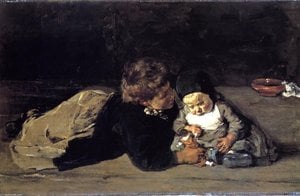
Max Liebermann, 1847 – 1935

Max Liebermann: The 100 Most Famous Paintings

Hora livre no orfanato de Amsterdã (1876) is the most famous painting by Max Liebermann. Self Portrait with Kitchen Still LIfe (1873) and Corner of a Dutch Village with Washing Hung up to Dry (1890) are the next two works the world knows best. From the 280 works of Max Liebermann in our catalogue, here are the 100 that collectors and museum visitors look at most, with the year, the museum and the story of each.

Ranked by our popularity score, which combines the searches, visits and orders for each work. Updated Outubro 2026. Every masterpiece on this page can be ordered as a museum-quality, hand-painted oil reproduction or a fine art print, at the size you choose.

Portrait of Max Liebermann
Max Liebermann · 1847 – 1935
Born · died
1847 – 1935, Berlim
Movement
Impressionist realism
Works in our catalogue
280
Most famous
Hora livre no orfanato de Amsterdã (1876)
Most works at
Alte Nationalgalerie

Top 10: Max Liebermann's best-known paintings

Hora livre no orfanato de Amsterdã (1876) by Max Liebermann
1

Hora livre no orfanato de Amsterdã

1876 · Óleo sobre tela

"Hora livre no orfanato de Amsterdã", de Max Liebermann, é uma obra cativante que captura com beleza um momento da vida comunitária na Amsterdã do século XIX. Esta pintura convida os espectadores para um pátio ao ar livre onde mulheres e crianças se reúnem, criando uma cena rica em interação social e patrimônio cultural.

Self Portrait with Kitchen Still LIfe (1873) by Max Liebermann
2

Self Portrait with Kitchen Still LIfe

1873 · Oil On Canvas · Stadtisches Museum, Gelsenkirchen

To stand before Max Liebermann’s Self Portrait with Kitchen Still Life is not merely to observe a painting; it is to step directly into the vibrant, sun-drenched moments of late nineteenth-century Berlin. Created in 1873, this oil on canvas captures more than just a likeness; it encapsulates the artist's profound belief that true beauty resides within the quotidian—the humble objects and simple acts of daily life. Liebermann, a master whose…

Corner of a Dutch Village with Washing Hung up to Dry (1890) by Max Liebermann
3

Corner of a Dutch Village with Washing Hung up to Dry

1890 · Oil On Panel · Harvard Art Museums, Cambridge

The air feels heavy with the scent of damp fabric and the salt of a nearby coast. In this corner of a Dutch village, time seems to pause, caught in the soft, overcast light of 1890. A white building dominates the immediate view, its red door and blue shutters providing the only sharp interruptions to the muted, earthy tones of the village. Above the doorway, laundry hangs from a line,…

Portrait of Richard Strauss (1918) by Max Liebermann
4

Portrait of Richard Strauss

1918 · Oil · Alte Nationalgalerie, Berlim

This 1918 impressionist painting by Max Liebermann presents a black and white portrait of Richard Strauss. The subject is depicted sitting in a chair with his hands clasped together, wearing a suit and tie. He is shown with a mustache and appears to be looking directly at the viewer. To provide depth to the scene, the background features a curtain behind the seated man.

Restaurant De oude Vink (1905) by Max Liebermann
5

Restaurant De oude Vink

1905 · Oil

There is a certain quietude found in the middle of a crowd, a feeling captured here in 1905. In Restaurant De oude Vink, we find ourselves seated among patrons enjoying a meal under the dappled shade of trees. The scene is one of casual, unhurried leisure. Green chairs are scattered around tables, some occupied by figures lost in conversation, others left empty as if the guests have only just stepped…

Self-portrait (1916) by Max Liebermann
6

Self-portrait

1916 · Oil On Canvas · Kunsthalle Bremen, Bremen

An older man sits in a moment of quiet creation, his presence filling the space with a heavy, contemplative dignity. He faces the viewer directly, his gaze steady and unblinking, even as his hands remain occupied with the tools of his trade. In his right hand, he holds a palette, while his left hand brings a brush toward an easel, capturing a fragment of life in real-time. The light enters…

The Preserve Makers (1879) by Max Liebermann
7

The Preserve Makers

1879 · Oil On Canvas · Museum der bildenden Künste, Leipzig

The Preserve Makers is a somber and intimate realist painting that captures a group of women gathered within a dimly lit, rustic interior. The composition is dense and crowded, utilizing a shallow depth of field that brings the figures into the immediate foreground to create a sense of enclosure and shared labor. These women are engaged in the communal task of preparing vegetables, their presence evoking a sense of quiet…

The rest of the Max Liebermann ranking, 11 to 100

The farrier (1874) by Max Liebermann
#11

The farrier

1874 · Staatliche Kunsthalle Karlsruhe

The farrier (Beim Hufschmied) is an oil on panel painting by Max Liebermann. Created about 1874, the work belongs to the genre art category. It captures a specific…

Commission a hand-painted copy →
Albert Einstein (1879–1955) (1922) by Max Liebermann
#13

Albert Einstein (1879–1955)

1922 · Royal Society

Max Liebermann's 1922 portrait of Albert Einstein isn’t merely a likeness; it’s a carefully constructed distillation of intellect, contemplation, and the burgeoning promise of a revolutionary mind. Painted…

Order a reproduction →
Portrait Dr. Wilhelm Bode (1909) by Max Liebermann
#15

Portrait Dr. Wilhelm Bode

1909 · Alte Nationalgalerie

In this 1909 oil painting, titled Portrait Dr. Wilhelm Bode, the artist Max Liebermann presents a formal study of a man of significant intellectual standing. The work captures…

Order a reproduction →
The Siblings (1876) by Max Liebermann
#16

The Siblings

1876 · Staatliche Kunstsammlungen

In the quietude of Max Liebermann’s 1876 masterpiece, “The Siblings,” time seems to suspend its forward march, allowing a singular moment of human connection to breathe. This monochrome…

Bring it home →
Swimmers (1875) by Max Liebermann
#17

Swimmers

1875 · Dallas Museum of Art

We are looking at Swimmers, a work by Max Liebermann that captures a quiet, unposed moment of daily life. Also known by the title Swimming boys, this painting…

Commission a hand-painted copy →
Dutch Farmhouse with Woman (1882) by Max Liebermann
#33

Dutch Farmhouse with Woman

1882 · Frye Art Museum

To gaze upon Max Liebermann’s "Dutch Farmhouse with Woman" is to step across the threshold of time and into a moment suspended in golden, gentle light. This 1882…

Bring it home →
A Dutch lacemaker (1881) by Max Liebermann
#55

A Dutch lacemaker

1881 · Hamburger Kunsthalle

The painting titled A Dutch lacemaker (Eine holländische Klöpplerin) is an oil on canvas work by the artist Max Liebermann. This specific piece was executed in 1881. The…

Bring it home →
Gerhart Hauptmann (1912) by Max Liebermann
#56

Gerhart Hauptmann

1912 · Hamburger Kunsthalle

A dignified and somber oil portrait of an elderly man, rendered with expressive, painterly brushstrokes that convey a sense of psychological depth and realism. The composition is a…

Order a reproduction →
Parrot Avenue (1902) by Max Liebermann
#76

Parrot Avenue

1902 · Kunsthalle Bremen

Max Liebermann's "Parrot Avenue," painted in 1902, is a captivating example of Impressionism that transports viewers to a vibrant scene of urban life. Measuring 88 x 72 cm,…

Commission a hand-painted copy →
Table with Pieces of Meat (1877) by Max Liebermann
#77

Table with Pieces of Meat

1877 · Neue Pinakothek

To gaze upon Max Liebermann’s Table with Pieces of Meat is to step directly into the warm, luminous heart of late nineteenth-century Berlin. This oil on canvas from…

Order a reproduction →
The Surgeon, Ferdinand Sauerbruch (1932) by Max Liebermann
#81

The Surgeon, Ferdinand Sauerbruch

1932

In the quiet, contemplative depths of Max Liebermann’s 1932 masterpiece, The Surgeon, Ferdinand Sauerbruch, we are invited into a moment of profound psychological stillness. The painting presents a…

Bring it home →
Jewish Street in Amsterdam (1908) by Max Liebermann
#88

Jewish Street in Amsterdam

1908 · Städel Museum

Jewish Street in Amsterdam is an oil painting by Max Liebermann. Created in 1908, the work depicts a bustling street market scene located in Amsterdam. The subject matter…

Bring it home →

Max Liebermann's paintings by period

The subjects Max Liebermann painted most

The four subjects that return most often among these masterpieces, with the finest example of each.

Where to see Max Liebermann's paintings

The 8 museums that hold the most of the paintings on this page.

Museum City Works by Max Liebermann Paintings from this list
Alte Nationalgalerie, BerlimAlte Nationalgalerie Berlim 17 Portrait of Richard Strauss, Portrait Study of Emil Rathenau, Portrait Dr. Wilhelm Bode
Hamburger Kunsthalle, HamburgoHamburger Kunsthalle Hamburgo 8 The Net Menders, The Terrace at the Hotel Louis C. Jacob in Nienstedten on the Elbe, A Dutch lacemaker
Bavarian State Painting Collections, MuniqueBavarian State Painting Collections Munique 7 Self portrait in painting smock (Selbstbildnis im Malkittel), Children Bathing in the Sea, Still life of meat (Fleischstillleben)
Museu Wallraf-Richartz, ColôniaMuseu Wallraf-Richartz Colônia 6 Two riders on the beach, Self-portrait, The artist's daughter riding
Staatliche Kunsthalle Karlsruhe, KarlsruheStaatliche Kunsthalle Karlsruhe Karlsruhe 5 The farrier, The Basketweavers (Die Korbflechter), Copy of the Bohémienne after Frans Hals (Young woman)
Stadtisches Museum, GelsenkirchenStadtisches Museum Gelsenkirchen 3 Self Portrait with Kitchen Still LIfe, The Flower Terrace in the Wannsee Garden, Facing Northwest
Kunsthalle Bremen, BremenKunsthalle Bremen Bremen 3 Self-portrait, Parrot Avenue
Staatliche Kunstsammlungen Dresden, DresdenStaatliche Kunstsammlungen Dresden Dresden 3 Alfred von Berger, On the Alster in Hamburg

Max Liebermann through the decades: one masterpiece for each

  1. 1860s
  2. 1870s
    Hora livre no orfanato de Amsterdã (1876) by Max Liebermann
    No. 1 of 100

    Hora livre no orfanato de Amsterdã

    Age 23 – 32

    "Hora livre no orfanato de Amsterdã", de Max Liebermann, é uma obra cativante que captura com beleza um momento da vida comunitária na Amsterdã do século XIX. Esta…

  3. 1880s
  4. 1890s
  5. 1900s
    Restaurant De oude Vink (1905) by Max Liebermann
    No. 5 of 100

    Restaurant De oude Vink

    Age 53 – 62

    There is a certain quietude found in the middle of a crowd, a feeling captured here in 1905. In Restaurant De oude Vink, we find ourselves seated among…

  6. 1910s
    Portrait of Richard Strauss (1918) by Max Liebermann
    No. 4 of 100

    Portrait of Richard Strauss

    Age 63 – 72 · Alte Nationalgalerie

    This 1918 impressionist painting by Max Liebermann presents a black and white portrait of Richard Strauss. The subject is depicted sitting in a chair with his hands clasped…

  7. 1920s
    Albert Einstein (1879–1955) (1922) by Max Liebermann
    #13 of 100

    Albert Einstein (1879–1955)

    Age 73 – 82 · Royal Society

    Max Liebermann's 1922 portrait of Albert Einstein isn’t merely a likeness; it’s a carefully constructed distillation of intellect, contemplation, and the burgeoning promise of a revolutionary mind. Painted…

  8. 1930s
    The Surgeon Dr. Ferdinand Sauerbruch (1932) by Max Liebermann
    No. 57 of 100

    The Surgeon Dr. Ferdinand Sauerbruch

    Age 83 – 88 · Hamburger Kunsthalle

    The painting, titled The Surgeon Dr. Ferdinand Sauerbruch, is an oil on canvas created in 1932. The portrait depicts a man wearing glasses and a white coat, seated…

Max Liebermann's paintings: frequently asked questions

What is the most famous Max Liebermann painting?Show the answer

Hora livre no orfanato de Amsterdã (1876). Next come Self Portrait with Kitchen Still LIfe (1873) and Corner of a Dutch Village with Washing Hung up to Dry (1890).

At what age did Max Liebermann paint Hora livre no orfanato de Amsterdã?Show the answer

29 years old: Hora livre no orfanato de Amsterdã dates from 1876 and Max Liebermann was born in 1847.

Which are the 10 most famous Max Liebermann paintings?Show the answer

Hora livre no orfanato de Amsterdã, Self Portrait with Kitchen Still LIfe, Corner of a Dutch Village with Washing Hung up to Dry, Portrait of Richard Strauss, Restaurant De oude Vink, Self-portrait, The Preserve Makers, Schreitender Bauer, KIRCHGANG IN Laren and Alfred von Berger. The ranking above gives the year and the museum of each.

How many paintings by Max Liebermann are there?Show the answer

Our catalogue lists 280 works by Max Liebermann, dated from 1865 to 1932.

Where can I see the most famous Max Liebermann paintings?Show the answer

Most of them are in Alte Nationalgalerie (Berlim), Hamburger Kunsthalle (Hamburgo) and Bavarian State Painting Collections (Munique). The table above lists the museums one by one.

In which period did Max Liebermann paint the best-known works?Show the answer

In 1910s: 18 of the 100 works on this page date from then, among them Portrait of Richard Strauss.

What is the earliest famous Max Liebermann painting, and the latest?Show the answer

The earliest on this page is Portrait of Felix Liebermann (1865), the latest The Surgeon Dr. Ferdinand Sauerbruch (1932).

What subjects did Max Liebermann paint?Show the answer

Man (10), Portrait (6) and Garden scene (6), among the 100 works on this page.

What did Max Liebermann paint on, and with what?Show the answer

Oil On Canvas: 29 of the 100 works on this page.

Which movement does Max Liebermann's art belong to?Show the answer

Impressionist realism, as the paintings on this page show.

What Max Liebermann paintings does the Alte Nationalgalerie hold?Show the answer

Portrait of Richard Strauss, Portrait Study of Emil Rathenau and Portrait Dr. Wilhelm Bode are among the 9 works on this page held by the Alte Nationalgalerie, Berlim.

Where can I buy a Max Liebermann reproduction?Show the answer

Yes. Every painting on this page can be ordered as a museum-quality, hand-painted oil reproduction or a fine art print, in the size you choose, from the painting's own page.

Max Liebermann: biography

A Life Immersed in Light: The World of Max Liebermann

Born into a prosperous Jewish family in 1847 Berlin, Max Liebermann’s path to becoming one of Germany's foremost Impressionist painters wasn’t preordained. Initially steered towards the respectable professions of law and philosophy at the University of Berlin, his true calling resonated far more powerfully from the canvas than the courtroom. This early period of intellectual exploration, however, undoubtedly shaped his observant eye and thoughtful approach to depicting the world around him. It was a deliberate shift – studies in Weimar, Paris, and the Netherlands – that truly ignited his artistic passion, exposing him to diverse styles and laying the foundation for a career defined by capturing fleeting moments with an exquisite sensitivity to light and color. He wasn’t merely painting what he saw; he was translating the very essence of experience onto the canvas. Liebermann's early works often depicted scenes of everyday life, particularly those of the working class, rendered with a naturalism that challenged the prevailing romanticized aesthetic of the time. These paintings weren’t intended as social commentary, but rather as honest portrayals of human existence, imbued with dignity and respect.

Embracing Impressionism in a German Context

Liebermann's artistic development was profoundly influenced by his exposure to French Realism and, crucially, the burgeoning Impressionist movement. The spirit of Édouard Manet – his boldness, his rejection of academic convention, his focus on contemporary life – resonated deeply with Liebermann. However, he didn’t simply replicate what he saw in Paris; instead, he adapted these principles to a German sensibility, creating an Impressionism uniquely his own. His palette became brighter, his brushstrokes looser and more spontaneous, and his subjects shifted towards scenes of bourgeois leisure and the tranquil beauty of his garden near Lake Wannsee. This garden, in particular, became a recurring motif throughout his career, offering a sanctuary from the rapidly changing world outside and providing endless inspiration for his explorations of light and atmosphere. He wasn’t just painting flowers and foliage; he was capturing the very feeling of summer, the warmth of the sun, the gentle breeze rustling through the leaves. Liebermann's early works often featured vibrant colors and a focus on capturing the effects of light, reflecting the influence of artists like Claude Monet and Pierre-Auguste Renoir. He sought to translate the fleeting impressions of nature onto his canvases, prioritizing atmosphere and color over precise detail.

A Champion of Artistic Freedom

Liebermann wasn't content to simply paint; he actively championed artistic innovation and independence. Recognizing the stifling constraints imposed by the traditional art establishment, he became a driving force behind the Berlin Secession in 1898, leading this avant-garde group for over a decade. The Secession challenged conventional norms, providing a platform for artists working outside the confines of academic tradition. This commitment to artistic freedom extended beyond his own work; Liebermann believed passionately that artists should be free to explore their vision without interference from political or ideological pressures. His election to the Prussian Academy of Arts in 1909 and subsequent presidency in 1920 were testaments to his growing influence within the German art world, but these positions also brought him face-to-face with the rising tide of anti-Semitism and nationalism that would ultimately threaten his life’s work. The Secession fostered a spirit of experimentation and collaboration, encouraging artists to push boundaries and challenge established artistic conventions. Liebermann's leadership was instrumental in shaping the movement's identity and promoting its ideals.

Shadows of a Changing World: Legacy and Resilience

The rise of Nazism cast a dark shadow over Liebermann’s later years. His principled stance against discrimination led to his resignation from the Prussian Academy in 1933, a courageous act that signaled his refusal to compromise his values. Despite facing increasing persecution, he continued to paint, finding solace and purpose in his art. He passed away in Berlin in 1935, leaving behind a rich legacy of paintings, prints, and a profound commitment to artistic freedom. His wife, Martha, tragically took her own life in 1943 to avoid deportation, a heartbreaking testament to the horrors of the Holocaust. For years after the war, Liebermann’s work was somewhat overlooked, but in recent decades there has been a renewed appreciation for his contributions to German Impressionism and modern art history. Today, he is remembered not only as a brilliant painter but also as a courageous advocate for artistic expression and a symbol of resistance against tyranny. His paintings continue to captivate viewers with their luminous beauty, insightful observations, and enduring humanity.

Key Achievements & Lasting Influence

  • “The Twelve-Year-Old Jesus in the Temple”: This early work sparked considerable debate due to its unconventional depiction of a Semitic-looking Jesus, challenging traditional religious iconography.
  • Leadership of the Berlin Secession: His pivotal role in leading this avant-garde movement challenged artistic norms and paved the way for modern art in Germany.
  • Presidency of the Prussian Academy of Arts: A significant recognition of his artistic merit, though ultimately compromised by the rise of Nazism.
  • Masterful Portraiture: His ability to capture the essence of his subjects in over 200 commissioned portraits cemented his reputation as a leading portrait painter.
  • Influence on German Impressionism: Liebermann successfully translated the principles of Impressionism into a uniquely German context, inspiring generations of artists.

All 280 works by Max Liebermann →