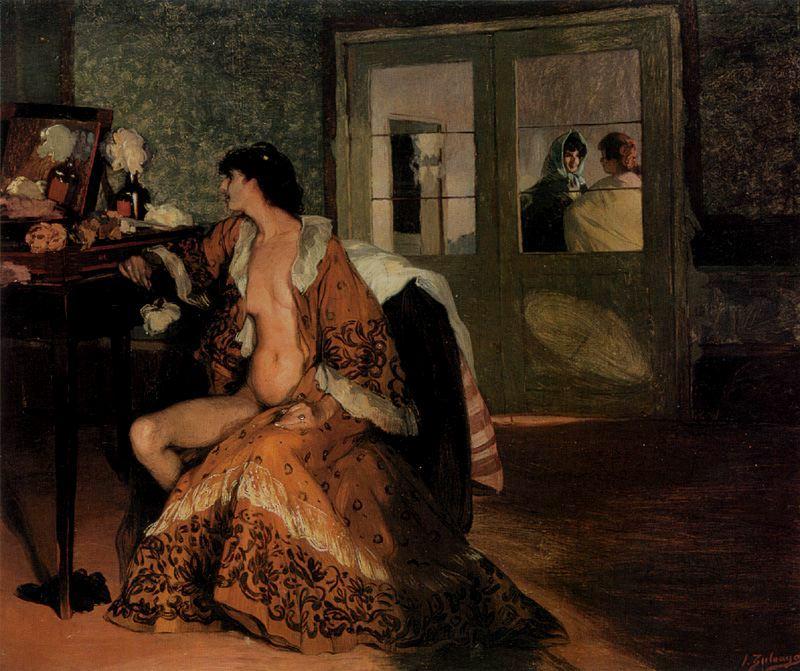
Ignácio Zuloaga, 1870 – 1945

Ignácio Zuloaga Paintings: The 100 Most Famous Works, Ranked

Ignácio Zuloaga's most famous painting is Portrait of Maurice Barrès. With Woman in Andalusian Dress (1911) and Anita Ramírez, in black (1915), it completes the three works everyone recognises. Our catalogue lists 108 works by Ignácio Zuloaga; the 100 below are the ones the world looks at most, each with its year, the museum that holds it and why it matters.

Ranked by our popularity score, which combines the searches, visits and orders for each work. Updated Outubro 2026. Every masterpiece on this page can be ordered as a museum-quality, hand-painted oil reproduction or a fine art print, at the size you choose.

Portrait of Ignácio Zuloaga
Ignácio Zuloaga · 1870 – 1945
Born · died
1870 – 1945, Eibar
Movement
Spanish realism
Works in our catalogue
108
Most famous
Portrait of Maurice Barrès
Most works at
Hispanic Society Museum - Library

The 10 most famous Ignácio Zuloaga paintings

Portrait of Maurice Barrès by Ignácio Zuloaga
1

Portrait of Maurice Barrès

Oil On Canvas

The figure of Maurice Barrès occupies the left side of the canvas, a steady anchor amidst a swirling, dramatic landscape. He gazes toward a distant cityscape, his expression caught in a moment of quiet introspection. There is a certain weight to his presence, a sense of a man deeply connected to the history he contemplates. The light, diffused and soft as if filtered through an overcast sky, casts gentle shadows…

Woman in Andalusian Dress (1911) by Ignácio Zuloaga
2

Woman in Andalusian Dress

1911 · Oil On Canvas · National Gallery of Art, Washington

A woman emerges from a swirl of deep blues and teals. She is captured from the waist up, her presence anchored by the heavy textures of her attire. An orange headpiece rests upon her hair, pinned with pink and white floral accents that catch the light. Her skin glows with warmth against the cool, atmospheric clouds that churn in the background. There is a stillness in her gaze, a poised…

Julia Wainwright Robbins (1923) by Ignácio Zuloaga
7

Julia Wainwright Robbins

1923 · Oil On Canvas · Metropolitan Museum of Art, Nova York

In this 1923 oil on canvas, Ignacio Zuloaga captures Julia Wainwright Robbins as a solitary figure. She occupies the center of the frame, a single female presence held within a quiet, dark space. Her posture is formal, defined by an aristocratic poise that commands the stillness of the composition. She holds a closed fan, a small, rigid object that anchors her hands against the soft volume of her attire.

Ignácio Zuloaga, paintings 11 to 100

Portrait of Ivan Shchukin (1869-1908) (1899) by Ignácio Zuloaga
#11

Portrait of Ivan Shchukin (1869-1908)

1899 · Museu Hermitage

A full-length portrait depicts a man positioned centrally against a desolate, rocky landscape. He is oriented slightly toward the viewer, maintaining a frontal posture that occupies much of…

Bring it home →
My Uncle and My Cousins (1898) by Ignácio Zuloaga
#32

My Uncle and My Cousins

1898 · Musée d'Orsay

Ignacio Zuloaga y Zabala's 1898 painting, *My Uncle and My Cousins*, offers a poignant window into the formal portraiture traditions of late 19th-century Spain. More than simply a…

Bring it home →
Sepulveda (1909) by Ignácio Zuloaga
#39

Sepulveda

1909 · National Gallery of Art

The oil on canvas titled Sepúlveda was painted in 1909. It is a work by the Spanish artist Ignacio Zuloaga, who lived from 1870 to 1945. The painting…

Bring it home →
Torero (1902) by Ignácio Zuloaga
#91

Torero

1902 · Vil·la Casals-Museu Pau Casals

In the evocative portrait titled Torero, created in 1902 by the master of Spanish realism, Ignacio Zuloaga y Zabala, we are invited into a moment of profound stillness…

Commission a hand-painted copy →

Ignácio Zuloaga's paintings by period

The subjects Ignácio Zuloaga painted most

The four subjects that return most often among these masterpieces, with the finest example of each.

Where to see Ignácio Zuloaga's paintings

The 8 museums that hold the most of the paintings on this page.

Museum City Works by Ignácio Zuloaga Paintings from this list
Hispanic Society Museum - Library, Nova YorkHispanic Society Museum - Library Nova York 12 The Penitents, My Cousin Cándida, Self-Portrait
Metropolitan Museum of Art, Nova YorkMetropolitan Museum of Art Nova York 4 Julia Wainwright Robbins, Alva B. Gimbel, Mountains of Calatayud
Museu Nacional de Belas Artes, Buenos AiresMuseu Nacional de Belas Artes Buenos Aires 4 The Witches of San Millán, Gitanilla, Return of the Harvest
Museo Nacional Centro de Arte Reina Sofía, MadridMuseo Nacional Centro de Arte Reina Sofía Madrid 3 Tipo de Segovia (Man from Segovia), Retrato de Madame Malinowska (La Rusa) (Portrait of Madame Malinowska [The Russian]), Don Placido Zuloaga in his studio
National Gallery of Art, WashingtonNational Gallery of Art Washington 2 Woman in Andalusian Dress, Sepulveda
Museu de Belas Artes de Boston, BostonMuseu de Belas Artes de Boston Boston 2 My Uncle Daniel and his Family, Castilian Landscape
Museu Hermitage, São PetersburgoMuseu Hermitage São Petersburgo 3 Portrait of Ivan Shchukin (1869-1908)
Museu do Brooklyn, BrooklynMuseu do Brooklyn Brooklyn 1 Anita Ramírez, in black

Ignácio Zuloaga's most famous painting of each decade

  1. 1890s
    Portrait of Ivan Shchukin (1869-1908) (1899) by Ignácio Zuloaga
    Rank 11 / 100

    Portrait of Ivan Shchukin (1869-1908)

    Age 20 – 29 · Museu Hermitage

    A full-length portrait depicts a man positioned centrally against a desolate, rocky landscape. He is oriented slightly toward the viewer, maintaining a frontal posture that occupies much of…

  2. 1900s
  3. 1910s
    Woman in Andalusian Dress (1911) by Ignácio Zuloaga
    No. 2 of 100

    Woman in Andalusian Dress

    Age 40 – 49 · National Gallery of Art

    A woman emerges from a swirl of deep blues and teals. She is captured from the waist up, her presence anchored by the heavy textures of her attire.…

  4. 1920s
    Julia Wainwright Robbins (1923) by Ignácio Zuloaga
    #7 of 100

    Julia Wainwright Robbins

    Age 50 – 59 · Metropolitan Museum of Art

    In this 1923 oil on canvas, Ignacio Zuloaga captures Julia Wainwright Robbins as a solitary figure. She occupies the center of the frame, a single female presence held…

  5. 1930s

Questions about Ignácio Zuloaga's paintings

What is Ignácio Zuloaga's most famous painting?Show the answer

Portrait of Maurice Barrès. Next come Woman in Andalusian Dress (1911) and Anita Ramírez, in black (1915).

What are the top 10 paintings by Ignácio Zuloaga?Show the answer

Portrait of Maurice Barrès, Woman in Andalusian Dress, Anita Ramírez, in black, My cousin Candida, Alice Lolita Muth Maacha, Celestina, Julia Wainwright Robbins, Segoviano, My friends and Mrs. Philip M. Lydig (Rita H. de Alba de Acosta). The ranking above gives the year and the museum of each.

How many paintings did Ignácio Zuloaga make?Show the answer

Our catalogue lists 108 works by Ignácio Zuloaga, dated from 1898 to 1931.

Where are Ignácio Zuloaga's most famous paintings?Show the answer

Most of them are in Hispanic Society Museum - Library (Nova York), Metropolitan Museum of Art (Nova York) and Museu Nacional de Belas Artes (Buenos Aires). The table above lists the museums one by one.

When did Ignácio Zuloaga paint the most famous works?Show the answer

In 1920s: 11 of the 100 works on this page date from then, among them Julia Wainwright Robbins.

What are Ignácio Zuloaga's earliest and latest famous paintings?Show the answer

The earliest on this page is My Uncle and My Cousins (1898), the latest Carlos de Beistegui (Mexico, 1863 - Biarritz, 1953) (1931).

What did Ignácio Zuloaga paint most often?Show the answer

Portraits (8), Portraiture (7) and Landscape (6), among the 100 works on this page.

What medium did Ignácio Zuloaga use most?Show the answer

Oil On Canvas: 10 of the 100 works on this page.

Which art movement does Ignácio Zuloaga belong to?Show the answer

Spanish realism, as the paintings on this page show.

Which Ignácio Zuloaga paintings can I see at the Hispanic Society Museum - Library?Show the answer

The Penitents, My Cousin Cándida and Self-Portrait are among the 10 works on this page held by the Hispanic Society Museum - Library, Nova York.

Can I buy a reproduction of a Ignácio Zuloaga painting?Show the answer

Yes. Every painting on this page can be ordered as a museum-quality, hand-painted oil reproduction or a fine art print, in the size you choose, from the painting's own page.

About Ignácio Zuloaga

Ignacio Zuloaga: Um Retrato Íntimo da Alma Espanhola

Nascido em Eibar, no País Basco, em 1870, Ignacio Zuloaga y Zabala emergiu como uma das vozes mais marcantes da pintura espanhola do final do século XIX e início do XX. Sua trajetória artística não foi um caminho predefinido, mas sim o desabrochar de uma paixão inesperada despertada durante uma viagem a Roma com seu pai. Proveniente de uma família com raízes profundas na arte e no artesanato – seu avô era armeiro da realeza e seu pai, um renomado damasceno –, Zuloaga parecia destinado a seguir uma carreira mais convencional. Contudo, o fascínio pela expressão artística provou ser irresistível, levando-o, aos dezoito anos, a mergulhar na vibrante cena pós-impressionista de Paris. Essa imersão não se tratava de mera cópia, mas sim de absorção; ele observou as inovações de artistas como Ramon Casas, Gauguin e Toulouse-Lautrec, mantendo sempre um foco singular em sua herança espanhola. A influência familiar também foi crucial: a habilidade artesanal transmitida por seu pai e avô moldou sua percepção da forma e do detalhe, elementos que se refletiriam em suas obras.

Da Experimentação Parisiense à Redescoberta da Espanha

Sua passagem por Montmartre foi fundamental para o desenvolvimento de Zuloaga, expondo-o a novas ideias e técnicas. No entanto, o chamado de sua terra natal provou ser mais forte. Após alguns anos no exterior, retornou à Espanha, inicialmente estabelecendo-se em Sevilha antes de encontrar um lar em Segóvia. Essa mudança marcou um ponto de inflexão, uma aceitação consciente de sua identidade nacional que se tornaria a marca registrada de sua arte. Deliberadamente, buscou inspiração nos mestres espanhóis – Velázquez e Murillo em particular –, adotando suas paletas terrosas e temas de gênero, ao mesmo tempo em que forjava um estilo expressivo singularmente seu. Era um ato deliberado de escavação artística, desenterrando a alma da Espanha através da pintura. Seus primeiros trabalhos demonstram essa busca por autenticidade, afastando-se das influências parisienses em direção a uma estética distintamente espanhola. A influência do impressionismo e do pós-impressionismo é visível em suas primeiras obras, mas rapidamente evoluiu para um estilo mais realista e introspectivo.

Temas Nacionais e a Condição Humana: Um Espelho da Espanha

A obra de Zuloaga está profundamente enraizada na representação da essência da Espanha – não uma visão romantizada, mas sim uma descrição honesta, por vezes implacável, de seu povo e suas paisagens. Ele voltou seus olhos para toureiros, dançarinos de flamenco, anões aldeões, mendigos e a beleza austera do campo espanhol. Suas pinturas não são meras representações; são experiências viscerais, capturando o espírito de uma nação com honestidade crua. Um elemento característico de seu estilo é uma paleta de cores atenuada – marrons, pretos e cinzas dominam, pontuados por salpicos vibrantes de cor em trajes tradicionais ou vestimentas religiosas. Esse uso deliberado do tom cria um senso de drama e intensidade, atraindo o espectador para o núcleo emocional de cada cena. Seus retratos são particularmente cativantes, revelando não apenas a semelhança física, mas também uma profunda compreensão da psicologia humana, frequentemente transmitindo melancolia, introspecção ou dignidade silenciosa. Além das vidas cotidianas de seus súditos, Zuloaga explorou temas de penitência e fervor religioso, mais notavelmente em obras como “Cristo de la Sangre” (Cristo da Sangue) e representações de flagelantes – reflexos das tradições católicas profundamente enraizadas da Espanha.

Reconhecimento e Legado Duradouro

O talento de Zuloaga não passou despercebido. Sua obra foi exibida internacionalmente, ganhando reconhecimento em prestigiadas instituições como o Salon de Paris, a Bienal de Veneza (onde foi aceito em 1901 e 1903) e a Exposição Internacional de Barcelona. Ele conquistou o aplauso crítico de figuras proeminentes como Miguel de Unamuno, que elogiou sua representação honesta dos aspectos religiosos e trágicos da Espanha. O patrocínio desempenhou um papel crucial em sua carreira, com Alice Warder Garrett se tornando uma apoiadora significativa; seu apoio levou, em última análise, ao estabelecimento do Evergreen Museum & Library em Baltimore, que abriga uma coleção notável de suas obras. O legado de Ignacio Zuloaga reside em sua capacidade de capturar a essência da vida espanhola com realismo implacável e profundidade emocional. Sua arte oferece uma janela inestimável para a paisagem cultural, social e religiosa da Espanha durante um período de mudanças significativas. Ele permanece como um dos pintores realistas espanhóis mais importantes de sua geração, cujas representações evocativas da identidade nacional e da experiência humana continuam a ressoar poderosamente com o público até hoje.

All 108 works by Ignácio Zuloaga →