Honoré Daumier, 1808 – 1879

Honoré Daumier: As 100 Pinturas Mais Famosas

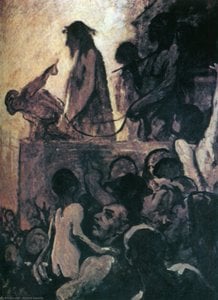
Nós queremos Barabbas (1852) é a pintura mais famosa de Honoré Daumier, guardada pelo Museum Folkwang em Essen. The Third-class Carriage (1860) e Unknown, maybe Hippolyte Lucien-Joseph Lucas (1807-1878), a Journalist, maybe P.Mendez de Vigo (1790-1860) a Spanish General, but Most Probably the Count Pelet de la Lozere (1785-1871), a Politician (1833) são as próximas duas obras que o mundo melhor conhece. Dos 355 trabalhos de Honoré Daumier em nosso catálogo, aqui estão os 100 que colecionadores e visitantes de museus mais observam, com o ano, o museu e a história de cada um.

Classificado de acordo com o nosso índice de popularidade, que combina buscas, visitas e pedidos de cada obra. Atualizado em Outubro 2026. Cada obra-prima nesta página pode ser encomendada como uma reprodução em óleo pintada à mão, com qualidade de museu, ou como uma impressão de fine art, no tamanho de sua escolha.

Retrato de Honoré Daumier
Honoré Daumier · 1808 – 1879
Nascimento · falecimento
1808 – 1879, Marselha
Movimento
Realism
Obras em nosso catálogo
355
Mais famosas
Nós queremos Barabbas (1852)
Mais obras em
Musée d'Orsay

Top 10: as pinturas mais conhecidas de Honoré Daumier

Nós queremos Barabbas (1852) de Honoré Daumier
1

Nós queremos Barabbas

1852 · Óleo sobre tela · Museum Folkwang, Essen

Uma Representação Poderosa do Sofrimento Humano e da Justiça Social Esta obra de arte envolvente captura uma cena bíblica pungente que ressoa profundamente com temas de compaixão, injustiça e crítica social. Renderizada em um estilo cru e expressivo, a cena convida os espectadores a um momento de emoção coletiva e reflexão moral. As figuras, retratadas com uma imediatez gestual, evocam um senso de urgência e vulnerabilidade humana, tornando-se um manifesto…

The Third-class Carriage (1860) de Honoré Daumier
2

The Third-class Carriage

1860 · Oil On Canvas · Metropolitan Museum of Art, Nova York

In the crowded, dimly lit confines of a mid-19th-century railway carriage, Honoré Daumier captures more than just a moment in transit; he captures the very essence of human endurance. The Third-class Carriage serves as a profound window into the burgeoning urban reality of France during the Second Empire. As the industrial revolution reshaped the landscape of Europe, Daumier turned his gaze away from the gilded salons of the aristocracy and…

Unknown, maybe Hippolyte Lucien-Joseph Lucas (1807-1878), a Journalist, maybe P.Mendez de Vigo (1790-1860) a Spanish General, but Most Probably the Count Pelet de la Lozere (1785-1871), a Politician (1833) de Honoré Daumier
3

Unknown, maybe Hippolyte Lucien-Joseph Lucas (1807-1878), a Journalist, maybe P.Mendez de Vigo (1790-1860) a Spanish General, but Most Probably the Count Pelet de la Lozere (1785-1871), a Politician

1833 · Clay / Terracotta · Musée d'Orsay, Paris

This evocative portrait captures more than just the likeness of an elderly gentleman; it arrests a moment in time, freezing the very essence of 19th-century Parisian intellectual life. The subject, whose identity is suggested by the possibilities of a journalist or politician, possesses a gaze that seems to look past the viewer, into some distant, weighty contemplation. Rendered with the unmistakable hand of Honoré Daumier, the piece transcends mere portraiture;…

Ratapoil (front view) (1850) de Honoré Daumier
4

Ratapoil (front view)

1850 · Bronze · Musée d'Orsay, Paris

Honoré Daumier's "Ratapoil (front view)," created around 1850, is more than just a bronze sculpture; it’s a potent distillation of 19th-century French social commentary and political critique. This arresting figure, rendered with remarkable dynamism and a touch of unsettling realism, offers a captivating window into the turbulent world of post-Revolutionary France – a world grappling with nascent democracy, imperial ambitions, and the pervasive inequalities of its society. The sculpture’s enduring…

Intermission at the Comédie Française (1858) de Honoré Daumier
5

Intermission at the Comédie Française

1858 · Watercolor · Museu Hermitage, São Petersburgo

Honoré Daumier's “Intermission at the Comédie Française,” painted in 1858, isn’t merely a depiction of an elderly gathering; it’s a meticulously crafted observation of a specific moment frozen in time – and brimming with unspoken commentary. The artwork immediately draws the viewer into a densely packed scene: rows upon rows of men, their faces etched with age and lined with contemplation, are absorbed in reading newspapers or pamphlets within the…

Ratapoil (1850) de Honoré Daumier
6

Ratapoil

1850 · Bronze · Staatliche Kunsthalle Karlsruhe, Karlsruhe

The photograph captures a pivotal moment – a frozen dance of energy and emotion rendered in the enduring medium of bronze. This exquisite reproduction offers an intimate encounter with "Ratapoil," a sculpture by the visionary artist Honoré Daumier, born in Marseille in 1808 and tragically lost in 1879. More than just a depiction of a figure, it’s a window into the social anxieties and artistic fervor that defined mid-19th century…

Scene from a Comedy (1858) de Honoré Daumier
8

Scene from a Comedy

1858 · Oil On Canvas · Musée d'Orsay, Paris

Honoré Daumier's "Scene from a Comedy," painted in 1858, isn’t merely a depiction of two figures; it’s a meticulously crafted snapshot of Parisian society and the biting social commentary that defined the artist’s career. Housed within the walls of the Musée d’Orsay, this oil on canvas offers a rare glimpse into Daumier's world – a world brimming with observation, critique, and an undeniable sense of humor laced with profound sadness.…

Ratapoil (1850) de Honoré Daumier
9

Ratapoil

1850 · Acrylic On Canvas · Artizon Museum, Tóquio

Honoré Daumier's "Ratapoil," created in 1850, isn’t merely a sculpture; it’s a distilled embodiment of the anxieties and frustrations simmering beneath the surface of mid-19th century France. This arresting figure, rendered in cast iron with a deliberate roughness that mirrors its subject matter, captures a moment of profound disillusionment – a silent indictment of societal hypocrisy and the precariousness of human existence. The sculpture’s power lies not just in its…

Family on the Barricades in 1848 (1854) de Honoré Daumier
10

Family on the Barricades in 1848

1854 · Oil · Galeria Nacional de Praga, Praga

In the heart of Honoré Daumier’s 1854 masterpiece, Family on the Barricades in 1848, we find a moment suspended in the amber of history. This is not merely a painting of a political uprising; it is a profound psychological study of human resilience. As the Second French Revolution tore through the streets of Paris, Daumier captured the very essence of the era's turbulent spirit. The scene presents a family huddled…

O restante do ranking de Honoré Daumier, de 11 a 100

O Colecionador de Gravuras (1865) de Honoré Daumier
#11

O Colecionador de Gravuras

1865 · Art Institute of Chicago

Honoré Daumier, em "O Colecionador de Impressões" (1865), nos apresenta uma cena que transcende a mera representação de um ambiente; é um retrato da introspecção, da solidão e…

Leve para casa →
The Republic (1848) de Honoré Daumier
#12

The Republic

1848 · Musée d'Orsay

Honoré Daumier’s “The Republic” (1848) isn't merely a painting; it’s a potent distillation of the anxieties and aspirations swirling within post-revolutionary France. Captured with his signature blend of…

Leve para casa →
Comedy scene (scene from Molière) (1862) de Honoré Daumier
#13

Comedy scene (scene from Molière)

1862 · Musée d'Orsay

Honoré Daumier's 1862 painting, "Comedy Scene (Scene from Molière)," isn’t merely a depiction of a theatrical moment; it’s a vibrant snapshot of Parisian society grappling with wit, social…

Leve para casa →
On a Bridge at Night (1848) de Honoré Daumier
#14

On a Bridge at Night

1848 · The Phillips Collection

The scene captures a moment of silent intimacy under the artificial glow of lamplight. Two figures move across a bridge, their forms defined by expressive, simplified outlines that…

Leve para casa →
Burden (1850) de Honoré Daumier
#16

Burden

1850 · Museu Hermitage

In the quiet, somber depths of Honoré Daumier’s 1850 masterpiece, "Burden," we are invited into a moment of profound human endurance that transcends the boundaries of time. The…

Encomendar uma reprodução →
Street Musicians (1855) de Honoré Daumier
#17

Street Musicians

1855 · Art Institute of Chicago

This expressive oil painting presents a somber scene, capturing two figures within an intimate, dimly lit environment. The composition utilizes a tight crop on the subjects, fostering a…

Encomende uma cópia pintada à mão →
The Studio (1870) de Honoré Daumier
#19

The Studio

1870 · J. Paul Getty Museum

In this intimate oil on canvas, a man leans toward a seated woman within a dimly lit interior. The composition is tightly cropped, creating a sense of enclosure…

Encomendar uma reprodução →
Jean-Marie Fruchard (1788-1872), Deputy (1833) de Honoré Daumier
#20

Jean-Marie Fruchard (1788-1872), Deputy

1833 · Musée d'Orsay

Honoré Daumier’s 1833 sculpture of Jean-Marie Fruchard, a deputy of the French parliament, functions as a sharp political indictment. Rather than an idealized likeness, the bust utilizes deliberate…

Load (Washerwoman) (1853) de Honoré Daumier
#21

Load (Washerwoman)

1853 · Galeria Nacional de Praga

In this 1853 lithograph, a woman moves through a Parisian street, her form defined by the heavy burden she carries. A large basket, filled to the brim with…

Leve para casa →
Two Lawyers (1860) de Honoré Daumier
#24

Two Lawyers

1860 · Art Institute of Chicago

This small-scale oil painting presents two men in profile, positioned side-by-side while facing one another. The subjects are captured from the upper torso upward, creating a close-up view…

Encomendar uma reprodução →
Outside the Print–Seller's Shop (1860) de Honoré Daumier
#25

Outside the Print–Seller's Shop

1860 · Dallas Museum of Art

This painting, titled Outside the Print–Seller's Shop, was created by the French artist Honoré Daumier. It offers a quiet glimpse into the social fabric of 19th-century France, capturing…

Leve para casa →
Exit from the Theater (1863) de Honoré Daumier
#26

Exit from the Theater

1863 · Nelson-Atkins Museum of Art

The work titled Exit from the Theater is an oil on panel. It is attributed to the artist Honoré Daumier. The painting captures a street scene of theater-goers…

Leve para casa →
The Uprising (L (1848) de Honoré Daumier
#28

The Uprising (L

1848 · The Phillips Collection

For Duncan Phillips, the jewel of his unit of works by Honoré Daumier was The Uprising. When this long forgotten painting appeared on the market, Phillips seized the…

Encomendar uma reprodução →
Penelopa's Dream (1842) de Honoré Daumier
#34

Penelopa's Dream

1842 · Biblioteca Nacional da França

Penelopa's Dream is a lithograph created by the artist Honoré Daumier. The work was produced in 1842. This specific piece belongs to the Ancient History series, a collection…

Leve para casa →
The Washerwoman (1863) de Honoré Daumier
#36

The Washerwoman

1863 · Musée d'Orsay

Honoré Daumier’s “The Washerwoman,” painted in 1863, is more than just a depiction of a woman laboring by the Seine; it's a poignant meditation on poverty, resilience, and…

Encomendar uma reprodução →
The Beautiful Narcissus (1842) de Honoré Daumier
#59

The Beautiful Narcissus

1842 · Biblioteca Nacional da França

Honoré Daumier’s lithograph, "The Beautiful Narcissus," transcends mere depiction; it embodies the spirit of Realism—a courageous confrontation with societal realities tempered by profound artistic sensitivity. Created in 1842…

Leve para casa →
Two Singers de Honoré Daumier
#66

Two Singers

Harvard Art Museums

In this oil painting, we find ourselves drawn into a quiet, private moment between two figures. A man and a woman are positioned closely together, their upper bodies…

Leve para casa →
The Serenade (1858) de Honoré Daumier
#69

The Serenade

1858 · Scottish National Gallery

The Serenade is a painting by Honoré Daumier, created about 1858. In this work, the artist captures a strolling player singing within the setting of a garden restaurant.…

Encomende uma cópia pintada à mão →
The Print Amateur (1855) de Honoré Daumier
#70

The Print Amateur

1855 · Harvard Art Museums

The Print Amateur is an oil on panel by Honoré Daumier. Created in France, this work captures a specific moment of observation. The pigment rests upon the hard,…

Leve para casa →
Jacques Lefévre (1777-1856), Banqueiro e Deputado (1833) de Honoré Daumier
#72

Jacques Lefévre (1777-1856), Banqueiro e Deputado

1833 · Musée d'Orsay

A obra “Jacques Lefévre (1777-1856), Banker and Deputy” de Honoré Daumier, criada em 1833, transcende a mera representação de um retrato. É uma pincelada audaciosa da sociedade francesa…

Head of Pasquin (1863) de Honoré Daumier
#76

Head of Pasquin

1863 · Dallas Museum of Art

Honoré Daumier’s “Head of Pasquin,” painted in 1863, is far more than a simple portrait; it's a potent distillation of social commentary and a masterful demonstration of the…

Encomende uma cópia pintada à mão →
Rue Transnonain, April 15, 1834 (1834) de Honoré Daumier
#79

Rue Transnonain, April 15, 1834

1834 · Biblioteca Nacional da França

Honoré Daumier's "Rue Transnonain, April 15, 1834" isn’t merely a depiction of an event; it’s a visceral scream frozen in lithograph ink. Published six months after the brutal…

Leve para casa →
Theater Audience (1856) de Honoré Daumier
#80

Theater Audience

1856 · Museu Nacional de Arte Ocidental

Theater Audience is an oil painting by the French artist Honoré Daumier. The work was created about 1856-60. Daumier was a male artist born in 1808 and he…

Encomendar uma reprodução →
Don Quixote Reading (1866) de Honoré Daumier
#81

Don Quixote Reading

1866 · National Museum Cardiff

In this oil on canvas, Honoré Daumier presents us with a quiet, intense moment of absorption. The work, titled Don Quixote Reading, captures the titular character lost within…

Leve para casa →
Avant l (1865) de Honoré Daumier
#84

Avant l

1865

Honoré Daumier’s “Avant l’audience” (Before the Hearing), painted in 1865, is a deceptively simple yet profoundly resonant work that captures a pivotal moment of restrained tension and intellectual…

Encomendar uma reprodução →
Don Quixote and Sancho Panza (1870) de Honoré Daumier
#90

Don Quixote and Sancho Panza

1870 · Courtauld Gallery

Don Quixote and Sancho Panza is an oil painting by the artist Honoré Daumier. Dated 1866, this work is categorized within the movements of Realism, Satire, and Narrative.…

Leve para casa →
The Reader de Honoré Daumier
#91

The Reader

The quiet intensity of The Reader meets the viewer through the focused gaze of its subject. Painted by Honoré Daumier, this work captures a moment of profound stillness.…

Encomendar uma reprodução →
Street Scene (1864) de Honoré Daumier
#92

Street Scene

1864 · Museum Boijmans Van Beuningen

The shadows of a mid-19th-century urban environment emerge through Street Scene, a work by the French painter Honoré Daumier. Created about 1864, this piece captures a fleeting moment…

Encomende uma cópia pintada à mão →
To the Street (1850) de Honoré Daumier
#97

To the Street

1850 · The Phillips Collection

In the evocative monochrome of Honoré Daumier’s To the Street, we are transported back to the mid-19th century, a period defined by the rapid pulse of urban transformation.…

Leve para casa →
Mother (1855) de Honoré Daumier
#100

Mother

1855 · Museu Nacional da Sérvia

Executed in 1855, Mother by Honoré Daumier presents a portrait of disquiet. This work functions as a genre painting, utilizing a depiction of a mother and child to…

Leve para casa →

Os temas que Honoré Daumier mais pintou

Os quatro temas que mais se repetem entre estas obras-primas, com o melhor exemplo de cada um.

Onde ver as pinturas de Honoré Daumier

Os 8 museus que detêm a maioria das pinturas desta página.

Museu Cidade Obras de Honoré Daumier Pinturas desta lista
Musée d'Orsay, ParisMusée d'Orsay Paris 33 Unknown, maybe Hippolyte Lucien-Joseph Lucas (1807-1878), a Journalist, maybe P.Mendez de Vigo (1790-1860) a Spanish General, but Most Probably the Count Pelet de la Lozere (1785-1871), a Politician, Ratapoil (front view), Ratapoil (rear view)
Burrell Collection, GlasgowBurrell Collection Glasgow 9 The Good Samaritan, Susannah and the Elders, The Miller, His Son and the Donkey
The Phillips Collection, Washington, D.C.The Phillips Collection Washington, D.C. 8 On a Bridge at Night, The Uprising (L, The Strong Man
Art Institute of Chicago, ChicagoArt Institute of Chicago Chicago 4 O Colecionador de Gravuras, Street Musicians, Two Lawyers
National Museum Cardiff, CardiffNational Museum Cardiff Cardiff 8 Head of a Man, A Third Class Carriage, Don Quixote Reading
Rhode Island School of Design Museum of Art, ProvidenceRhode Island School of Design Museum of Art Providence 4 Second-Class Carriage, Mme Pipelet, the Concierge, Au Palais de Justice (At the Law Courts)
Biblioteca Nacional da França, ParisBiblioteca Nacional da França Paris 3 Penelopa's Dream, The Beautiful Narcissus, Rue Transnonain, April 15, 1834
Harvard Art Museums, CambridgeHarvard Art Museums Cambridge 3 Scapin, Two Singers, The Print Amateur

Honoré Daumier através das décadas: uma obra-prima para cada uma

  1. 1830s
  2. 1840s
    The Republic (1848) de Honoré Daumier
    Posição 12 de 100

    The Republic

    Idade 32 – 41 · Musée d'Orsay

    Honoré Daumier’s “The Republic” (1848) isn't merely a painting; it’s a potent distillation of the anxieties and aspirations swirling within post-revolutionary France. Captured with his signature blend of…

  3. 1850s
    Nós queremos Barabbas (1852) de Honoré Daumier
    #1 de 100

    Nós queremos Barabbas

    Idade 42 – 51 · Museum Folkwang

    Uma Representação Poderosa do Sofrimento Humano e da Justiça Social Esta obra de arte envolvente captura uma cena bíblica pungente que ressoa profundamente com temas de compaixão, injustiça…

  4. 1860s
    The Third-class Carriage (1860) de Honoré Daumier
    Nº 2 de 100

    The Third-class Carriage

    Idade 52 – 61 · Metropolitan Museum of Art

    In the crowded, dimly lit confines of a mid-19th-century railway carriage, Honoré Daumier captures more than just a moment in transit; he captures the very essence of human…

  5. 1870s
    The Studio (1870) de Honoré Daumier
    #19 de 100

    The Studio

    Idade 62 – 71 · J. Paul Getty Museum

    In this intimate oil on canvas, a man leans toward a seated woman within a dimly lit interior. The composition is tightly cropped, creating a sense of enclosure…

Pinturas de Honoré Daumier: perguntas frequentes

Qual é a pintura mais famosa de Honoré Daumier?Mostrar a resposta

Nós queremos Barabbas (1852), Museum Folkwang, Essen. Seguem-se The Third-class Carriage (1860) e Unknown, maybe Hippolyte Lucien-Joseph Lucas (1807-1878), a Journalist, maybe P.Mendez de Vigo (1790-1860) a Spanish General, but Most Probably the Count Pelet de la Lozere (1785-1871), a Politician (1833).

Com que idade Honoré Daumier pintou Nós queremos Barabbas?Mostrar a resposta

44 anos: Nós queremos Barabbas data de 1852 e Honoré Daumier nasceu em 1808.

Quais são as 10 pinturas mais famosas de Honoré Daumier?Mostrar a resposta

Nós queremos Barabbas, The Third-class Carriage, Unknown, maybe Hippolyte Lucien-Joseph Lucas (1807-1878), a Journalist, maybe P.Mendez de Vigo (1790-1860) a Spanish General, but Most Probably the Count Pelet de la Lozere (1785-1871), a Politician, Ratapoil (front view), Intermission at the Comédie Française, Ratapoil, Ratapoil (rear view), Scene from a Comedy, Ratapoil e Family on the Barricades in 1848. O ranking acima apresenta o ano e o museu de cada uma.

Quantas pinturas de Honoré Daumier existem?Mostrar a resposta

Nosso catálogo lista 355 obras de Honoré Daumier, datadas de 1832 a 1870.

Onde posso ver as pinturas mais famosas de Honoré Daumier?Mostrar a resposta

A maioria deles está em Musée d'Orsay (Paris), Burrell Collection (Glasgow) e The Phillips Collection (Washington, D.C.). A tabela acima lista os museus um a um.

Em que período Honoré Daumier pintou as suas obras mais conhecidas?Mostrar a resposta

Em 1850s: 34 das 100 obras nesta página datam dessa época, entre elas Nós queremos Barabbas.

Qual é a pintura mais antiga e a mais recente de Honoré Daumier?Mostrar a resposta

A obra mais antiga nesta página é de Count Antoine-Maurice-Apollinaire d'Argout (1782-1858), Minister and Peer of France (1832), e a mais recente é de The Studio (1870).

Quais temas Honoré Daumier pintou?Mostrar a resposta

People (18), Satire (15) e Man (13), entre as 100 obras nesta página.

Sobre o que Honoré Daumier pintou e com o que?Mostrar a resposta

Oil On Canvas: 14 de um total de 100 obras nesta página.

A qual movimento pertence a arte de Honoré Daumier?Mostrar a resposta

Realism, como mostram as pinturas nesta página.

Quais pinturas de Honoré Daumier o Musée d'Orsay possui?Mostrar a resposta

Unknown, maybe Hippolyte Lucien-Joseph Lucas (1807-1878), a Journalist, maybe P.Mendez de Vigo (1790-1860) a Spanish General, but Most Probably the Count Pelet de la Lozere (1785-1871), a Politician, Ratapoil (front view) e Ratapoil (rear view) estão entre as 19 obras nesta página pertencentes ao Musée d'Orsay, Paris.

Onde posso comprar uma reprodução de Honoré Daumier?Mostrar a resposta

Sim. Todas as pinturas desta página podem ser encomendadas como uma reprodução em óleo pintada à mão com qualidade de museu ou como uma impressão de fine art, no tamanho de sua escolha, a partir da própria página da pintura.

Honoré Daumier: biografia

A Vida Esculpida em Sátira: O Mundo de Honoré Daumier

Nascido em Marselha em 1808, a jornada de Honoré-Victorin Daumier esteve intrinsecamente ligada às correntes turbulentas da França do século XIX. Sua vida inicial, marcada pelas ambições poéticas de seu pai e subsequente mudança para Paris em 1814, o imerso em uma cidade fervilhando com energia artística. Embora inicialmente destinado a uma carreira jurídica, a inclinação de Daumier se inclinou irrevogavelmente para as artes. Ele aprendeu com Alexandre Lenoir, absorvendo influências clássicas ao lado de uma apreciação pelo chiaroscuro dramático de Rubens, e aperfeiçoou ainda mais suas habilidades na Academia Suíça. Esse treinamento fundamental provaria crucial para moldar seu estilo distinto – uma combinação poderosa de realismo e draftsmanship expressiva. No entanto, não foi apenas a técnica artística que definiu Daumier; foi uma profunda sensibilidade às injustiças sociais e à absurdidade política ao seu redor.

A Caneta Afiada: Caricatura e Comentário Social

A carreira de Daumier ganhou verdadeiro ímpeto após a Revolução de 1830, um evento que alterou irreversivelmente o curso da história francesa e, simultaneamente, forneceu terreno fértil para seu talento satírico em ascensão. Ele rapidamente se estabeleceu como um mestre litógrafo, contribuindo inicialmente anonimamente para várias publicações antes de ganhar destaque por meio de seu trabalho com *Le Charivari*, uma revista cômica independente fundada por Charles Philipon. Foi aqui que o gênio de Daumier realmente floresceu. Suas caricaturas não eram meras representações humorísticas; eram denúncias mordazes da burguesia, do sistema legal e do establishment político. Ele ridicularizou sem piedade Luís-Philippe, ganhando uma prisão de seis meses em 1832 por uma caricatura particularmente mordaz. Essa experiência, longe de silenciá-lo, solidificou seu compromisso em expor a hipocrisia e desafiar a autoridade através da arte. Seus litografias se tornaram manifestos visuais, capturando o espírito da dissidência e oferecendo um comentário crítico sobre as desavenças sociais de sua época. O volume impressionante de sua produção durante esse período é notável – milhares de litografias que serviram tanto como entretenimento popular quanto como declarações políticas poderosas.

Além da Caricatura: Pintura e Visões Esculturais

Embora Daumier seja mais celebrado por sua litografia, limitar sua existência apenas a caricaturas seria um grave desrespeito. Ele também era um pintor e escultor dedicado, embora o reconhecimento para esses trabalhos tenha chegado mais tarde em sua vida. Suas pinturas, frequentemente retratando cenas da vida cotidiana parisiense – o vagão de terceira classe, as lavadeiras, os advogados – estão imbuídas de um profundo senso de realismo e empatia. Eles não são representações idealizadas, mas sim descrições sem compromisso de dificuldades e lutas. Ele empregou habilmente pinceladas soltas e iluminação dramática para transmitir emoção e atmosfera, prenunciando algumas das técnicas mais tarde adotadas pelos Impressionistas. Seu trabalho escultórico, em grande parte criado em argila (muitos pedaços permanecendo não cozidos durante sua vida), revela um compromisso semelhante em capturar a forma humana com honestidade e profundidade emocional. Essas esculturas, redescobertas após sua morte, demonstram um talento notável para modelagem e uma capacidade de transmitir complexidade psicológica através da postura física.

Um Legado Duradouro: Influência e Significado Histórico

O impacto de Honoré Daumier na história da arte é inegável. Ele preencheu a lacuna entre o Romantismo e o Realismo, abrindo caminho para as gerações futuras de artistas que buscavam retratar o mundo como ele realmente era – com todas as suas imperfeições. Seu comentário social implacável influenciou artistas como Gustave Courbet e Édouard Manet, enquanto seu uso inovador da litografia revolucionou a gravura. Sua obra continua a ressoar hoje, nos lembrando do poder da arte para desafiar a autoridade, expor a injustiça e testemunhar a condição humana. O Musée d'Orsay em Paris abriga uma coleção significativa de suas pinturas e esculturas, oferecendo aos visitantes um vislumbre do mundo que ele retratou tão vívidamente. Suas litografias estão amplamente acessíveis por meio de coleções como as encontradas em WahooArt, garantindo que seu gênio satírico continue a provocar o pensamento e inspirar o diálogo. Daumier não era apenas um artista; ele era um cronista de sua época – um poeta visual que usou seu talento para dar voz aos marginalizados e responsabilizar o poder. Seu legado perdura como um testemunho da relevância duradoura da arte como força para a mudança social.

Informações Adicionais

  • Artistas Influenciados: Alexandre Lenoir, Jacques-Louis David
  • Período Artístico: Romantismo, Realismo
  • Técnicas Principais: Litografia, Pintura a óleo, Escultura em argila
  • Temas Recorrentes: A vida cotidiana parisiense, a pobreza, a hipocrisia social, a crítica política

Curiosidades

  • Daumier foi preso por sua caricatura de Luís-Philippe.
  • Sua obra influenciou artistas como Courbet e Manet.
  • Muitas de suas esculturas permaneceram inacabadas durante sua vida.

Ligações Externas

Todas as 355 obras de Honoré Daumier →