

Saint Louis Forgiving Pierre de Bretagne (1817) é a pintura mais famosa de Georges Rouget, guardada pelo Musée des Beaux-Arts de Quimper em Quimper. Sketch for the church Saint Gervais "Ecce Homo" (1819) e Jean-Nicolas Houchard (1835) são as próximas duas obras que o mundo melhor conhece. Dos 39 trabalhos de Georges Rouget em nosso catálogo, aqui estão os 39 que colecionadores e visitantes de museus mais observam, com o ano, o museu e a história de cada um.
Classificado de acordo com o nosso índice de popularidade, que combina buscas, visitas e pedidos de cada obra. Atualizado em Outubro 2026. Cada obra-prima nesta página pode ser encomendada como uma reprodução em óleo pintada à mão, com qualidade de museu, ou como uma impressão de fine art, no tamanho de sua escolha.


A middle-aged man sits in a moment of profound stillness, his gaze drifting toward the upper right as if caught by a sudden, unspoken thought. He is draped in the heavy, dark navy blue of a jacket that absorbs the light, contrasting sharply against the crisp, creamy white of his cravat. The light strikes the left side of his face with a deliberate intensity, sculpting the sharp lines of his…


The canvas before you presents not merely a likeness, but an embodiment of the 19th century’s fascination with portraiture – a meticulously rendered study in dignity and quiet authority. Painted by Georges Rouget between 1803 and 1857, this depiction of Jean Pierre Thenot is more than just a representation; it's a window into a specific moment in French history, imbued with the formal elegance and restrained emotion characteristic of his…


Georges Rouget's "Mesdemoiselles Mollien," painted in 1811, is more than just a portrait; it’s a window into the refined world of early 19th-century French society and a testament…
Encomendar uma reprodução →
Georges Rouget (1783-1869) permanece um testemunho do fervor artístico do início do século XIX, especificamente durante o reinado de Napoleão. Não era uma figura famosa como David ou…
Encomende uma cópia pintada à mão →
This striking portrait depicts Emmanuel de Grouchy, Colonel du 2e Dragon in 1792. Painted by Georges Rouget, a neoclassical French painter known for his historical scenes and association…
Encomendar uma reprodução →Os quatro temas que mais se repetem entre estas obras-primas, com o melhor exemplo de cada um.
Os 8 museus que detêm a maioria das pinturas desta página.
| Museu | Cidade | Obras de Georges Rouget | Pinturas desta lista |
|---|---|---|---|
 Opera House |
Versailles | 6 | Achille Alexandre Alphonse, Viscount de Cailleux (1788-1876), Director of the Musées royaux, ALEXANDRE FRANCOIS MARIE, VICOMTE DE BEAUHARNAIS, GENERAL EN CHEF DE L'ARMEE DU RHIN (1760 1794), VICTOR GUY BARON DUPERRE, MATELOT EN 1792 (1775 1846) |
 Museu do Louvre |
Paris | 2 | JEAN PIERRE THENOT (1803 1857), MESDEMOISELLES MOLLIEN |
 Musée des Beaux-Arts de Quimper |
Quimper | 1 | Saint Louis Forgiving Pierre de Bretagne |
 Petit Palais |
Paris | 1 | Sketch for the church Saint Gervais "Ecce Homo" |
 Musée de l'Armée |
Paris | 1 | Jean-Nicolas Houchard |
 Bavarian State Painting Collections |
Munique | 1 | Jacques-Louis David |
 Musée Fesch |
Aix-en-Provence | 1 | The King of Rome in the Tuileries Garden |
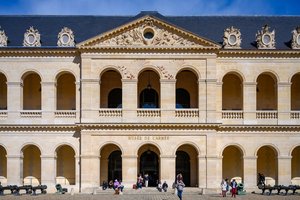 Ministère de la Défense Nationale |
Paris | 1 | FRANCOIS CHASSELOUP LAUBAT, GÉNÉRAL DE DIVISION |


Saint Louis Forgiving Pierre de Bretagne (1817), Musée des Beaux-Arts de Quimper, Quimper. Seguem-se Sketch for the church Saint Gervais "Ecce Homo" (1819) e Jean-Nicolas Houchard (1835).
34 anos: Saint Louis Forgiving Pierre de Bretagne data de 1817 e Georges Rouget nasceu em 1783.
Saint Louis Forgiving Pierre de Bretagne, Sketch for the church Saint Gervais "Ecce Homo", Jean-Nicolas Houchard, Jacques-Louis David, Achille Alexandre Alphonse, Viscount de Cailleux (1788-1876), Director of the Musées royaux, The King of Rome in the Tuileries Garden, JEAN PIERRE THENOT (1803 1857), DEBARQUEMENT DE SAINT LOUIS EN EGYPTE.4 JUIN 1249, ALEXANDRE FRANCOIS MARIE, VICOMTE DE BEAUHARNAIS, GENERAL EN CHEF DE L'ARMEE DU RHIN (1760 1794) e FRANCOIS CHRISTOPHE KELLERMAN, GENERAL EN CHEF DE L'ARMEE DE LA MOSELLE EN 1792 (1735 1820). O ranking acima apresenta o ano e o museu de cada uma.
Nosso catálogo lista 39 obras de Georges Rouget, datadas de 1817 a 1850.
A maioria deles está em Opera House (Versailles), Museu do Louvre (Paris) e Musée des Beaux-Arts de Quimper (Quimper). A tabela acima lista os museus um a um.
Em 1810s: 2 das 39 obras nesta página datam dessa época, entre elas Saint Louis Forgiving Pierre de Bretagne.
A obra mais antiga nesta página é de Saint Louis Forgiving Pierre de Bretagne (1817), e a mais recente é de The King of Rome in the Tuileries Garden (1850).
Portrait (4), Dignified (3) e Formal (2), entre as 39 obras nesta página.
Oil On Canvas: 3 de um total de 39 obras nesta página.
Neoclassicism, como mostram as pinturas nesta página.
Achille Alexandre Alphonse, Viscount de Cailleux (1788-1876), Director of the Musées royaux, ALEXANDRE FRANCOIS MARIE, VICOMTE DE BEAUHARNAIS, GENERAL EN CHEF DE L'ARMEE DU RHIN (1760 1794) e VICTOR GUY BARON DUPERRE, MATELOT EN 1792 (1775 1846) estão entre as 6 obras nesta página pertencentes ao Opera House, Versailles.
Sim. Todas as pinturas desta página podem ser encomendadas como uma reprodução em óleo pintada à mão com qualidade de museu ou como uma impressão de fine art, no tamanho de sua escolha, a partir da própria página da pintura.

