Georges Braque, 1882 – 1963

Georges Braque: The 100 Most Famous Paintings

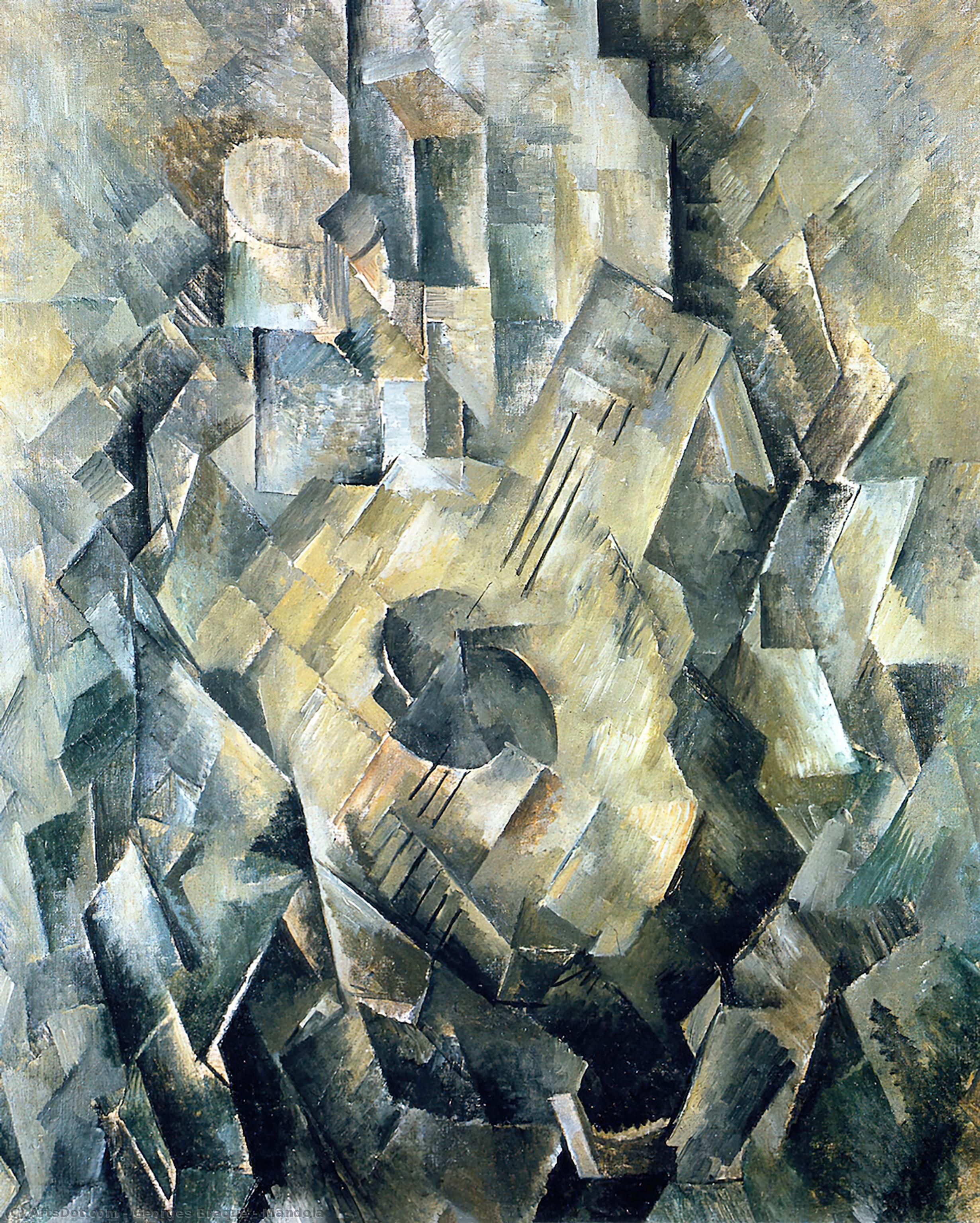
Mandola (1910) is the most famous painting by Georges Braque, held by the Tate Gallery in Londres. Homem com um Violino (1914) and Casas À Estaque are the next two works the world knows best. From the 700 works of Georges Braque in our catalogue, here are the 100 that collectors and museum visitors look at most, with the year, the museum and the story of each.

Ranked by our popularity score, which combines the searches, visits and orders for each work. Updated Outubro 2026.

Portrait of Georges Braque
Georges Braque · 1882 – 1963
Born · died
1882 – 1963, Argenteuil
Movement
Cubismo
Works in our catalogue
700
Most famous
Mandola (1910)
Most works at
The Phillips Collection

Top 10: Georges Braque's best-known paintings

Mandola (1910) by Georges Braque
1

Mandola

1910 · Óleo sobre tela · Tate Gallery, Londres

Uma Pedra Angular do Cubismo Analítico Georges Braque’s “Mandola,” pintado em 1910, permanece uma obra fundamental no desenvolvimento do Cubismo Analítico – um estilo revolucionário que desafiou as convenções tradicionais da arte. Esta pintura a óleo sobre tela (71 x 56 cm) não é apenas uma representação de um instrumento musical; é uma profunda exploração da forma, percepção e o próprio ato de ver. Em vez de apresentar uma imagem…

Homem com um Violino (1914) by Georges Braque
2

Homem com um Violino

1914 · Óleo sobre tela

A obra “Man with a Guitar” de Georges Braque, criada em 1914, transcende a mera representação de um músico; ela é uma profunda investigação sobre a forma, o espaço e a percepção, meticulosamente construída com a precisão intelectual que marcou o início do século XX. Mais do que um retrato, esta pintura é um convite à contemplação, um desafio à nossa maneira habitual de ver o mundo. A escolha deliberada…

Casas À Estaque by Georges Braque
3

Casas À Estaque

Óleo sobre tela

Uma Obra-Prima do Proto-Cubismo: Casas At L’Estaque, de Georges Braque Tema e Composição "Casas At L’Estaque", de Georges Braque, é uma exploração cativante da vila costeira de L'Estaque, renderizada em um estilo proto-cubista revolucionário. Esta paisagem captura a essência do campo mediterrâneo com suas casas distintas e arredores naturais. A composição é dinâmica e fragmentada, apresentando formas geométricas sobrepostas que desafiam a perspectiva tradicional, ao mesmo tempo em que mantêm…

Harbor em Normandia (1909) by Georges Braque
4

Harbor em Normandia

1909 · Óleo sobre tela · Art Institute of Chicago, Chicago

The painting exemplifies Braque's transition from Fauvism to Cubism, characterized by its emphasis on geometric abstraction and multiple perspectives. The Société des Artistes Indépendants, where Braque exhibited his works, played a crucial role in promoting avant-garde art.

Mulher Lendo (1911) by Georges Braque
5

Mulher Lendo

1911 · Óleo sobre tela

Uma Obra-Prima da Inovação Cubista A obra "Mulher Lendo" (1911), de Georges Braque, é um exemplo cativante do início do Cubismo, um movimento revolucionário que transformou o mundo da arte. Esta composição intrincada demonstra a maestria de Braque sobre a forma e a perspectiva, convidando os espectadores a explorar a beleza fragmentada da vida moderna. Tema e Composição A obra retrata uma mulher absorta na leitura, embora sua figura seja…

Violino e Paleta (1910) by Georges Braque
6

Violino e Paleta

1910 · Óleo sobre tela · Solomon R. Guggenheim Museum, Nova York

Explorando o Tema e a ComposiçãoEsta obra cativante apresenta uma cena dinâmica de natureza-morta, provavelmente apresentando instrumentos musicais como um violino e uma paleta, organizados de uma maneira fragmentada e abstrata. A composição convida os espectadores a explorar um jogo de formas em camadas, onde objetos familiares são desconstruídos em facetas geométricas. O tema celebra a criação artística e musical, simbolizando harmonia, criatividade e a interconexão dos elementos artísticos. Sua…

O Músico (1918) by Georges Braque
7

O Músico

1918 · Óleo sobre tela

Em 1918, no coração da turbulência pós-Primeira Guerra Mundial, Georges Braque entregou ao mundo “O Músico”, uma obra que transcende a mera representação visual para se tornar um manifesto de emoção e inovação. Esta pintura não é apenas um retrato de um homem tocando o violoncelo; é uma investigação profunda sobre a natureza da percepção, a fragmentação da realidade e a busca por novas formas de expressão artística. A obra,…

O Dueto (Le Duo) (1937) by Georges Braque
8

O Dueto (Le Duo)

1937 · Óleo sobre tela · Centre Pompidou, Paris

Uma Sinfonia de Geometria e Graça Na quietude de 1937, Georges Braque capturou mais do que apenas um momento musical; ele capturou a própria essência de um diálogo harmonioso. The Duet (Le Duo) convida o espectador para um santuário íntimo, onde duas figuras se entrelaçam com o pulso rítmico de um piano. À primeira vista, a cena surge como uma vinheta terna de companheirismo, mas sob esta superfície reside o…

Mulher com um Violão (1913) by Georges Braque
9

Mulher com um Violão

1913 · Acrílico sobre tela

Uma Fusão Revolucionária: Explorando a "Mulher com um Violão" de Braque (1913) A obra "Mulher com um Violão" de Georges Braque, pintada em 1913, ergue-se como um trabalho fundamental que faz a ponte entre a energia vibrante do Fauvismo e as inovações disruptivas do Cubismo. Esta não é meramente a representação de uma musicista; é uma desconstrução radical da forma e da percepção que alterou irrevocavelmente o curso da arte…

Heracles by Georges Braque
10

Heracles

Lithograph

The Deconstruction of Heroism In the dawn of the twentieth century, Georges Braque embarked on a visual revolution that would forever alter the trajectory of modern art. His work, Heracles, stands as a profound testament to this era of radical reimagining. Executed around 1910, this monochrome lithograph does not merely recount the legendary exploits of the Greek hero; instead, it embodies the very essence of Cubism’s departure from traditional representation.…

The rest of the Georges Braque ranking, 11 to 100

Casas em L'Estaque, Kunstmuseum Bern (1908) by Georges Braque
#11

Casas em L'Estaque, Kunstmuseum Bern

1908

Nas colinas tranquilas da Provença, onde a brisa do Mediterrâneo encontra o terreno acidentado de L’Estaque, Georges Braque capturou mais do que apenas uma paisagem; ele capturou o…

Violin and candlestick (1910) by Georges Braque
#12

Violin and candlestick

1910

Georges Braque's "Violin and Candlestick," painted in 1910, isn’t merely a depiction of objects; it’s an architectural exploration of perception itself. This pivotal work, rendered in the heart…

O Golfo, Les Lecques (1906) by Georges Braque
#13

O Golfo, Les Lecques

1906 · Centre Pompidou

Nos anais da arte moderna, poucos momentos capturam a energia bruta e desenfreada de uma revolução estilística como O Golfo, Les Lecques, de Georges Braque. Pintada em 1906,…

Guitar and Sheet Music (1919) by Georges Braque
#14

Guitar and Sheet Music

1919

In the quiet revolution of early 20th-century modernism, few works capture the delicate tension between structure and soul as poignantly as Georges Braque’s “Guitar and Sheet Music.” Painted…

Viaduct at L_Estaque (1908) by Georges Braque
#15

Viaduct at L_Estaque

1908

In the sun-drenched landscapes of southern France, a revolution was quietly brewing, captured forever in the vibrant strokes of Georges Braque’s Viaduct at L’Estaque. Painted during a pivotal…

Homem com um Violão (1911) by Georges Braque
#16

Homem com um Violão

1911 · MoMA - Museu de Arte Moderna

A obra “Homem com um Violão”, de Georges Braque, concluída em 1914, ergue-se como um pilar fundamental do Cubismo Analítico — um movimento que alterou irrevocavelmente o curso…

Still-life with Guitar (Still-life with Mandolin) (1912) by Georges Braque
#17

Still-life with Guitar (Still-life with Mandolin)

1912 · Museo del Novecento

Georges Braque's "Still Life with Guitar (Still-life with Mandolin)," painted in 1912, is more than just a depiction of musical instruments; it’s a pivotal snapshot of the burgeoning…

Still life with harp and violin (1911) by Georges Braque
#18

Still life with harp and violin

1911

To gaze upon Georges Braque’s Still Life with Harp and Violin is to witness the very moment the mirror of traditional art was shattered and reassembled into something…

Fox by Georges Braque
#19

Fox

In the quiet, monochromatic depths of Georges Braque’s Fox, we encounter a profound moment in the evolution of modern vision. Created in 1911 and published the following year,…

Violin and pitcher, Kunstmuseum Basel (1910) by Georges Braque
#20

Violin and pitcher, Kunstmuseum Basel

1910

In the quiet halls of the Kunstmuseum Basel, a profound dialogue between light and shadow unfolds within Georges Braque’s 1910 masterpiece, Violin and Pitcher. To gaze upon this…

The Clarinet Valse (1912) by Georges Braque
#21

The Clarinet Valse

1912

To gaze upon Georges Braque’s 1912 masterpiece, The Clarinet Valse, is to step into a world where the boundaries between sound and sight begin to dissolve. This is…

Natureza-morta com harpa e violino (1912) by Georges Braque
#22

Natureza-morta com harpa e violino

1912

Uma Visão Fragmentada da Vida Moderna A obra Natureza-morta com harpa e violino, de Georges Braque, pintada em 1912, é um trabalho fundamental que exemplifica o auge do…

Large nude (1908) by Georges Braque
#23

Large nude

1908

A Glimpse into Early Modern Sensuality: Georges Braque’s *Large Nude* (1908) This captivating painting by Georges Braque, created in 1908, offers a compelling window into the artistic ferment…

Still-Life Le Jour (1929) by Georges Braque
#24

Still-Life Le Jour

1929

Georges Braque’s “Still Life Le Jour,” painted in 1929, stands as a cornerstone of Fauvist art—a movement that irrevocably altered the course of twentieth-century painting. More than just…

O Metrônomo (1909) by Georges Braque
#25

O Metrônomo

1909 · Statens Museum For Kunst

O metrônomo repousa no canto superior esquerdo, um peso piramidal de ocre e siena. Sua caixa de madeira é fragmentada em facetas trapezoidais que se sobrepõem às bordas…

Bottle, Glass, and Newspaper (1914) by Georges Braque
#26

Bottle, Glass, and Newspaper

1914

In Georges Braque’s 1914 masterpiece, Bottle, Glass, and Newspaper, the boundaries between reality and representation dissolve into a captivating visual conversation. This work is not merely a depiction…

Plums, Pears, Nuts and Knife (1926) by Georges Braque
#27

Plums, Pears, Nuts and Knife

1926 · The Phillips Collection

In this 1926 oil on canvas, we find a composition that feels remarkably intimate, as if we have just stepped into a private moment of stillness. The subject…

L'Estaque (1906) by Georges Braque
#28

L'Estaque

1906

In the sun-drenched landscape of 1906, Georges Braque captured something far more profound than a mere Mediterranean vista; he captured the very moment art began to break free…

Bottle and Fishes (1910) by Georges Braque
#29

Bottle and Fishes

1910

In the quiet revolution of early twentieth-century modernism, few works capture the intellectual tension between reality and perception as poignantly as Georges Braque’s “Bottle and Fishes.” Executed around…

Still Life with Guitar (1935) by Georges Braque
#30

Still Life with Guitar

1935

In the quietude of 1935, Georges Braque captured a moment of profound stillness that transcends the simple arrangement of domestic objects. Still Life with Guitar is not merely…

Still Life with Grapes (1918) by Georges Braque
#31

Still Life with Grapes

1918

A Fragmented Reflection of Modernity In 1918, as the world emerged from the profound shadows of the Great War, Georges Braque was busy redefining the very essence of…

Dois Pássaros (1955) by Georges Braque
#32

Dois Pássaros

1955 · Tel Aviv Museum of Art

“Dois Pássaros”, de Georges Braque, concluída em 1955, não é meramente uma representação de formas aviárias; é a essência destilada da revolução artística que fervilhava na França entre…

Fruitdish and Glass (1912) by Georges Braque
#33

Fruitdish and Glass

1912

Georges Braque’s Fruitdish and Glass stands as a pivotal work in the history of art, marking a significant milestone in the development of Cubism. Created in 1912, this…

Still Life: The Table (1928) by Georges Braque
#34

Still Life: The Table

1928

Georges Braque’s “Still Life: The Table,” painted in 1928, isn't merely a depiction of objects; it’s an invitation into a carefully constructed world of fragmented perception and deliberate…

Portrait of a Woman (1911) by Georges Braque
#35

Portrait of a Woman

1911

In the annals of modern art, few moments are as transformative as the birth of Cubism, and few works capture this seismic shift with such intimate grace as…

Still Life with a Guitar (1919) by Georges Braque
#36

Still Life with a Guitar

1919

Georges Braque's "Still Life with a Guitar," painted in 1919, isn’t merely a depiction of objects; it’s a profound exploration of perception and the very nature of representation.…

Fruit Dish, Ace of Clubs (1913) by Georges Braque
#37

Fruit Dish, Ace of Clubs

1913

A Cubist Still Life: Deconstructing Reality in Braque’s ‘Fruit Dish, Ace of Clubs’ Georges Braque's *Fruit Dish, Ace of Clubs*, painted in 1913, is a quintessential example of…

Leaves in color of light (1953) by Georges Braque
#38

Leaves in color of light

1953

A Symphony of Verdant Light To gaze upon Georges Braque’s Leaves, Color, Light is to step into a quiet sanctuary of color and form. Created during the artist's…

Portuguese (1911) by Georges Braque
#39

Portuguese

1911

In the quiet, fractured landscape of 1911, Georges Braque achieved something far more profound than a mere depiction of a musician; he captured the very vibration of sound…

Persephone by Georges Braque
#40

Persephone

The Fragmented Echo of Myth In the quiet, striking depths of Georges Braque’s Persephone, we encounter more than just a depiction of a Greek deity; we witness the…

Landscape by Georges Braque
#41

Landscape

A Pivotal Moment in Modernity In 1906, the tranquil hills of L’Estaque became the stage for a quiet revolution that would forever alter the trajectory of Western art.…

At Sunset, Bird XVI (1958) by Georges Braque
#42

At Sunset, Bird XVI

1958

In the quiet, evocative depths of Georges Braque’s "At Sunset, Bird XVI," we encounter a moment where the boundaries between the physical world and abstract emotion begin to…

O Copo das Lílias by Georges Braque
#43

O Copo das Lílias

O Copo das Lisias: Uma Meditação Cubista sobre uma Natureza-Morta A obra “O Copo das Lisias” de Georges Braque, pintada em 1912, não é meramente uma representação de…

Nature Morte (1926) by Georges Braque
#44

Nature Morte

1926 · Art Gallery of Hamilton

Georges Braque’s “Nature Morte,” painted in 1926, stands as a cornerstone of Cubist exploration and a testament to the artist's profound engagement with visual perception. More than just…

Dead nature by Georges Braque
#45

Dead nature

To gaze upon Georges Braque’s “Dead Nature” is to witness a profound moment of stillness within the turbulent currents of modern art history. Created in 1930, this work…

Still Life on a Table Gillette (1914) by Georges Braque
#48

Still Life on a Table Gillette

1914

Georges Braque’s Still Life on a Table Gillette: A Fragmented Reflection of Modern Consciousness Still Life on a Table Gillette by Georges Braque stands as a cornerstone of…

Portrait of a woman 1 by Georges Braque
#49

Portrait of a woman 1

To stand before Georges Braque’s "Portrait of a Woman 1" is to witness the very moment the mirror of traditional art was shattered and reassembled into something far…

Big Nude (1908) by Georges Braque
#50

Big Nude

1908

In the annals of modern art, few moments are as transformative as the birth of Cubism, and few works capture this seismic shift as viscerally as Georges Braque’s…

Still Life with a Violin (1911) by Georges Braque
#51

Still Life with a Violin

1911

To gaze upon Georges Braque’s “Still Life with a Violin,” painted in the transformative year of 1911, is to witness the very moment the mirror of traditional art…

Factory of Rio Tinto in the L'estanque by Georges Braque
#52

Factory of Rio Tinto in the L'estanque

To gaze upon Georges Braque’s Factory of Rio Tinto in the L'estanque is to witness the very moment the mirror of traditional art was shattered and reassembled into…

Ceiling: The Birds (1953) by Georges Braque
#53

Ceiling: The Birds

1953

High above the floor of the Salle Henri II in the Louvre, a monumental vision unfolds within an oval frame. The air feels thick with the weight of…

Seated woman 1 by Georges Braque
#54

Seated woman 1

The studio overlooks the Normandy coast, yet the view is broken into shards. A woman sits at her easel, her form caught in a web of grey planes…

Guitar ''Program statue d'epouvante'' (1913) by Georges Braque
#55

Guitar ''Program statue d'epouvante''

1913

A Cubist Still Life: Deconstructing Form in Braque’s ‘Guitar ''Program statue d'epouvante''’ Georges Braque’s *Guitar ''Program statue d'epouvante''* (1913) is a pivotal example of Analytical Cubism, showcasing the…

Limões, Pêssegos e Compotier (1927) by Georges Braque
#56

Limões, Pêssegos e Compotier

1927 · The Phillips Collection

A luz captura a borda de uma fruteira, revelando um mundo onde os objetos existem em um estado de fragmentação silenciosa. Nesta composição de 1927, limões, pêssegos e…

Ceiling: The Birds (1953) by Georges Braque
#58

Ceiling: The Birds

1953

To stand beneath this oval expanse is to witness a moment where the heavy weight of architecture dissolves into something far more fluid. Created between 1952 and 1953,…

Estudo para o teto do Louvre by Georges Braque
#59

Estudo para o teto do Louvre

O “Estudo para o teto do Louvre” de Georges Braque, uma exploração cativante de formas aviárias e maravilhas celestiais, transcende a mera representação para se tornar uma profunda…

Churth at Carrieres Saint-Denis (1909) by Georges Braque
#60

Churth at Carrieres Saint-Denis

1909

The painting is a depiction of a village with buildings and stairs. The scene features a muted palette dominated by earthy tones—greens, yellows, and browns—creating an atmosphere of…

The Round Table (1929) by Georges Braque
#61

The Round Table

1929

Georges Braque’s “The Round Table”: A Dialogue Between Tradition and Innovation Subject Matter and Composition: Cubist Style and Technique: Historical Context – The Birth of Cubism: Symbolic Resonance…

Glass, Pipe and Playing Cards (1918) by Georges Braque
#62

Glass, Pipe and Playing Cards

1918 · Des Moines Art Center

A Study in Fragmented Reality Glass, Pipe and Playing Cards presents us with a quiet, intellectual puzzle. At first glance, one might see only the remnants of a…

Landscape at L'Estaque (1907) by Georges Braque
#63

Landscape at L'Estaque

1907

In the annals of modern art, few moments capture the raw, unbridled energy of a revolution quite like Georges Braque’s Landscape at L'Estaque. Painted in 1907, this oil…

Yellow Seacoast by Georges Braque
#64

Yellow Seacoast

In the quiet evolution of modern art, few works capture the delicate balance between structural revolution and serene observation as masterfully as Georges Braque’s Yellow Seacoast. This evocative…

Pedestal Table (1913) by Georges Braque
#66

Pedestal Table

1913

The painting Pedestal Table is a collage that presents a seemingly chaotic arrangement of various objects. Within the composition, a vase is positioned in the middle of the…

Still Life with Grapes and Clarinet (1927) by Georges Braque
#67

Still Life with Grapes and Clarinet

1927 · The Phillips Collection

The eye wanders across a surface where wood grain and marble appear to ripple through layers of oil paint. A clarinet rests within this arrangement, its dark, slender…

Woman with a Mandolin (1910) by Georges Braque
#68

Woman with a Mandolin

1910

In the quiet revolution of early twentieth-century modernism, few works capture the seismic shift in human perception as profoundly as Georges Braque’s Woman with a Mandolin. Created in…

Cartas e Dados (1914) by Georges Braque
#69

Cartas e Dados

1914 · Museo Nacional Centro de Arte Reina Sofía

A pintura a óleo sobre tela Cartas e Dados apresenta uma composição contida dentro de uma forma oval, situada contra um fundo retangular escuro marcado por estriações verticais.…

White Bird by Georges Braque
#70

White Bird

In the vast landscape of early twentieth-century modernism, few works possess the quiet, arresting power of Georges Braque’s “White Bird.” To gaze upon this piece is to witness…

Port of La Ciotat (1907) by Georges Braque
#71

Port of La Ciotat

1907

A Harbor in Fragments The water at La Ciotat holds a heavy, fractured light. In this 1907 scene, sailboats and yachts drift through a landscape broken into geometric…

Tithonos by Georges Braque
#72

Tithonos

In the quiet evolution of modernism, few moments are as profound as the emergence of Analytical Cubism, and few works capture this seismic shift with such poetic restraint…

Bottle (1914) by Georges Braque
#73

Bottle

1914

In this 1914 work, we find ourselves looking at a scene that has been carefully dismantled and reassembled. The composition centers on a bowl and various bottles, yet…

Still Life with a Pair of Banderillas (1911) by Georges Braque
#74

Still Life with a Pair of Banderillas

1911

In this 1911 oil on canvas, the surface is occupied by a collection of everyday items arranged upon a dining table and near a chair. Two banderillas, used…

A Table Grise by Georges Braque
#75

A Table Grise

A Window Into Cubist Still Life: Georges Braque’s “A Table Grise” Georges Braque's "A Table Grise" (1930) isn’t merely a depiction of an arrangement; it’s a carefully constructed…

Violin and Glass (1913) by Georges Braque
#76

Violin and Glass

1913 · Kunstmuseum Basel

In this 1913 composition, we find ourselves observing a quiet arrangement of everyday objects that have been carefully deconstructed. A violin rests upon a wooden bow, positioned near…

Nature Morte a la Guitare (1938) by Georges Braque
#77

Nature Morte a la Guitare

1938

The scene unfolds through a fractured lens, where the boundaries between objects and space dissolve into a rhythmic dance of planes. A guitar neck and body emerge from…

Saint-Pol Roux by Georges Braque
#78

Saint-Pol Roux

The composition is defined by a stark, graphic tension between deep black silhouettes and a cream-colored ground. A profile face, rendered as a solid dark form, is integrated…

The Violin Valse (1913) by Georges Braque
#79

The Violin Valse

1913

Created in 1913, The Violin Valse is a still life painting that utilizes charcoal, oil, and canvas. The artwork features the contour of a violin, including its f-holes…

Viaduct At L'estaque. Le Viadue De L'estaque by Georges Braque
#80

Viaduct At L'estaque. Le Viadue De L'estaque

Georges Braque’s “Viaduct At L’Estaque,” painted in 1907, stands as a pivotal moment in the burgeoning Cubist movement—a bold assertion of artistic innovation that simultaneously honors and departs…

untitled by Georges Braque
#81

untitled

In the quiet revolution that redefined the boundaries of modern vision, Georges Braque’s “untitled (7718)” emerges as a profound meditation on the nature of sight itself. This seminal…

untitled (928) by Georges Braque
#83

untitled (928)

In the realm of modern art, few moments are as profoundly transformative as the birth of Cubism, and Georges Braque’s “untitled (928)” stands as a breathtaking testament to…

The Painter and His Model (1939) by Georges Braque
#84

The Painter and His Model

1939

In the quiet, contemplative atmosphere of 1939, Georges Braque captured more than just a moment in time; he captured the very essence of perception itself. The Painter and…

embattled head by Georges Braque
#85

embattled head

In the quiet intensity of Georges Braque’s embattled head, we encounter a profound meditation on the human condition, captured through the radical lens of Cubist innovation. Executed in…

Pitchet, Glass And Lemons by Georges Braque
#86

Pitchet, Glass And Lemons

Georges Braque’s 1942 painting, “Pitchet, Glass and Lemons,” isn’t merely a depiction of everyday objects; it’s a profound exploration of perception itself. Born in Argenteuil, France, in 1882,…

untitled (3508) by Georges Braque
#87

untitled (3508)

The painting features a guitarist playing an instrument set against a red background. The scene depicts a crowd, with several individuals visible throughout the composition.

L'Estaque (1906) by Georges Braque
#88

L'Estaque

1906

In the quiet landscape of 1906, a profound transformation was taking place within the confines of a canvas. Georges Braque’s L'Estaque is far more than a mere depiction…

Terrace Of Hotel Mistral by Georges Braque
#89

Terrace Of Hotel Mistral

The painting Terrace Of Hotel Mistral captures a sunlit scene featuring a group of trees positioned in front of the hotel. Some trees appear closer to the foreground,…

Still Life with Ace of Hearts (1914) by Georges Braque
#90

Still Life with Ace of Hearts

1914

To stand before Georges Braque’s Still Life with Ace of Hearts is to step directly into the crucible of early 20th-century modernism. This painting, executed in 1914, is…

The large trees by Georges Braque
#91

The large trees

In the quiet, sun-dappled groves of the French countryside, Georges Braque captured something far more profound than a mere landscape; he captured the very pulse of nature. “The…

The Chariot II by Georges Braque
#92

The Chariot II

In The Chariot II, we encounter a profound exploration of movement and structural deconstruction, a piece that serves as a window into the radical shifts of early twentieth-century…

Head Of A Woman by Georges Braque
#93

Head Of A Woman

A Fragmented Gaze: Exploring Braque’s “Head of a Woman” Georges Braque’s “Head of a Woman” is a compelling example of Analytical Cubism, a revolutionary style he pioneered alongside…

The Studio (III) (1949) by Georges Braque
#94

The Studio (III)

1949

The painting The Studio (III), executed by Georges Braque in 1949, presents a room viewed through a fractured lens. The composition is built from geometric planes, primarily rectangular…

Landscape at L'Estaque (1906) by Georges Braque
#95

Landscape at L'Estaque

1906

In the quiet coastal reaches of Provence, where the Mediterranean sun warms the earth, Georges Braque captured a moment that would forever alter the trajectory of Western art.…

The Bottle of Rum (1914) by Georges Braque
#96

The Bottle of Rum

1914

In the quiet, revolutionary atmosphere of 1914, Georges Braque captured more than just a still life; he captured the very fracturing of modern perception. The Bottle of Rum…

The Birds (1953) by Georges Braque
#97

The Birds

1953

Georges Braque’s “The Birds”: A Symphony of Geometric Abstraction “The Birds,” completed in 1953, stands as a testament to Georges Braque's unwavering commitment to Cubist principles even amidst…

untitled (9288) by Georges Braque
#98

untitled (9288)

Georges Braque’s “untitled (9288)” stands as a testament to the transformative power of artistic experimentation during the early years of the 20th century. Executed in 1974, this photolithograph…

Girl with a Cross (1911) by Georges Braque
#99

Girl with a Cross

1911 · Kimbell Art Museum

In the quiet, fractured landscape of Georges Braque’s 1911 masterpiece, Girl with a Cross, the viewer is invited into a world where reality is not merely observed, but…

Guitar and Still Life on a Guéridon (1922) by Georges Braque
#100

Guitar and Still Life on a Guéridon

1922

A Moment Frozen in Time: Georges Braque’s “Guitar and Still Life on a Guéridon” Georges Braque's "Guitar and Still Life on a Guéridon" isn’t merely a depiction of…

Georges Braque's paintings by period

The subjects Georges Braque painted most

The four subjects that return most often among these masterpieces, with the finest example of each.

Where to see Georges Braque's paintings

The 8 museums that hold the most of the paintings on this page.

Museum City Works by Georges Braque Paintings from this list
The Phillips Collection, Washington, D.C.The Phillips Collection Washington, D.C. 11 Plums, Pears, Nuts and Knife, Limões, Pêssegos e Compotier, Still Life with Grapes and Clarinet
Centre Pompidou, ParisCentre Pompidou Paris 4 O Dueto (Le Duo), O Golfo, Les Lecques, Little Bay at La Ciotat (also known as Cove at La Ciotat)
Art Institute of Chicago, ChicagoArt Institute of Chicago Chicago 5 Harbor em Normandia, Still Life with Glass, Dice, Newspaper and Playing Card
Statens Museum For Kunst, CopenhagueStatens Museum For Kunst Copenhague 8 O Metrônomo
Kunstmuseum Basel, BasileiaKunstmuseum Basel Basileia 5 Violin and Glass
Kunstsammlung Nordrhein-Westfalen, DüsseldorfKunstsammlung Nordrhein-Westfalen Düsseldorf 2 Still life with fruit bowl, bottle and mandolin (Nature morte au compotier, bouteille et mandoline)
Tate Gallery, LondresTate Gallery Londres 1 Mandola
Solomon R. Guggenheim Museum, Nova YorkSolomon R. Guggenheim Museum Nova York 1 Violino e Paleta

Georges Braque through the decades: one masterpiece for each

  1. 1900s
    Harbor em Normandia (1909) by Georges Braque
    Rank 4 / 100

    Harbor em Normandia

    Age 18 – 27 · Art Institute of Chicago

    The painting exemplifies Braque's transition from Fauvism to Cubism, characterized by its emphasis on geometric abstraction and multiple perspectives. The Société des Artistes Indépendants, where Braque exhibited his…

  2. 1910s
    Mandola (1910) by Georges Braque
    No. 1 of 100

    Mandola

    Age 28 – 37 · Tate Gallery

    Uma Pedra Angular do Cubismo Analítico Georges Braque’s “Mandola,” pintado em 1910, permanece uma obra fundamental no desenvolvimento do Cubismo Analítico – um estilo revolucionário que desafiou as…

  3. 1920s
    Still-Life Le Jour (1929) by Georges Braque
    No. 24 of 100

    Still-Life Le Jour

    Age 38 – 47

    Georges Braque’s “Still Life Le Jour,” painted in 1929, stands as a cornerstone of Fauvist art—a movement that irrevocably altered the course of twentieth-century painting. More than just…

  4. 1930s
    O Dueto (Le Duo) (1937) by Georges Braque
    No. 8 of 100

    O Dueto (Le Duo)

    Age 48 – 57 · Centre Pompidou

    Uma Sinfonia de Geometria e Graça Na quietude de 1937, Georges Braque capturou mais do que apenas um momento musical; ele capturou a própria essência de um diálogo…

  5. 1940s
    The Studio (III) (1949) by Georges Braque
    #94 of 100

    The Studio (III)

    Age 58 – 67

    The painting The Studio (III), executed by Georges Braque in 1949, presents a room viewed through a fractured lens. The composition is built from geometric planes, primarily rectangular…

  6. 1950s
    Dois Pássaros (1955) by Georges Braque
    Rank 32 / 100

    Dois Pássaros

    Age 68 – 77 · Tel Aviv Museum of Art

    “Dois Pássaros”, de Georges Braque, concluída em 1955, não é meramente uma representação de formas aviárias; é a essência destilada da revolução artística que fervilhava na França entre…

Georges Braque's paintings: frequently asked questions

What is the most famous Georges Braque painting?Show the answer

Mandola (1910), Tate Gallery, Londres. Next come Homem com um Violino (1914) and Casas À Estaque.

At what age did Georges Braque paint Mandola?Show the answer

28 years old: Mandola dates from 1910 and Georges Braque was born in 1882.

Which are the 10 most famous Georges Braque paintings?Show the answer

Mandola, Homem com um Violino, Casas À Estaque, Harbor em Normandia, Mulher Lendo, Violino e Paleta, O Músico, O Dueto (Le Duo), Mulher com um Violão and Heracles. The ranking above gives the year and the museum of each.

How many paintings by Georges Braque are there?Show the answer

Our catalogue lists 700 works by Georges Braque, dated from 1906 to 1958.

Where can I see the most famous Georges Braque paintings?Show the answer

Most of them are in The Phillips Collection (Washington, D.C.), Centre Pompidou (Paris) and Art Institute of Chicago (Chicago). The table above lists the museums one by one.

In which period did Georges Braque paint the best-known works?Show the answer

In 1910s: 37 of the 100 works on this page date from then, among them Mandola.

What is the earliest famous Georges Braque painting, and the latest?Show the answer

The earliest on this page is O Golfo, Les Lecques (1906), the latest At Sunset, Bird XVI (1958).

What subjects did Georges Braque paint?Show the answer

Geometric forms (21), Geometric shapes (13) and Geometric (11), among the 100 works on this page.

What did Georges Braque paint on, and with what?Show the answer

Oil On Canvas: 49 of the 100 works on this page.

Which movement does Georges Braque's art belong to?Show the answer

Cubismo, as the paintings on this page show.

What Georges Braque paintings does the The Phillips Collection hold?Show the answer

Plums, Pears, Nuts and Knife, Limões, Pêssegos e Compotier and Still Life with Grapes and Clarinet are among the 3 works on this page held by the The Phillips Collection, Washington, D.C..

Georges Braque: biography

Infância, Família e Formação

Georges Braque nasceu em Argenteuil, França, em 1882. Seus primeiros anos foram passados em Le Havre, França, no seio de um lar definido pelas praticidades da decoração e da cor. Ao crescer em uma família de pintores e decoradores de casas, ele mergulhou nas realidades táteis de seu ofício desde muito jovem. Essa criação proporcionou uma base de maestria técnica que, mais tarde, informaria sua abordagem à tela.

Antes de seguir o caminho das belas artes, ele seguiu a trajetória estabelecida de seus parentes, trabalhando como aprendiz de pintor e decorador de casas. Este período de trabalho manual instilou nele uma compreensão específica dos materiais e das propriedades físicas das superfícies. Tal treinamento prático ofereceu uma perspectiva fundamentada sobre como os pigmentos interagem com diferentes texturas, uma sensibilidade que acabaria por distinguir seus experimentos posteriores com a materialidade.

A transição do ofício para o estudo formal levou-o a Paris em 1902. Foi lá que ele continuou seus estudos na Académie Humbert, buscando refinar suas inclinações inatas por meio da disciplina acadêmica. Este período de instrução formal forneceu a estrutura necessária para sua visão em desenvolvimento, preenchendo a lacuna entre a aplicação manual da tinta e a busca intelectual pela composição.

O Período Fauvista e a Influência de Cézanne

Os primeiros anos da carreira de Georges Braque foram moldados pelas sombras persistentes do Impressionismo e do Pós-Impressionismo. Suas explorações iniciais buscavam capturar as qualidades fugazes da luz e da atmosfera, mas uma fome estrutural mais profunda começou a emergir. Por volta de 1905, ele voltou-se para os princípios do Fauvismo, abraçando um uso mais intenso e não naturalista da cor para transmitir emoção. Este período foi marcado por um afastamento da mera observação, à medida que ele passava a priorizar o poder expressivo da paleta em detrimento da representação literal de seus temas.

Essa nova liberdade colorística encontrou uma âncora necessária na obra de Paul Cézanne. Georges Braque sentiu-se atraído pela maneira como Cézanne utilizava estruturas firmes e uma abordagem deliberada da cor para organizar o campo visual. Foi essa intersecção entre a cor fauvista e a geometria cézanniana que definiria sua transição para um modo de visão mais radical. Ele buscou reconciliar a intensidade emocional de suas cores com um senso de permanência arquitetônica.

Os resultados dessa síntese são visíveis em sua obra de 1908, Casas em L'Estaque. Nesta peça, a paisagem não é mais uma coleção de impressões suaves, mas uma série de planos coloridos e inclinados e formas geométricas. A influência de Cézanne é inconfundível aqui, conforme o terreno é reduzido aos seus volumes essenciais. Ele começou a desmantelar a perspectiva tradicional da paisagem, substituindo-a por uma realidade fragmentada e estruturada que priorizava a forma subjacente do mundo.

O Desenvolvimento do Cubismo

Entre 1907 e 1914, Paris tornou-se o cenário de uma profunda reestruturação visual através da colaboração entre Georges Braque e Pablo Picasso. Esta parceria transcendeu a intensidade emocional do Fauvismo, movendo-se em direção a uma investigação mais cerebral da forma. Juntos, eles desenvolveram o Cubismo Analítico, um método que dissecava objetos em formas geométricas fragmentadas. Em vez de tentarem replicar a ilusão do espaço tridimensional, eles buscavam representar a totalidade de um objeto ao apresentar múltiplos pontos de vista simultaneamente. Esta abordagem despojou a perspectiva tradicional, substituindo-a por um arranjo complexo de planos e linhas.

Por volta de 1912, o movimento passou por uma transição significativa para o Cubismo Sintético. Esta fase afastou-se da dissecação das formas e voltou-se para a construção de novas imagens através da montagem de diversos elementos. Georges Braque foi um inovador primordial nesta mudança, tendo criado o primeiro papier collé ao colar papel de parede sobre um desenho. Este ato de colar materiais físicos sobre a superfície desafiou os limites da tela, afirmando a pintura como um objeto autônomo, e não apenas uma janela para outro mundo. Sua obra durante este período focou na relação entre a representação e a realidade tangível dos materiais utilizados.

Técnica e Inovação Artística

A abordagem de Georges Braque em relação à tela era definida por uma curiosidade inquieta sobre as propriedades físicas de seus materiais. Ele transcendeu os limites tradicionais da pintura a óleo ao introduzir elementos que desafiavam a ilusão de profundidade. Ao incorporar materiais do mundo real, como recortes de jornal, papel de parede e tecido, ele rompeu com a perspectiva única do plano pictórico. Essa experimentação levou ao desenvolvimento do papier collé, um método de colagem de papel que lhe permitia integrar as texturas da vida cotidiana diretamente em suas composições. Ele buscava, de forma magistral, estreitar a distância entre a imagem pintada e o objeto tangível.

Seu repertório técnico era marcado por uma sensibilidade tátil, quase escultural. Frequentemente, ele misturava pigmentos com areia para alterar a textura da superfície, criando uma granulação que capturava a luz de maneiras inesperadas. Para manipular ainda mais a percepção do espectador sobre o espaço e a materialidade, ele experimentava ao mimetizar os padrões visuais dos veios da madeira e do mármore. Esta não era apenas uma escolha decorativa, mas uma maneira de explorar como diferentes superfícies interagem com a luz e a forma. Ele também utilizava letras estêncil em suas obras, uma técnica que adicionava uma camada de dimensão gráfica e ajudava a ancorar a composição dentro de uma realidade moderna e legível.

  • Fruit Dish and Glass (1912)
  • Violin and Pipe (1912)
  • Clarinet and Bottle of Rum on the Mantlepiece (1912)

Guerra e Evolução Estilística

O estopim da Primeira Guerra Mundial, em 1914, trouxe uma interrupção súbita e violenta ao rigor intelectual do movimento cubista. Georges Braque foi convocado para o serviço militar, um período que alteraria fundamentalmente tanto o seu bem-estar físico quanto o seu temperamento criativo. Em 1915, ele sofreu um grave ferimento na cabeça nas trincheiras, uma lesão que resultou em cegueira temporária e exigiu uma trepanação para que recuperasse a visão. Este encontro com a escuridão forçou uma mudança em sua percepção. As estruturas rígidas e analíticas que haviam definido seus anos anteriores começaram a suavizar-se, sendo substituídas por uma abordagem mais pessoal e lírica em relação aos seus temas.

Ao retornar da guerra, as estritas restrições geométricas de sua colaboração anterior com Picasso já não eram sua única preocupação. Seu estilo evoluiu para incorporar elementos de composição clássica, buscando um senso de equilíbrio e harmonia que parecesse mais fundamentado no mundo físico. Ele afastou-se da dissecação puramente intelectual da forma, abraçando uma maneira de ver mais matizada e contemplativa. Sua obra tornou-se menos focada na fragmentação do espaço e mais voltada para a atmosfera silenciosa e serena dos próprios objetos.

  • Natureza Morta com Cartas de Jogo (1919)

Obras-Chave e Peças Notáveis

A trajetória da carreira de Georges Braque é marcada por composições específicas que sinalizam suas transições de pensamento e técnica. Em 1908, surgiu Casas em L'Estaque, utilizando planos coloridos e inclinados e formas geométricas que refletiam um afastamento da perspectiva tradicional. Este período de experimentação continuou em 1910 com Violino e Paleta, uma obra que utilizava papel e técnicas mistas para estudar como a cor interage com a forma. Por volta de 1911, seu foco deslocou-se para a dissecação do espaço em Homem com um Violão, uma peça que exemplifica a abordagem analítica que ele desenvolveu ao lado de seus contemporâneos.

À medida que seus métodos evoluíam, a introdução de novos materiais alterava a textura de suas telas. A obra de 1912, Prato de Frutas e Copo, demonstrou a transição para um estilo onde o tema reconhecível era reincorporado através do uso da colagem. Mesmo após as interrupções da guerra, sua produção manteve uma conexão com suas investigações anteriores. O Músico, criado em 1918, reflete um período de transição pessoal, enquanto sua pintura muito posterior de 1955, Dois Pássaros, mostra um interesse contínuo pelas propriedades fundamentais de seus temas escolhidos.

Legado e Impacto Duradouro

Ao tempo de sua morte, em 31 de agosto de 1963, Georges Braque havia alterado fundamentalmente a compreensão de como percebemos e representamos o mundo. Como cofundador do movimento Cubista, ele ajudou a desmantelar a longa dependência da perspectiva tradicional, substituindo-a por uma realidade fragmentada e multidimensional. Sua obra transcendeu a mera imitação da natureza, buscando, em vez disso, capturar a essência dos objetos através de um estudo rigoroso da forma e do espaço. Essa mudança forçou uma transformação permanente na linguagem visual do século XX.

Sua influência sobre as gerações subsequentes de artistas permanece imensurável. Ao introduzir o papier collé e integrar materiais cotidianos em suas composições, ele estreitou a lacuna entre a tela e o mundo tangível. Essa inovação desafiou os limites do que uma pintura poderia ser, pavimentando o caminho para futuras explorações de textura e materialidade. Mesmo quando seu estilo evoluiu para temas mais líricos e serenos em seus anos tardios, a integridade estrutural de suas bases cubistas permaneceu como uma presença constante em sua produção artística.

  • Houses at L'Estaque
  • Man with a Guitar
  • Fruit Dish and Glass
  • Violin and Pipe

All 700 works by Georges Braque →