Fernando Botero, 1932 – 2023

Fernando Botero: The 100 Most Famous Paintings

The President and First Lady is the most famous painting by Fernando Botero. la collectionneuse and Dancing in Colombia (1980) are the next two works the world knows best. From the 279 works of Fernando Botero in our catalogue, here are the 100 that collectors and museum visitors look at most, with the year, the museum and the story of each.

Ranked by our popularity score, which combines the searches, visits and orders for each work. Updated Outubro 2026.

Portrait of Fernando Botero
Fernando Botero · 1932 – 2023
Born · died
1932 – 2023, Medellín
Movement
Boterismo
Works in our catalogue
279
Most famous
The President and First Lady
Most works at
Museu Nacional da Colômbia

Top 10: Fernando Botero's best-known paintings

The President and First Lady by Fernando Botero
1

The President and First Lady

Oil On Canvas

To stand before a work by Fernando Botero is not merely to observe paint on canvas; it is to encounter a celebration of form itself. His signature style, often termed Boterismo, immediately arrests the viewer with its magnificent exaggeration. Here, in "The President and First Lady," this characteristic volume takes center stage. The figures—the woman poised elegantly upon the horse, the attendant figures flanking the scene—are rendered with a delightful,…

la collectionneuse by Fernando Botero
2

la collectionneuse

Oil On Canvas

The gaze of the viewer meets the presence of la collectionneuse, a work that carries the unmistakable weight and volume of its creator. Fernando Botero, born in Medellín, Colombia, on April 19, 1932, breathes life into this scene through his singular way of seeing the world. The canvas holds a quiet, heavy energy that feels as though it has always existed in this specific, rounded state.

Dancing in Colombia (1980) by Fernando Botero
3

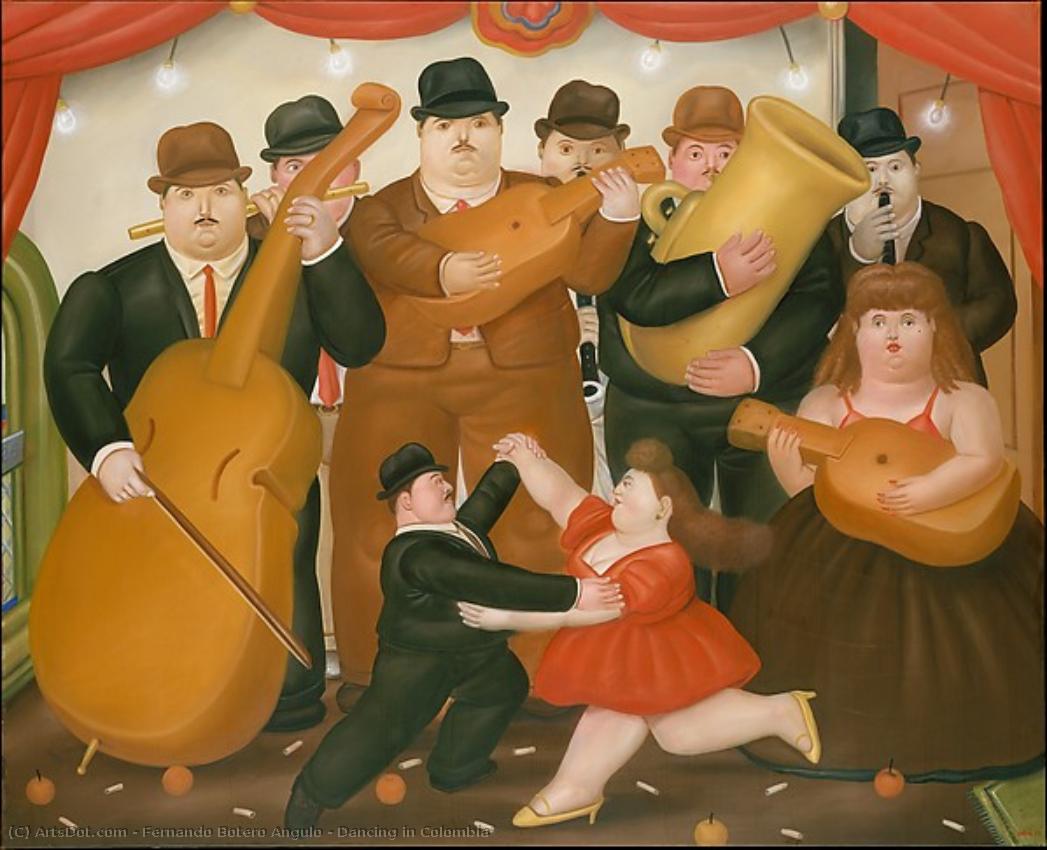
Dancing in Colombia

1980 · Oil On Canvas · Metropolitan Museum of Art, Nova York

In the vibrant tapestry of twentieth-century Latin American art, few works capture the exuberant pulse of a nation quite like Fernando Botero’s Dancing in Colombia. Completed in 1980, this masterful oil painting serves as a window into a world where movement and mass coexist in a joyful, rhythmic embrace. At first glance, the viewer is swept up in a scene of delightful disorder; a crowded café or social gathering teems…

la famille by Fernando Botero
4

la famille

Oil On Canvas

To stand before Fernando Botero’s depiction of la famille is to be enveloped in an atmosphere of profound, almost monumental warmth. This painting transcends a mere portrait; it is a celebration of connection, a visual ode to the enduring bond that ties generations together. The composition centers on a family unit—a mother seated between her two children, all gathered beneath the sheltering canopy of a tree. Botero masterfully captures not…

scene de famille by Fernando Botero
5

scene de famille

Oil On Canvas

To gaze upon Fernando Botero’s Scene de Famille is to be enveloped in an atmosphere of profound, yet utterly comfortable, domesticity. This painting transcends a mere depiction; it captures the very essence of togetherness—the quiet moments shared between loved ones that form the bedrock of human experience. The composition centers around a family unit of four—a man, a woman, and two children—all settled into a tableau of relaxed intimacy. Botero’s…

mona lisa by Fernando Botero
6

mona lisa

Oil On Canvas

Introduction to the Artist and his Style Fernando Botero Angulo, a renowned Colombian figurative artist, is celebrated for his unique style characterized by voluminous, exaggerated forms. His work has been exhibited worldwide and can be found in prestigious museums such as the Metropolitan Museum of Art in New York City and the Museo de Arte Moderno in Bogotá. At AllPaintingsStore.com, we offer handmade oil paintings reproductions of famous artwork, including…

Frank Lloyd et sa famille à paradise island by Fernando Botero
7

Frank Lloyd et sa famille à paradise island

Oil On Canvas

In this scene, we find ourselves on a tropical shore, observing a quiet moment shared by a family of four. Two adults and two children are positioned amidst the soft sands of paradise island, their presence anchored to the landscape. There is a certain weight to the figures; they do not merely occupy the beach but seem to emerge from it, their rounded silhouettes mirroring the organic curves of the…

les musiciens by Fernando Botero
8

les musiciens

Oil On Canvas

The scene unfolds through les musiciens, a work that carries the unmistakable presence of its creator, Fernando Botero. Created in 1986, this piece captures a moment of quiet musicality. The artist, who was born in Medellín, Colombia, in 1932, brings a specific sense of weight and volume to the figures within the frame. Every shape feels substantial, as if the air in the room has a physical density that holds…

Dog Turning a Corner (1980) by Fernando Botero
9

Dog Turning a Corner

1980 · Oil On Canvas

In the masterful hands of Fernando Botero, a simple street corner is transformed into a theatrical stage where life unfolds with exaggerated grace and exuberant color. Dog Turning a Corner invites the viewer into a sun-drenched village scene, captured with the unmistakable warmth that defines the Colombian master's vision. The painting presents a bustling tableau of small-town life, where yellow buildings glow under an unseen sun, casting a nostalgic radiance…

Walk in the hills (1977) by Fernando Botero
10

Walk in the hills

1977 · Oil On Canvas

In the vast landscape of twentieth-century Latin American art, few figures command attention with as much whimsical gravity as Fernando Botero. His 1977 masterpiece, Walk in the hills, serves as a profound window into the artist's signature aesthetic, often referred to as "Boterismo." At first glance, the painting presents a scene of quietude: a solitary figure, draped in heavy, dark garments and crowned with a black hat, stands amidst the…

The rest of the Fernando Botero ranking, 11 to 100

July 20th (1984) by Fernando Botero
#11

July 20th

1984 · Museu Nacional da Colômbia

Fernando Botero’s “July 20th,” painted in 1984, isn't merely a depiction of two figures on a street; it’s a carefully constructed tableau brimming with quiet drama and subtle…

Quatre Musiciens by Fernando Botero
#12

Quatre Musiciens

Fernando Botero Angulo's "Quatre Musiciens" is a captivating oil painting that exemplifies the artist’s signature style – a harmonious blend of bold colors, exaggerated forms, and a playful…

couple dansant by Fernando Botero
#13

couple dansant

is an oil painting by the Colombian artist Fernando Botero. The work captures a couple lost in the rhythm of dance, presenting a scene of movement and intimacy.…

monna lisa by Fernando Botero
#14

monna lisa

The gaze of the woman in monna lisa by Fernando Botero holds a quiet, heavy presence. She sits before us, draped in a black dress that anchors her…

danse en colombie by Fernando Botero
#15

danse en colombie

The painting "Danse en Colombie" by Fernando Botero Angulo is a captivating representation of the rich cultural heritage of Colombia. This vibrant artwork, available as a handmade oil…

tablao flamenco by Fernando Botero
#16

tablao flamenco

In the painting tablao flamenco by Fernando Botero, the scene captures a lively performance taking place within a club setting. At the center of the activity is a…

le chasseur by Fernando Botero
#17

le chasseur

The work before us is titled le chasseur, a painting by the Colombian artist Fernando Botero. Born in Medellín, Colombia, in 1932, Botero developed a singular visual language…

pastèques et oranges by Fernando Botero
#18

pastèques et oranges

To stand before a piece evoking the spirit of Fernando Botero’s still life compositions is to encounter an immediate sense of opulent, almost monumental presence. This painting, featuring…

tête de christ by Fernando Botero
#20

tête de christ

The work before us is titled tête de christ, a painting by the Colombian artist Fernando Botero. Born in 1932 in Medellín, Colombia, Botero developed a singular visual…

oranges by Fernando Botero
#21

oranges

In the vibrant world of Fernando Botero, even the simplest objects undergo a profound transformation. His painting, oranges, invites the viewer into a tactile universe where volume and…

nature morte à la soupe verte by Fernando Botero
#22

nature morte à la soupe verte

To stand before Nature Morte à la Soupe Verte is to be enveloped in the warm, generous embrace of Colombian artistry. Fernando Botero Angulo’s vision here transcends a…

les soeurs by Fernando Botero
#23

les soeurs

In the captivating realm of Fernando Botero’s les soeurs, the viewer is immediately enveloped by a sense of profound intimacy and exaggerated grace. The painting presents a tender…

The Widower (1968) by Fernando Botero
#30

The Widower

1968

“The Widower,” painted in 1968 by Colombian artist Fernando Botero, is a striking oil painting depicting a poignant family portrait set within the confines of a domestic interior.…

jeune fille sur l'ane by Fernando Botero
#46

jeune fille sur l'ane

jeune fille sur l'ane is an oil painting by Fernando Botero. The artist was born in 1932 in Medellín, Colombia, and maintained a presence in international art hubs…

nature morte de fruits by Fernando Botero
#73

nature morte de fruits

Fernando Botero Angulo's “nature morte de fruits” is more than just a depiction of fruit; it’s an embodiment of the artist’s singular vision, a testament to his mastery…

Guitar Lesson (1960) by Fernando Botero
#81

Guitar Lesson

1960 · Museu Nacional da Colômbia

Fernando Botero’s “Guitar Lesson,” painted in 1960, isn’t merely a depiction of a musical scene; it’s an embodiment of the artist’s signature style – what he himself termed…

hommage à Bonnard by Fernando Botero
#83

hommage à Bonnard

The painting Hommage à Bonnard by Fernando Botero Angulo is a unique and fascinating work of art that pays tribute to the French painter Pierre Bonnard. As a…

rubens et sa femme by Fernando Botero
#84

rubens et sa femme

In the captivating realm of Fernando Botero, reality is not merely observed but reimagined through a lens of magnificent abundance. His work, rubens et sa femme, serves as…

chambre avec jeux d'enfants by Fernando Botero
#85

chambre avec jeux d'enfants

In the captivating realm of Fernando Botero, reality is not merely observed but reimagined through a lens of magnificent abundance. The painting chambre avec jeux d'enfants invites the…

le bain des évêques dans un fleuve by Fernando Botero
#86

le bain des évêques dans un fleuve

A Moment of Leisure: "Le Bain des Évêques dans un Fleuve" by Fernando Botero Angulo This captivating painting, “Le Bain des Évêques dans un Fleuve” (The Bathing of…

l'étude de vermeer by Fernando Botero
#87

l'étude de vermeer

The painting l'étude de vermeer emerges from the year 1964, a moment when Fernando Botero captures a singular presence on canvas. This work presents a portrait of a…

The subjects Fernando Botero painted most

The four subjects that return most often among these masterpieces, with the finest example of each.

Where to see Fernando Botero's paintings

The 6 museums that hold the most of the paintings on this page.

Museum City Works by Fernando Botero Paintings from this list
Museu Nacional da Colômbia, BogotáMuseu Nacional da Colômbia Bogotá 2 July 20th, Guitar Lesson
Bavarian State Painting Collections, MuniqueBavarian State Painting Collections Munique 2 The First Lady, El Presidente
Metropolitan Museum of Art, Nova YorkMetropolitan Museum of Art Nova York 1 Dancing in Colombia
Museum of Latin American Art, Long BeachMuseum of Latin American Art Long Beach 1 Title translation: The Family
Tucson Museum of Art, TucsonTucson Museum of Art Tucson 1 Sailor Boy
Royal Museum of Fine Arts Antwerp, AntuérpiaRoyal Museum of Fine Arts Antwerp Antuérpia 1 The Prima Donna

Fernando Botero through the decades: one masterpiece for each

  1. 1950s
  2. 1960s
  3. 1970s
    Walk in the hills (1977) by Fernando Botero
    No. 10 of 100

    Walk in the hills

    Age 38 – 47

    In the vast landscape of twentieth-century Latin American art, few figures command attention with as much whimsical gravity as Fernando Botero. His 1977 masterpiece, Walk in the hills,…

  4. 1980s
    Dancing in Colombia (1980) by Fernando Botero
    #3 of 100

    Dancing in Colombia

    Age 48 – 57 · Metropolitan Museum of Art

    In the vibrant tapestry of twentieth-century Latin American art, few works capture the exuberant pulse of a nation quite like Fernando Botero’s Dancing in Colombia. Completed in 1980,…

  5. 1990s

Fernando Botero's paintings: frequently asked questions

What is the most famous Fernando Botero painting?Show the answer

The President and First Lady. Next come la collectionneuse and Dancing in Colombia (1980).

Which are the 10 most famous Fernando Botero paintings?Show the answer

The President and First Lady, la collectionneuse, Dancing in Colombia, la famille, scene de famille, mona lisa, Frank Lloyd et sa famille à paradise island, les musiciens, Dog Turning a Corner and Walk in the hills. The ranking above gives the year and the museum of each.

How many paintings by Fernando Botero are there?Show the answer

Our catalogue lists 279 works by Fernando Botero, dated from 1959 to 1992.

Where can I see the most famous Fernando Botero paintings?Show the answer

Most of them are in Museu Nacional da Colômbia (Bogotá), Bavarian State Painting Collections (Munique) and Metropolitan Museum of Art (Nova York). The table above lists the museums one by one.

In which period did Fernando Botero paint the best-known works?Show the answer

In 1960s: 10 of the 100 works on this page date from then, among them Camera degli Sposi (Homage to Mantegna) II.

What is the earliest famous Fernando Botero painting, and the latest?Show the answer

The earliest on this page is Mona Lisa, Age Twelve (1959), the latest Title translation: The Family (1992).

What subjects did Fernando Botero paint?Show the answer

Woman (14), Portrait (9) and Volume (8), among the 100 works on this page.

What did Fernando Botero paint on, and with what?Show the answer

Oil On Canvas: 22 of the 100 works on this page.

Which movement does Fernando Botero's art belong to?Show the answer

Boterismo, as the paintings on this page show.

What Fernando Botero paintings does the Museu Nacional da Colômbia hold?Show the answer

July 20th and Guitar Lesson are among the 2 works on this page held by the Museu Nacional da Colômbia, Bogotá.

Fernando Botero: biography

Primeiros Anos, Família e Formação

Fernando Botero nasceu em 19 de abril de 1932, em Medellín, Colômbia. Seus primeiros anos foram moldados pelos ritmos tranquilos e constantes de um lar que lutava para garantir o sustento. Seu pai, David Botero, ganhava a vida como vendedor, muitas vezes viajando a cavalo para alcançar seus clientes. Sua mãe, Flora Angulo, trabalhava como costureira, provendo o apoio necessário para a família. Esse ambiente primordial conferiu-lhe um senso de pertencimento que permaneceria com ele muito tempo depois de deixar a cidade.

Em sua juventude, Fernando Botero passou vários anos frequentando uma escola de matadores. Ele foi treinado nos movimentos e nas tradições da arena de touros, mas seus interesses acabaram por afastá-lo do ruedo. Aos 16 anos, seu foco já havia se voltado para o desenho e o esboço. Em 1948, suas primeiras ilustrações foram publicadas no suplemento de domingo do El Colombiano, marcando o início de sua presença pública através de seu trabalho visual.

Formação Artística e Viagens pela Europa

Em 1952, Botero utilizou o dinheiro obtido com as vendas em sua galeria para navegar em direção à Europa. Sua primeira parada foi Barcelona, mas logo seguiu para Madri. Foi na Espanha que ele iniciou seus estudos na Academia de San Fernando. Ele dedicou horas preciosas ao Museu do Prado, onde se sentava para copiar as obras de Goya e Velázquez. Esse hábito de estudar os Mestres Antigos tornou-se uma parte constante e fundamental de sua prática artística.

Seus estudos acabaram levando-o a Florença, onde frequentou a Academia de San Marcos. Por volta de 1953, ele já estava em Paris. Passou grande parte do seu tempo no Louvre, observando a maneira como a luz e a forma se assentavam sobre as figuras nos salões do museu. Esses anos na Europa foram marcados pelo movimento entre cidades como Madri, Florença e Paris, absorvendo a densidade e a presença monumental da arte clássica.

O Desenvolvimento do Estilo Boterismo

As formas em sua obra carregam um peso muito específico. Esta abordagem, frequentemente chamada de Boterismo, concentra-se em pessoas e figuras representadas em volumes amplos e exagerados. Em vez de focar em linhas finas, o olhar permanece sobre formas arredondadas e corpulentas que ocupam o espaço com uma presença densa. Essas figuras possuem uma certa massa que parece física, como se a própria tinta tivesse ganhado peso. Ele utiliza frequentemente cores vibrantes e contornos marcantes para definir essas formas, fazendo com que os temas se destaquem de forma magistral contra seus fundos.

Por volta de 1964, esse interesse pelo volume transbordou da tela para as três dimensões. Ele começou a criar esculturas, traduzindo essa mesma sensação de expansão para o bronze e outros materiais. A arredondamento visto em suas pinturas encontrou uma nova vida nessas formas sólidas, permitindo que as proporções exageradas existissem em espaços públicos. O trabalho permanece focado na pura fisicalidade do sujeito, seja ele uma figura humana ou um animal.

Obras-Primas e Temas Artísticos

A obra de Fernando Botero frequentemente gravita em torno do peso da forma humana e da tensão silenciosa que permeia os contextos sociais. Em Mona Lisa, Age Twelve (1959), o sujeito é retratado com uma presença arredondada e singular que se afasta das proporções tradicionais. Esse foco no volume tornou-se um meio para explorar estruturas sociais mais complexas. Já em The Presidential Family (1967), as formas exageradas das figuras oferecem um olhar sutil sobre as elites políticas, utilizando a massa para tecer comentários sobre aqueles que detêm o poder. Através dessas formas, o artista foi capaz de abordar tanto a alegria vibrante da vida quanto a densidade melancólica do conflito.

Seus temas oscilam, com maestria, entre a celebração e a dura realidade da violência. Dancing in Colombia (1980) captura uma cena animada de músicos e dançarinos, utilizando camadas espessas de tinta para conferir às figuras uma qualidade tátil e pesada. Em contraste, suas obras de maturidade frequentemente confrontaram os aspectos mais sombrios de sua terra natal. The Death of Pablo Escobar (1999/2006) e suas diversas séries que abordam os abusos em Abu Ghraib revelam uma disposição de utilizar seu estilo icônico para encarar verdades difíceis. Mesmo suas peças tardias, como La paloma de la paz (2016), carregam um sentido de peso monumental, seja o tema uma pessoa, um animal ou um símbolo de paz.

  • Mona Lisa, Age Twelve (1959)
  • The Presidential Family (1967)
  • Dancing in Colombia (1980)
  • The Death of Pablo Escobar (1999/2006)
  • La paloma de la paz (2016)

Anos Finais e Despedida

As décadas finais de sua vida foram marcadas por um constante movimento entre diversos centros internacionais. Fernando Botero manteve residências em cidades vibrantes como Nova York, Paris e Monte Carlo, mas nunca perdeu o vínculo com sua essência, retornando frequentemente a Medellín para se reconectar com suas raízes. Sua presença no espaço público tornou-se onipresente, à medida que suas esculturas em bronze eram instaladas em parques e praças por diversos continentes, integrando-se à vida urbana. Mesmo com o passar dos anos, sua obra não recuou diante da complexidade; pelo contrário, continuou a enfrentar temas densos e profundos, como as tensões sociais e políticas na Colômbia e os eventos sombrios na prisão de Abu Ghraib.

Em seus últimos anos, estabeleceu-se no Principado de Mônaco. Foi ali que, em 15 de setembro de 2023, aos 91 anos de idade, o artista nos deixou, devido a complicações decorrentes de uma pneumonia. Sua partida marcou o encerramento de uma trajetória artística monumental, dedicada a observar a forma humana e as intrincadas camadas da vida social através de sua lente única de volume e proporção.

Legado e Influência

A presença de Fernando Botero na esfera pública era constante e imponente. Em Nova York, suas esculturas ocupam espaços emblemáticos como a Park Avenue, onde suas formas pesadas e arredondadas coexistem em um diálogo silencioso com a arquitetura urbana da metrópole. Já na Colômbia, ele se tornou um verdadeiro tesouro nacional, uma figura cuja obra se entrelaçou profundamente com o cotidiano do país. Durante sua trajetória, ele foi o artista latino-americano mais reconhecido e citado, um fato que se reflete na maneira como suas figuras se tornaram familiares para pessoas de diversas fronteiras e culturas.

Seu compromisso com a terra natal era visível através de generosas doações de grande escala. No ano de 2000, ele presenteou o Banco da República com 208 obras de arte, um gesto que ajudou a moldar o panorama cultural de Bogotá. Além disso, ele compartilhou grande parte de sua coleção pessoal, doando 123 peças e outras 85 obras ao Museo Botero. Essas contribuições fundamentais garantiram que sua visão singular de mundo permanecesse acessível e viva para as gerações que o sucederam.

  • La paloma de la paz
  • The Death of Pablo Escobar
  • Mona Lisa, Age Twelve

Onde Contemplar suas Obras Hoje

A presença de Fernando Botero é sentida nos cantos tranquilos de Bogotá, especificamente no vibrante bairro de La Candelaria. O Museo Botero abriga grande parte de sua produção, uma coleção que floresceu a partir de sua própria decisão de doar muitas de suas peças à nação. Em Medellín, o Museu de Antioquia também preserva um número significativo de suas obras, mantendo um vínculo eterno com suas raízes. Esses espaços convidam o espectador a um olhar pausado sobre a maestria com que ele manipulou o volume e o peso de seus temas.

Para além das fronteiras da Colômbia, suas pinturas podem ser encontradas no Metropolitan Museum of Art, em Nova York. Ali, a escala de suas figuras assume um caráter distinto sob o pano de fundo de uma instituição global. Suas esculturas em bronze também encontraram lares permanentes em espaços públicos, convidando o transeunte a caminhar ao redor delas nas ruas de Florença e Medellín. Essas formas densas e arredondadas existem ao ar livre, entregues à luz e ao movimento constante da cidade.

  • Dancing in Colombia (1980)
  • July 20th (1984)
  • Mona Lisa (c. 1959)
  • The Death of Pablo Escobar (c. 1999)

All 279 works by Fernando Botero →