David Roberts, 1796 – 1864

The 100 Most Famous Paintings by David Roberts

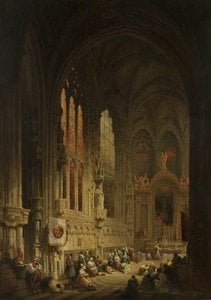
The painting that made David Roberts famous is Interior de Catedral de Colón, com uma Funerais (1838); it hangs in the Wolverhampton Art Gallery, Wolverhampton. The Chancel of the Church of the Nativity (or St. Helena), Bethlehem (1842) and Philae, Temple of Isis, the Court and the Second Pylon follow it in the hearts of collectors and museum visitors. Of the 291 works by David Roberts in our catalogue, these 100 are the most admired, each presented with its date, its museum and what sets it apart.

Ranked by our popularity score, which combines the searches, visits and orders for each work. Updated Outubro 2026. Every masterpiece on this page can be ordered as a museum-quality, hand-painted oil reproduction or a fine art print, at the size you choose.

Portrait of David Roberts
David Roberts · 1796 – 1864
Born · died
1796 – 1864, Stockbridge
Movement
Romanticism
Works in our catalogue
291
Most famous
Interior de Catedral de Colón, com uma Funerais (1838)
Most works at
Scottish National Gallery

David Roberts: the ten masterpieces

Interior de Catedral de Colón, com uma Funerais (1838) by David Roberts
1

Interior de Catedral de Colón, com uma Funerais

1838 · Acrílico sobre tela · Wolverhampton Art Gallery, Wolverhampton

David Roberts’s “Interior of Cologne Cathedral, with a Funeral” transcends mere depiction; it's an immersive experience into the spiritual heart of Victorian England. Completed in 1838, this monumental lithograph captures not just architectural grandeur but also the solemn reverence surrounding a funeral procession within one of Europe’s most sacred spaces.

The Chancel of the Church of the Nativity (or St. Helena), Bethlehem (1842) by David Roberts
2

The Chancel of the Church of the Nativity (or St. Helena), Bethlehem

1842 · Watercolor · National Museums Liverpool, Liverpool

David Roberts' "The Chancel of the Church of the Nativity (or St. Helena)," painted in 1842, isn’t merely a depiction of a building; it’s an immersion into a profound atmosphere of reverence and historical significance. This watercolor, rendered with meticulous detail and imbued with a subtle luminosity, transports the viewer to the heart of Bethlehem – the birthplace of Jesus Christ. Roberts, a Scottish painter celebrated for his evocative depictions…

Philae, Temple of Isis, the Court and the Second Pylon by David Roberts
3

Philae, Temple of Isis, the Court and the Second Pylon

Oil On Canvas

In this landscape composition, we encounter Philae, Temple of Isis, the Court and the Second Pylon, a work by the Scottish painter David Roberts. The scene focuses on the architectural remains of the Temple of Isis at Philae. Roberts produced these paintings during his time in Egypt, specifically around 1838, capturing the structures as they appeared in the early nineteenth century.

More David Roberts masterpieces, 11 to 100

Rouen Cathedral (1826) by David Roberts
#35

Rouen Cathedral

1826 · Smithsonian American Art Museum

In his 1826 masterpiece, Rouen Cathedral, David Roberts invites the viewer into a breathtaking window of the nineteenth century, where the monumental weight of history meets the delicate…

Commission a hand-painted copy →
Ruins of the Temple of Bacchus (1840) by David Roberts
#37

Ruins of the Temple of Bacchus

1840 · Walker Art Gallery

The artwork titled Ruins of the Temple of Bacchus was painted by David Roberts in 1840. This composition depicts the monumental remains of a classical structure located in…

Bring it home →
Interior of York Minster (1827) by David Roberts
#67

Interior of York Minster

1827 · York Museums Trust

Interior of York Minster: A Symphony of Light and Stone York Minster, nestled in the heart of York City, stands as a testament to Gothic grandeur and artistic…

Order a reproduction →
Inside of The Mosque of Cordoba by David Roberts
#69

Inside of The Mosque of Cordoba

Museu de Belas Artes de Córdoba

In the quiet, shadowed corridors of history, few images capture the intersection of architectural grandeur and spiritual serenity as profoundly as David Roberts’s Inside of The Mosque of…

Bring it home →
The Giudecca, Venice (1854) by David Roberts
#85

The Giudecca, Venice

1854 · Yale Center for British Art

David Roberts’s “The Giudecca, Venice” isn't merely a depiction of a cityscape; it’s a carefully constructed tableau of light, atmosphere, and the enduring spirit of a city steeped…

Bring it home →

David Roberts's paintings by period

The subjects David Roberts painted most

The four subjects that return most often among these masterpieces, with the finest example of each.

Where to see David Roberts's paintings

The 8 museums that hold the most of the paintings on this page.

Museum City Works by David Roberts Paintings from this list
Scottish National Gallery, EdimburgoScottish National Gallery Edimburgo 10 Hindoo Architecture A Composition, St Patrick's Church, Cowgate, Edinburgh, Baalbec
Birmingham Museum and Art Gallery, BirminghamBirmingham Museum and Art Gallery Birmingham 5 Colossi, Thebes, Egypt, St Catherine's Convent, Mount Sinai, Holy Land, Interior Of Seville Cathedral, Spain
Government Art Collection, LondresGovernment Art Collection Londres 3 The Great Staircase, Stafford House, Interior of St Peter's, Rome, Interior of the Duomo, Milan
Museu do Prado, MadridMuseu do Prado Madrid 4 Untitled (AQTNF8), Español Interior de la mezquita de Córdoba English The Interior of the Mosque, Cordoba
Yale Center for British Art, New HavenYale Center for British Art New Haven 3 The Hypostyle Hall of the Great Temple at Abu Simbel, Egypt, The Giudecca, Venice
York Museums Trust, YorkYork Museums Trust York 2 Entrance to St Germain, Amiens, Interior of York Minster
Guildhall Art Gallery, LondresGuildhall Art Gallery Londres 2 Edinburgh from the Calton Hill, The Forum, Rome, Italy
Wallace Collection, LondresWallace Collection Londres 2 Lierre Interior of Saint Gommaire, Granada the Chapel of Ferdinand and Isabella

David Roberts, decade by decade: the defining painting of each

  1. 1820s
  2. 1830s
    Interior de Catedral de Colón, com uma Funerais (1838) by David Roberts
    No. 1 of 100

    Interior de Catedral de Colón, com uma Funerais

    Age 34 – 43 · Wolverhampton Art Gallery

    David Roberts’s “Interior of Cologne Cathedral, with a Funeral” transcends mere depiction; it's an immersive experience into the spiritual heart of Victorian England. Completed in 1838, this monumental…

  3. 1840s
  4. 1850s
  5. 1860s

David Roberts's masterpieces: questions and answers

Which painting is David Roberts best known for?Show the answer

Interior de Catedral de Colón, com uma Funerais (1838), Wolverhampton Art Gallery, Wolverhampton. Next come The Chancel of the Church of the Nativity (or St. Helena), Bethlehem (1842) and Philae, Temple of Isis, the Court and the Second Pylon.

How old was David Roberts when painting Interior de Catedral de Colón, com uma Funerais?Show the answer

42 years old: Interior de Catedral de Colón, com uma Funerais dates from 1838 and David Roberts was born in 1796.

What are David Roberts's ten greatest paintings?Show the answer

Interior de Catedral de Colón, com uma Funerais, The Chancel of the Church of the Nativity (or St. Helena), Bethlehem, Philae, Temple of Isis, the Court and the Second Pylon, Interview with the Viceroy of Egype at His Palace in Alexandria, The Grand Portico Of The Temple At Esneh, Egypt, Caiaphas Looking Towards Mount Carmel, Citadel Of Sidon, Untitled (AQTNEW), Edinburgh Town and Castle and Entrance to St Germain, Amiens. The ranking above gives the year and the museum of each.

How many works did David Roberts paint?Show the answer

Our catalogue lists 291 works by David Roberts, dated from 1822 to 1863.

In which museums can I see David Roberts's masterpieces?Show the answer

Most of them are in Scottish National Gallery (Edimburgo), Birmingham Museum and Art Gallery (Birmingham) and Government Art Collection (Londres). The table above lists the museums one by one.

When did David Roberts paint the masterpieces?Show the answer

In 1830s: 28 of the 100 works on this page date from then, among them Interior de Catedral de Colón, com uma Funerais.

What are the first and last famous paintings of David Roberts?Show the answer

The earliest on this page is Interior of a Cathedral (1822), the latest Edinburgh from the Calton Hill (1863).

What were David Roberts's favourite subjects?Show the answer

Religious art (7), Architecture (6) and Victorian era (5), among the 100 works on this page.

Which technique did David Roberts favour?Show the answer

Oil On Canvas: 5 of the 100 works on this page.

What art movement is David Roberts part of?Show the answer

Romanticism and Orientalist painting, as the paintings on this page show.

Which masterpieces by David Roberts hang at the Scottish National Gallery?Show the answer

Hindoo Architecture A Composition, St Patrick's Church, Cowgate, Edinburgh and Baalbec are among the 8 works on this page held by the Scottish National Gallery, Edimburgo.

Can I own a reproduction of a David Roberts masterpiece?Show the answer

Yes. Every painting on this page can be ordered as a museum-quality, hand-painted oil reproduction or a fine art print, in the size you choose, from the painting's own page.

The life of David Roberts

David Roberts: Uma Vida na Arte

David Roberts (1796-1864) foi um pintor escocês celebrado por suas detalhadas cenas orientalistas e litografias meticulosas. Sua obra oferece uma documentação visual inestimável do Oriente Médio durante o século XIX, unindo a representação artística ao registro histórico.

Primeiros Anos e Carreira

Nascido em 24 de outubro de 1796, em Stockbridge, perto de Edimburgo, os primeiros anos de vida de Roberts foram marcados por um treinamento prático. Aos dez anos, ele iniciou um aprendizado com o pintor e decorador de casas Gavin Beugo. Essa experiência fundamental instilou um forte conjunto de habilidades técnicas, que ele complementou por meio de estudos artísticos noturnos.

Seu trabalho profissional inicial incluiu a redecoração do Palácio de Scone em 1815. Posteriormente, ele transitou para a pintura de cenários para o circo de James Bannister, aperfeiçoando suas habilidades na criação de ambientes imersivos. Essas experiências precoces lançaram as bases para seu sucesso posterior como um proeminente pintor orientalista.

Jornada Artística e Influências

O desenvolvimento artístico de Roberts foi moldado por uma crescente fascinação por diferentes culturas e paisagens. Embora inicialmente focado em cenários teatrais, ele gradualmente mudou para buscas artísticas mais independentes. Suas viagens à Espanha em 1832 foram formativas, despertando um interesse pelo detalhe arquitetônico e por locais exóticos.

No entanto, foram suas extensas expedições pelo Egito e pelo Próximo Oriente (1838-1840) que verdadeiramente definiram sua carreira. Essas jornadas proporcionaram-lhe uma riqueza de esboços e observações que ele mais tarde traduziu em suas obras mais famosas. Seu estilo não foi fortemente influenciado por um único artista, mas desenvolveu-se, em vez disso, a partir da observação cuidadosa e do domínio técnico.

Obras Notáveis e Conquistas

Roberts é mais conhecido por The Holy Land, Syria, Idumea, Arabia, Egypt, and Nubia – uma série de impressões litográficas meticulosamente detalhadas. Essas imagens capturaram a grandiosidade de locais antigos e a vibração da vida contemporânea na região.

  • Litografias: Suas litografias circularam amplamente e tornaram-se altamente influentes na formação das percepções europeias sobre o Oriente Médio.
  • Pinturas: Ele também produziu inúmeras pinturas a óleo, muitas vezes obras de grande escala que retratavam paisagens expansivas e maravilhas arquitetônicas.

Em 1841, Roberts foi eleito como Acadêmico Real – um reconhecimento significativo de suas contribuições para o mundo da arte.

Estilo Artístico e Características

O estilo artístico de Roberts é caracterizado por:

  • Orientalismo: Um forte foco na representação de cenas do Oriente Médio, refletindo a fascinação europeia pelo “Oriente”.
  • Atenção aos Detalhes: Sua obra é renomada por sua precisão e exatidão ao renderizar detalhes arquitetônicos, trajes e paisagens.
  • Paisagens e Cenários Urbanos: Ele combinou habilidosamente sensibilidades românticas com observação detalhada, criando representações evocativas tanto de ambientes naturais quanto de cenários urbanos.

Legado e Significância Histórica

A obra de David Roberts desempenhou um papel crucial na popularização do Oriente Médio entre o público europeu. Suas imagens proporcionaram uma janela visual para uma região que era amplamente desconhecida por muitos, influenciando viagens, estudos acadêmicos e a representação artística.

Suas litografias serviram como importantes documentos históricos, preservando imagens de locais que desde então mudaram ou foram perdidos. Ele deixou uma marca indelével no mundo da arte, inspirando gerações subsequentes de artistas e continuando a cativar espectadores até hoje.

All 291 works by David Roberts →