Cy Twombly, 1928 – 2011

Pinturas de Cy Twombly: As 100 Obras Mais Famosas, Classificadas

A pintura mais famosa de Cy Twombly é The Rose (IV) (2008). Com Proteus (1984) e Quattro Stagioni, Autunno (1995), completam-se as três obras que todos reconhecem. O nosso catálogo lista 116 obras de Cy Twombly; as 100 abaixo são as mais admiradas no mundo, cada uma com o seu ano, o museu que a detém e a sua importância.

Classificado de acordo com o nosso índice de popularidade, que combina buscas, visitas e pedidos de cada obra. Atualizado em Outubro 2026.

Retrato de Cy Twombly
Cy Twombly · 1928 – 2011
Nascimento · falecimento
1928 – 2011, Lexington
Movimento
Abstract expressionism
Obras em nosso catálogo
116
Mais famosas
The Rose (IV) (2008)
Mais obras em
Metropolitan Museum of Art

As 10 pinturas mais famosas de Cy Twombly

The Rose (IV) (2008) de Cy Twombly
1

The Rose (IV)

2008 · Acrylic On Canvas

The Rose (IV) by Cy Twombly: A Symphony of Color and Poetic Echoes Subject: The painting "The Rose (IV)" by Cy Twombly is an arresting exploration of the rose motif, rendered through a vibrant and dynamic abstract expressionist style. It’s not merely a depiction of a flower; it's an invocation of beauty, passion, and the transient nature of existence, deeply rooted in historical and literary references. Style: As a quintessential…

Proteus (1984) de Cy Twombly
2

Proteus

1984 · Painting

To stand before Cy Twombly's Proteus is to encounter not merely paint on canvas, but a vibrant conversation across decades—a dialogue between raw energy and profound mythology. Created in 1984, this work pulses with the unmistakable spirit of Neo-Expressionism, a movement that yearned for visceral feeling after the cool intellectualism of earlier art forms. Twombly’s signature style here is breathtaking; it seems less applied and more excavated, as if the…

Quattro Stagioni, Autunno (1995) de Cy Twombly
3

Quattro Stagioni, Autunno

1995 · Mixed Media

Quattro Stagioni, Autunno is a painting by Cy Twombly. Created in 1995, this work exists as a single movement within a larger cycle. It is part of the Quattro Stagioni series, a collection of four canvases that map the passage of time. This specific piece, Autunno, follows the sequence established by its counterparts: Primavera, Estate, and Inverno.

Dutch Interior (1962) de Cy Twombly
4

Dutch Interior

1962 · Acrylic On Canvas · Metropolitan Museum of Art, Nova York

Cy Twombly's 1962 painting, *Dutch Interior*, isn’t merely a depiction of a room; it’s an immersive experience, a layered meditation on the act of creation itself. Emerging from a spacious studio in central Rome—a space that liberated him from the constraints of smaller formats—Twombly embarked on a work that immediately challenged conventional notions of representation. The painting’s genesis is inextricably linked to this new environment; it feels less like a…

Quattro Stagioni, Estate (1995) de Cy Twombly
5

Quattro Stagioni, Estate

1995 · Mixed Media

Introduction to Cy Twombly and his Artistic Style Cy Twombly, born Edwin Parker Twombly Jr. in 1928, was an American painter, sculptor, and photographer who spent much of his career living and working in Italy. His art is characterized by its large-scale, freely-scribbled, calligraphic, and graffiti-like qualities, often incorporating poetic elements from various sources. Quattro Stagioni, Estate: A Representation of Summer 'Quattro Stagioni, Estate' (1993-1994) is the second painting in…

The Four Seasons - Summer - Part II (1994) de Cy Twombly
6

The Four Seasons - Summer - Part II

1994 · Acrílico sobre tela · MoMA - Museu de Arte Moderna, Nova York

Edwin Parker Twombly Jr., universally known as Cy Twombly, stands apart from the titans of 20th-century art—an American painter, sculptor, and photographer whose oeuvre defied easy categorization. Born April 25, 1928, in Lexington, Virginia, his artistic journey began with a grounding in classical education and an irrepressible spirit that propelled him across continents. Early studies under Pierre Daura at Washington and Lee University were followed by formative experiences at the…

Untitled (19) (1970) de Cy Twombly
7

Untitled (19)

1970 · Mixed Media

Untitled (19) is a work by the American painter Cy Twombly, executed in 1970. This piece belongs to the artist's celebrated "blackboard" series, a period marked by a shift toward graphic regularity and formal restraint. The work is rooted in abstract expressionism, utilizing a specific vocabulary of gestural marks that emerged from Twombly's evolving aesthetic.

Fifty Days at Iliam. The Fire that Consumes All before It (1978) de Cy Twombly
8

Fifty Days at Iliam. The Fire that Consumes All before It

1978 · Oil On Canvas

The canvas of Fifty Days at Iliam. The Fire that Consumes All before It pulses with a heavy, urgent energy. Created by Cy Twombly in 1978, this work exists as the fourth movement in a larger, ten-part cycle known as Fifty Days at Iliam. The narrative tension within the paint draws directly from the ancient echoes of Homer’s Iliad, specifically through the lens of Alexander Pope’s eighteenth-century translation. It is…

Untitled (1954) de Cy Twombly
9

Untitled

1954 · Painting

This work, titled Untitled, was created by Cy Twombly in 1954. It represents a specific moment in the artist's early development, emerging from a period of significant transition. The piece carries the weight of a singular vision, captured through a deliberate and personal application of medium.

Cold Stream (1966) de Cy Twombly
10

Cold Stream

1966

Introduction to Cy Twombly Edwin Parker "Cy" Twombly Jr. (April 25, 1928 – July 5, 2011) was an American painter, sculptor, and photographer known for his large-scale, abstract works that often incorporated text and symbols. Born in Lexington, Virginia, Twombly studied at the School of the Museum of Fine Arts in Boston before serving in the United States Army during World War II. After the war, he continued his studies…

Cy Twombly, pinturas de 11 a 100

Untitled (Rome [Wall]) (1961) de Cy Twombly
#11

Untitled (Rome [Wall]) (1961)

Galleria Civica di Arte Moderna e Contemporanea Torino

The artwork titled Untitled (Rome [Wall]) (1961) is a large-scale abstract painting executed with oil on canvas. The composition features a white background upon which various colors and…

Leaving Paphos Ringed With Waves III (2009) de Cy Twombly
#17

Leaving Paphos Ringed With Waves III

2009

In the vast, evocative landscape of contemporary abstraction, few works command the viewer's attention with such raw, visceral energy as Cy Twombly’s "Leaving Paphos Ringed With Waves III."…

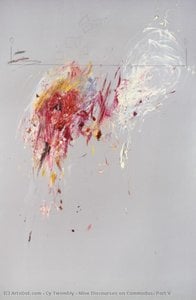
Nine discourses on Commodus (1963) de Cy Twombly
#18

Nine discourses on Commodus

1963 · Museu Guggenheim Bilbao

Nine Discourses on Commodus: A Descent into Roman Excess Cy Twombly’s “Nine Discourses on Commodus,” painted in 1963, isn't merely a depiction of a historical event; it’s an…

School of Athens (1961) de Cy Twombly
#19

School of Athens

1961

The painting presented here, tentatively titled “School of Athens,” offers a compelling glimpse into the intensely personal and often cryptic world of Cy Twombly. Executed in 1961, this…

Odeion (Rome) (1960) de Cy Twombly
#24

Odeion (Rome)

1960 · Bavarian State Painting Collections

In 1960, Cy Twombly produced Odeion (Rome), a work that exists at the intersection of calligraphy and chaos. The canvas bears the physical traces of a restless hand,…

Leda and the Swan (1962) de Cy Twombly
#29

Leda and the Swan

1962

A Symphony of Chaos and Eros: Exploring Cy Twombly’s Leda and the Swan Cy Twombly's *Leda and the Swan*, completed in 1962, stands as a cornerstone of abstract…

Night Watch (1966) de Cy Twombly
#32

Night Watch

1966

The artwork Night Watch is an abstract piece created in 1966. The composition is characterized by a dark background against which a network of thin, white lines creates…

Leaving Paphos Ringed With Waves V (2009) de Cy Twombly
#47

Leaving Paphos Ringed With Waves V

2009

“Leaving Paphos Ringed With Waves V,” created in 2009 by Cy Twombly, is a visceral and profoundly unsettling work that embodies the core tenets of Neo-Expressionism. This canvas,…

Untitled (1953) de Cy Twombly
#50

Untitled

1953 · Bavarian State Painting Collections

In this color photograph titled "Untitled" by Cy Twombly, a single-story, rustic brick house sits quietly within a sprawling rural landscape. The composition centers entirely on the structure,…

Untitled (1960) de Cy Twombly
#64

Untitled

1960 · Metropolitan Museum of Art
Untitled (1970) de Cy Twombly
#80

Untitled

1970 · Metropolitan Museum of Art
Olympia (1957) de Cy Twombly
#86

Olympia

1957

A Glimpse into Abstraction: Cy Twombly's *Olympia* Cy Twombly’s *Olympia*, created in 1957, is a captivating work of Neo-Expressionism that transcends traditional representation. This piece isn't about depicting…

Untitled I (2005) de Cy Twombly
#100

Untitled I

2005

In the realm of contemporary art, few pieces have managed to captivate audiences with the same level of intrigue as Cy Twombly's "Untitled I". Created in 2005, this…

Pinturas de Cy Twombly por período

Os temas que Cy Twombly mais pintou

Os quatro temas que mais se repetem entre estas obras-primas, com o melhor exemplo de cada um.

Onde ver as pinturas de Cy Twombly

Os 5 museus que detêm a maioria das pinturas desta página.

Museu Cidade Obras de Cy Twombly Pinturas desta lista
Metropolitan Museum of Art, Nova YorkMetropolitan Museum of Art Nova York 3 Dutch Interior, Untitled, Untitled
Bavarian State Painting Collections, MuniqueBavarian State Painting Collections Munique 2 Odeion (Rome), Untitled
MoMA - Museu de Arte Moderna, Nova YorkMoMA - Museu de Arte Moderna Nova York 1 The Four Seasons - Summer - Part II
Galleria Civica di Arte Moderna e Contemporanea Torino, TurimGalleria Civica di Arte Moderna e Contemporanea Torino Turim 1 Untitled (Rome [Wall]) (1961)
Museu Guggenheim Bilbao, BilbaoMuseu Guggenheim Bilbao Bilbao 1 Nine discourses on Commodus

A pintura mais famosa de cada década de Cy Twombly

  1. 1940s
    Ritual (1949) de Cy Twombly
    #60 de 100

    Ritual

    Idade 12 – 21
  2. 1950s
    Untitled (1954) de Cy Twombly
    #9 de 100

    Untitled

    Idade 22 – 31

    This work, titled Untitled, was created by Cy Twombly in 1954. It represents a specific moment in the artist's early development, emerging from a period of significant transition.…

  3. 1960s
    Dutch Interior (1962) de Cy Twombly
    Nº 4 de 100

    Dutch Interior

    Idade 32 – 41 · Metropolitan Museum of Art

    Cy Twombly's 1962 painting, *Dutch Interior*, isn’t merely a depiction of a room; it’s an immersive experience, a layered meditation on the act of creation itself. Emerging from…

  4. 1970s
    Untitled (19) (1970) de Cy Twombly
    Nº 7 de 100

    Untitled (19)

    Idade 42 – 51

    Untitled (19) is a work by the American painter Cy Twombly, executed in 1970. This piece belongs to the artist's celebrated "blackboard" series, a period marked by a…

  5. 1980s
    Proteus (1984) de Cy Twombly
    #2 de 100

    Proteus

    Idade 52 – 61

    To stand before Cy Twombly's Proteus is to encounter not merely paint on canvas, but a vibrant conversation across decades—a dialogue between raw energy and profound mythology. Created…

  6. 1990s
    Quattro Stagioni, Autunno (1995) de Cy Twombly
    Posição 3 de 100

    Quattro Stagioni, Autunno

    Idade 62 – 71

    Quattro Stagioni, Autunno is a painting by Cy Twombly. Created in 1995, this work exists as a single movement within a larger cycle. It is part of the…

  7. 2000s
    The Rose (IV) (2008) de Cy Twombly
    #1 de 100

    The Rose (IV)

    Idade 72 – 81

    The Rose (IV) by Cy Twombly: A Symphony of Color and Poetic Echoes Subject: The painting "The Rose (IV)" by Cy Twombly is an arresting exploration of the…

  8. 2010s

Dúvidas sobre as pinturas de Cy Twombly

Qual é a pintura mais famosa de Cy Twombly?Mostrar a resposta

The Rose (IV) (2008). Seguem-se Proteus (1984) e Quattro Stagioni, Autunno (1995).

Qual era a idade de Cy Twombly quando The Rose (IV) foi pintada?Mostrar a resposta

80 anos: The Rose (IV) data de 2008 e Cy Twombly nasceu em 1928.

Quais são as 10 principais pinturas de Cy Twombly?Mostrar a resposta

The Rose (IV), Proteus, Quattro Stagioni, Autunno, Dutch Interior, Quattro Stagioni, Estate, The Four Seasons - Summer - Part II, Untitled (19), Fifty Days at Iliam. The Fire that Consumes All before It, Untitled e Cold Stream. O ranking acima apresenta o ano e o museu de cada uma.

Quantas pinturas Cy Twombly fez?Mostrar a resposta

Nosso catálogo lista 116 obras de Cy Twombly, datadas de 1949 a 2010.

Onde estão as pinturas mais famosas de Cy Twombly?Mostrar a resposta

A maioria deles está em Metropolitan Museum of Art (Nova York), Bavarian State Painting Collections (Munique) e MoMA - Museu de Arte Moderna (Nova York). A tabela acima lista os museus um a um.

Quando é que Cy Twombly pintou as suas obras mais famosas?Mostrar a resposta

Em 1960s: 28 das 100 obras nesta página datam dessa época, entre elas Dutch Interior.

Quais são as pinturas mais antigas e mais recentes de Cy Twombly?Mostrar a resposta

A obra mais antiga nesta página é de Ritual (1949), e a mais recente é de Camino Real (II) (2010).

O que Cy Twombly mais pintou?Mostrar a resposta

Flowers (5), Color field (4) e Scribbles (4), entre as 100 obras nesta página.

Qual técnica Cy Twombly mais utilizou?Mostrar a resposta

Mixed Media: 5 de um total de 100 obras nesta página.

A qual movimento artístico Cy Twombly pertence?Mostrar a resposta

Abstract expressionism e Neo expressionism, como mostram as pinturas nesta página.

Quais pinturas de Cy Twombly posso ver no Metropolitan Museum of Art?Mostrar a resposta

Dutch Interior, Untitled e Untitled estão entre as 3 obras nesta página pertencentes ao Metropolitan Museum of Art, Nova York.

Sobre Cy Twombly

A Vida Eticada em Linhas e Cores

Edwin Parker Twombly Jr., conhecido mundialmente como Cy Twombly, foi uma força singular no século XX e XXI da arte – um pintor, escultor e fotógrafo americano cuja obra desafiou qualquer categorização fácil. Nascido em 25 de abril de 1928, em Lexington, Virgínia, sua jornada artística começou com uma base educacional clássica e um espírito inquieto que o impulsionou por continentes. Seus primeiros estudos sob Pierre Daura na Universidade de Washington and Lee foram seguidos por experiências formativas na Art Students League de Nova York e Black Mountain College, onde encontrou figuras centrais como Robert Rauschenberg, John Cage e Merce Cunningham. Esses encontros fomentaram um ambiente de experimentação e exploração interdisciplinar que moldaria profundamente sua visão artística. No entanto, uma viagem em 1952 para a Itália e o Norte da África com Rauschenberg – financiada por uma bolsa do Museu de Arte da Virgínia – provou ser verdadeiramente transformadora. Imerso em ruínas antigas, culturas vibrantes e o peso da história, Twombly descobriu um poço de inspiração que definiria sua estética por décadas.

A Evolução de um Estilo Enigmático

O estilo artístico de Twombly não nasceu totalmente formado; evoluiu através de uma série de explorações e refinamentos. Suas primeiras obras, como os *North African Sketchbooks* (1953), já prenunciavam sua mistura única de formas abstratas e referências poéticas. Estes não eram meros diários de viagem, mas sim investigações na essência do lugar – uma destilação de luz, textura e memória. Ao longo dos anos 1960, o estilo de Twombly começou a se consolidar em torno de um vocabulário distinto de linhas rabiscadas, marcas gestuais e palavras fragmentadas em telas expansivas. Obras como a série *Ferragosto* (1961) e *The Italians* (1961) exemplificam este período – pinturas que parecem existir entre a caligrafia e o caos, evocando tanto inscrições antigas quanto a imediatidade do grafite. Ele não estava interessado em replicar a realidade, mas sim em capturar um senso de sentimento, memória e passagem do tempo. Essa abordagem desafiou as noções convencionais de pintura, afastando-se da representação em direção a uma forma mais subjetiva e emocionalmente ressonante de expressão. *Cold Stream* (1966), com suas curvas sinuosas e texto ousado, é um exemplo poderoso desse estilo evocativo.

Influências e Linha Artística

Embora ferozmente independente, o trabalho de Twombly não foi criado em vácuo. Ele se inspirou em uma ampla gama de fontes – desde a energia bruta de Jean Dubuffet e Alberto Giacometti até as sensibilidades poéticas de Stéphane Mallarmé, Rainer Maria Rilke e John Keats. A mitologia clássica e a história também desempenharam um papel significativo, fornecendo-lhe um rico tecido de temas e símbolos para explorar. Suas pinturas frequentemente aludem a narrativas antigas, tecendo sutilmente fragmentos de histórias e lendas. Twombly influenciou gerações posteriores de artistas. Ele abriu o caminho para pintores como Jean-Michel Basquiat, Anselm Kiefer e Francesco Clemente, que abraçaram um espírito semelhante de experimentação e intensidade emocional. Sua disposição em derrubar fronteiras tradicionais e explorar novas formas de expressão ressoou profundamente com artistas buscando desafiar o status quo. Ele demonstrou que a pintura poderia ser mais do que apenas representação; ela podia ser um meio de transmitir emoções, ideias e experiências complexas.

Conquistas Notáveis e Legado Duradouro

Ao longo de sua carreira, Twombly recebeu inúmeros prêmios, incluindo o prêmio Ouro em Veneza em 2001 e a nomeação como Cavaleiro da Légion d'Honneur em 2010. Sua obra está representada nas principais coleções de museus de arte moderna em todo o mundo, incluindo a Menil Collection em Houston, a Tate Modern em Londres e o Museu de Arte Moderna em Nova York. Uma conquista notável foi sua comissão para criar uma obra no teto do Musée du Louvre em Paris – um testemunho de seu reconhecimento internacional e estatura artística. *Three studies from the Temeraire* (1998-99), agora mantida pela Galeria de Arte da Nova Zelândia, exemplifica seu estilo mais recente - obras monumentais que são ao mesmo tempo delicadas e poderosas. Twombly faleceu em 5 de julho de 2011, em Roma, após uma longa batalha contra o câncer, deixando para trás um legado que continuará a inspirar e desafiar artistas por gerações. Uma placa na Igreja de Santa Maria in Vallicella serve como um memorial duradouro à sua contribuição profunda ao mundo da arte.

Explorando o Mundo de Twombly

A obra de Cy Twombly é um convite para contemplar as complexidades da experiência humana – para se aprofundar nos reinos da memória, história e emoção. Suas pinturas não são meros objetos a serem admirados, mas sim portais para outro mundo – um mundo onde linhas dançam, palavras sussurram e sentimentos tomam forma. Seja a energia vibrante de *Untitled (Peony Blossom Painting)* ou a abstração evocativa de *Proteus*, cada obra oferece um vislumbre único da paisagem interior do artista. Sua influência se estende além da pintura, impactando a escultura e a fotografia também. Para apreciar verdadeiramente o gênio de Twombly, é preciso permitir-se ser levado pela fluidez de suas linhas, a riqueza de suas cores e a profundidade de sua visão poética.
  • Explore as obras de Cy Twombly na WahooArt.
  • Leia mais sobre Cy Twombly no Wikipedia.
  • Descubra a coleção do Musée du Louvre, que apresenta a obra comissionada de Twombly, na WahooArt: Musée du Louvre.

Todas as 116 obras de Cy Twombly →