Robert Perry: As 12 Pinturas Mais Famosas

Synthetic Chemicals Factory, Near Wolverhampton (1989) é a pintura mais famosa de Robert Perry, guardada pelo Wolverhampton Art Gallery em Wolverhampton. Nightfall over the Black Country, View from Turner's Hill, Dudley, the Habberleys just Visible 6.45pm, Thursday 18 October 2001 (2001) e Twilight in the Black Country, 7.30pm, 21 September 2003 (2003) são as próximas duas obras que o mundo melhor conhece. Dos 12 trabalhos de Robert Perry em nosso catálogo, aqui estão os 12 que colecionadores e visitantes de museus mais observam, com o ano, o museu e a história de cada um.

Classificado de acordo com o nosso índice de popularidade, que combina buscas, visitas e pedidos de cada obra. Atualizado em Novembro 2026.

Retrato de Robert Perry
Robert Perry
Obras em nosso catálogo
12
As mais famosas
Synthetic Chemicals Factory, Near Wolverhampton (1989)
Mais obras em
The Shire Hall Gallery

Top 10: as pinturas mais conhecidas de Robert Perry

Synthetic Chemicals Factory, Near Wolverhampton (1989) de Robert Perry
1

Synthetic Chemicals Factory, Near Wolverhampton

1989 · Wolverhampton Art Gallery, Wolverhampton

This black and white representation depicts an industrial scene featuring a factory with smoke billowing from its structures. The composition includes several buildings, one of which is topped with a clock tower. A train is visible passing by the factory premises. The sky above the industrial site appears dark and ominous. Near the center of the painting, a person is visible, appearing to be either working at the factory or…

O restante do ranking de Robert Perry, de 11 a 12

Os temas que Robert Perry mais pintou

Os quatro temas que mais se repetem entre estas obras-primas, com o melhor exemplo de cada um.

Onde ver as pinturas de Robert Perry

Os 3 museus que detêm a maioria das pinturas desta página.

Museus Cidade Obras de Robert Perry Pinturas desta lista
The Shire Hall Gallery, Stoke-on-TrentThe Shire Hall Gallery Stoke-on-Trent 4 Spanbroekmolen Mine Crater, Belgium, View near Rifle Range Corner, Cannock Chase, View from Messines Ridge, Belgium
Wolverhampton Art Gallery, WolverhamptonWolverhampton Art Gallery Wolverhampton 1 Synthetic Chemicals Factory, Near Wolverhampton
Royal Birmingham Society of Artists, BirminghamRoyal Birmingham Society of Artists Birmingham 1 Nightfall over the Black Country, View from Turner's Hill, Dudley, the Habberleys just Visible 6.45pm, Thursday 18 October 2001

Robert Perry através das décadas: uma obra-prima para cada uma

  1. 1980s
    Synthetic Chemicals Factory, Near Wolverhampton (1989) de Robert Perry
    Nº 1 de 12

    Synthetic Chemicals Factory, Near Wolverhampton

    Wolverhampton Art Gallery

    This black and white representation depicts an industrial scene featuring a factory with smoke billowing from its structures. The composition includes several buildings, one of which is topped…

  2. 2000s
  3. 2010s

Pinturas de Robert Perry: perguntas frequentes

Qual é a pintura mais famosa de Robert Perry?Mostrar a resposta

Synthetic Chemicals Factory, Near Wolverhampton (1989), Wolverhampton Art Gallery, Wolverhampton. Seguem-se Nightfall over the Black Country, View from Turner's Hill, Dudley, the Habberleys just Visible 6.45pm, Thursday 18 October 2001 (2001) e Twilight in the Black Country, 7.30pm, 21 September 2003 (2003).

Quais são as 10 pinturas mais famosas de Robert Perry?Mostrar a resposta

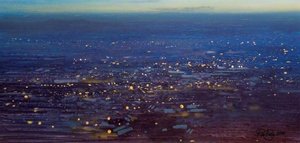
Synthetic Chemicals Factory, Near Wolverhampton, Nightfall over the Black Country, View from Turner's Hill, Dudley, the Habberleys just Visible 6.45pm, Thursday 18 October 2001, Twilight in the Black Country, 7.30pm, 21 September 2003, Blockhouse near Jenlain, France, Nightfall in the Black Country, 8.30pm, 26 September 2003, Sunshine in the Black Country, 4.30pm, 23 September 2003, Black Country Night, 10.45pm, 4 October 2005, Spanbroekmolen Mine Crater, Belgium, View near Rifle Range Corner, Cannock Chase e View from Messines Ridge, Belgium. O ranking acima apresenta o ano e o museu de cada uma.

Quantas pinturas de Robert Perry existem?Mostrar a resposta

Nosso catálogo lista 12 obras de Robert Perry, datadas de 1989 a 2014.

Onde posso ver as pinturas mais famosas de Robert Perry?Mostrar a resposta

A maioria deles está em The Shire Hall Gallery (Stoke-on-Trent), Wolverhampton Art Gallery (Wolverhampton) e Royal Birmingham Society of Artists (Birmingham). A tabela acima lista os museus um a um.

Em que período Robert Perry pintou as suas obras mais conhecidas?Mostrar a resposta

Em 2000s: 6 das 12 obras nesta página datam dessa época, entre elas Nightfall over the Black Country, View from Turner's Hill, Dudley, the Habberleys just Visible 6.45pm, Thursday 18 October 2001.

Qual é a pintura mais antiga e a mais recente de Robert Perry?Mostrar a resposta

A obra mais antiga nesta página é de Synthetic Chemicals Factory, Near Wolverhampton (1989), e a mais recente é de Spanbroekmolen Mine Crater, Belgium (2014).

Quais pinturas de Robert Perry o The Shire Hall Gallery possui?Mostrar a resposta

Spanbroekmolen Mine Crater, Belgium, View near Rifle Range Corner, Cannock Chase e View from Messines Ridge, Belgium estão entre as 4 obras nesta página pertencentes ao The Shire Hall Gallery, Stoke-on-Trent.

Robert Perry: biografia

The Soul of the Highlands: The Life and Art of Robert Perry

Born in the vibrant heart of Glasgow in 1783, Robert Perry emerged as a defining voice in the Scottish Romantic landscape tradition. His life and work were deeply intertwined with the shifting cultural tides of the nineteenth century, a period marked by an intense fascination with topographical precision and the sweeping, untamed beauty of the natural world. While his early training was rooted in the disciplined rigors of classical drawing—providing him with a masterful command of composition and perspective—it was his profound connection to the rugged landscapes of Scotland that would ultimately define his artistic legacy.

The trajectory of Perry’s creative spirit was irrevocably altered by his encounter with the celebrated artist David Roberts. Observing Roberts’ meticulous documentation of the exotic vistas of Egypt, Persia, and Syria, Perry found a new way to view his own homeland. He moved beyond mere representation, seeking instead to capture the very breath of the Highlands. This pursuit led him to study the subtle complexities of geological formations, the fleeting nuances of atmospheric light, and the dramatic shifts of the seasons, striving to translate emotional responses into tangible oil on canvas.

Technique and the Impressionistic Vision

What distinguishes a Perry landscape is not merely the subject matter, but the visceral texture of his execution. He became renowned for a distinctive impasto technique, applying paint in thick, deliberate layers that lent a sculptural quality to his works. This method allowed him to capture the luminosity of light as it breaks through heavy clouds or reflects off damp stone, creating an immersive experience for the viewer. His ability to blend colors harmoniously allowed for a subtle play of shadow and brilliance, making his canvases feel alive with movement.

<
  • Atmospheric Perspective: Perry mastered the art of using tonal variation to create depth, pulling the viewer’s eye from the textured foreground into the misty, ethereal distance.
  • Textural Richness: Through heavy impasto, he achieved a tactile quality that mirrored the ruggedness of the Scottish terrain.
  • Emotional Resonance: His work transcended simple topography, aiming to evoke the sublime grandeur and the quiet melancholy inherent in the natural world.

A Legacy of Light and Shadow

The breadth of Perry’s repertoire extended beyond the familiar hills of Scotland, demonstrating his versatility as a painter of light. In works such as “View from Messines Ridge,” he embraced an almost impressionistic style to render the panoramic vistas of Belgium, focusing on the dramatic interplay of sky and earth. Conversely, in pieces like “Black Country Night,” he turned his gaze toward the industrial energy of Birmingham, utilizing cool hues and evocative nocturnal lighting to capture the pulse of a changing era.

Though his life concluded in 1848, Perry’s contribution to the Romantic movement remains significant. He stands as a pioneer who bridged the gap between the meticulous topographical traditions of the past and the emotive, light-driven explorations of the future. His paintings remain enduring testaments to a period when artists sought to find the divine within the landscape, leaving behind a body of work that continues to resonate with the timeless beauty of the natural world.