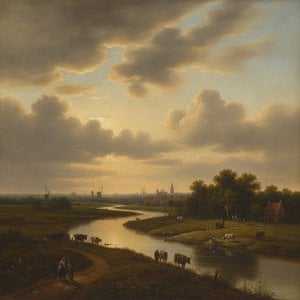
A Refined Vision of the Dutch Golden Age: Pieter van der Werff
Pieter van der Werff, a name perhaps less immediately recognized than those of Rembrandt or Vermeer, nevertheless occupies a significant and fascinating niche within the pantheon of Dutch Golden Age painters. Born in The Hague in 1665 and passing away in Rotterdam in 1722, his career unfolded during a period of immense artistic flourishing in the Netherlands, yet he carved out a distinctive style characterized by elegance, meticulous detail, and an early embrace of innovative pigments. His life was deeply intertwined with that of his older brother, Adriaen van der Werff, who served as both mentor and foundational influence, shaping Pieter’s trajectory from its earliest stages. While Adriaen achieved considerable renown – even securing a prestigious position at the court of the Elector Palatine – Pieter established himself primarily in Rotterdam, becoming the favored portraitist of the city's affluent citizenry and leaving behind a legacy that offers invaluable insights into the social fabric and aesthetic sensibilities of his time.Formative Years and Artistic Development
The artistic education received by Pieter van der Werff was profoundly shaped by familial ties. His older brother, Adriaen, already an established painter, provided not only technical instruction but also a crucial introduction to the prevailing artistic currents of the day. This early tutelage instilled in Pieter a commitment to precision and refinement, qualities that would become hallmarks of his mature style. He quickly distinguished himself through a remarkable ability to capture likenesses with both accuracy and psychological depth. His portraits weren’t merely representations of physical appearance; they were carefully constructed portrayals of status, personality, and social standing. The Baroque aesthetic, dominant during this era, profoundly influenced his work, manifesting in dramatic compositions, rich color palettes, and a heightened sense of emotional intensity. However, Pieter tempered the grandiosity often associated with Baroque art with a distinctly Dutch sensibility – a focus on realism, intimate detail, and a subtle psychological nuance that set him apart from many of his contemporaries. He diligently studied under Adriaen’s guidance, absorbing not only artistic techniques but also the brother's unwavering dedication to portraying human emotion with profound sensitivity.Portraits, Mythological Scenes, and a Pioneering Spirit
Van der Werff’s artistic output was diverse, encompassing portraiture, mythological scenes, historical narratives, and occasional forays into genre painting. However, it is in the realm of portraiture that he truly excelled. He immortalized prominent figures such as Paulus Verschuur, a Burgomaster of Rotterdam, and even Peter the Great of Russia, demonstrating his ability to convey power and authority through masterful brushwork and astute observation. These portraits are not merely historical records; they are compelling studies in character, revealing the inner lives of those who commissioned them. Beyond portraiture, Van der Werff engaged with classical mythology and history, creating works like “Expulsion of Adam and Eve” and “Granida and Diafilo,” which showcase his skill in depicting dramatic narratives and complex compositions. He skillfully rendered figures from Greek legend with meticulous detail and expressive gestures, capturing the drama and pathos inherent in these tales. Furthermore, Van der Werff explored more intimate scenes of everyday life, as seen in paintings such as “Bellen blazen (Bubble Blowing),” revealing a sensitivity to the nuances of human interaction—a characteristic that distinguishes him from many of his peers.A Masterful Palette: The Use of Prussian Blue
Pieter van der Werff’s artistic innovation extended beyond stylistic considerations; he was among the first Dutch painters to embrace and exploit the transformative potential of Prussian blue, a newly synthesized pigment in the early 18th century. Prior to this breakthrough, artists relied primarily on ultramarine – derived from lapis lazuli—a costly pigment that limited its accessibility. Van der Werff recognized the vibrant luminosity of Prussian blue and incorporated it extensively into his paintings, notably in “Johan de Vries portrait,” elevating the emotional impact of his compositions. This daring stylistic choice solidified his reputation as a visionary artist who pushed the boundaries of artistic convention and championed groundbreaking techniques—a testament to his intellectual curiosity and unwavering commitment to excellence.Legacy and Historical Significance
Pieter van der Werff’s importance extends beyond the aesthetic qualities of his paintings. His work serves as a valuable historical document, offering insights into the lives, fashions, and cultural values of Rotterdam's elite during the Dutch Golden Age. His portraits provide a visual record of the individuals who shaped the city’s political, economic, and social landscape—figures like Paulus Verschuur and Peter the Great—demonstrating his ability to capture both grandeur and psychological complexity. Moreover, Van der Werff’s contribution to artistic innovation – specifically his pioneering use of Prussian blue – underscores his role as a catalyst for change within the art world. His paintings continue to be admired for their elegance, precision, and psychological depth, offering a compelling glimpse into a bygone era and securing his place as one of the most influential artists of his time. His enduring legacy resides in his masterful portrayal of human emotion and his unwavering dedication to artistic excellence—a testament to the transformative power of innovation within the context of Dutch Baroque paintingPerguntas e Respostas
Onde posso ver as obras de Pieter van der Werff em ordem cronológica?
Existe uma linha do tempo das obras de Pieter van der Werff: a página Linha do tempo das obras do artista organiza as obras por data de criação.
Como posso encontrar obras de Pieter van der Werff sobre um tema específico?
As obras de Pieter van der Werff podem ser exploradas por palavra-chave na página de Por Palavras-chave do artista. Cada palavra-chave agrupa as obras relacionadas.
Quantas obras de Pieter van der Werff estão disponíveis para visualização?
Você pode explorar 64 obras de arte obras de Pieter van der Werff na página Todas as Obras de Arte.