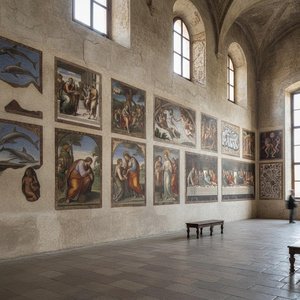
A Visionary of the Nazarene Movement
Philipp Veit stands as a luminous figure within the landscape of German Romanticism, serving as one of the primary exponents of the Nazarene movement. Born in Berlin, Prussia, his early life was shaped by a complex tapestry of cultural influences and personal transitions. As the son of a banker, Simon Veit, and Brendel, a descendant of Moses Mendelssohn, his upbringing moved through the intellectual hubs of Jena, Paris, and Cologne. This nomadic youth, influenced by the presence of Friedrich Schlegel, eventually led him to find his true artistic calling in Rome. It was within this Italian setting that Veit became deeply immersed in a movement dedicated to reviving the spiritual purity and technical mastery of the Middle Ages, particularly through the nearly forgotten art of fresco painting.
His artistic education began at the Royal Dresden Academy of Fine Arts, where he studied under masters such as Friedrich Matthäi and the renowned Caspar David Friedrich. While his early training provided a foundation in drawing, Veit found himself drawn toward more ethereal mediums; during his time in Vienna, he often turned to watercolours, finding a comfort in their fluidity that oil painting sometimes lacked. This period of development was marked by significant personal and spiritual shifts, including his conversion to Catholicism, which deeply informed the religious and allegorical depth of his later compositions.
Symbolism and National Identity
The work of Philipp Veit is profoundly characterized by its ability to weave together myth, spirituality, and the burgeoning sense of national identity prevalent in 19th-century Europe. His canvases often transcend mere depiction, acting as vessels for complex symbolic narratives. In works such as Germania, he utilized personification to capture the spirit of a unified German nation, employing symbols like the oak leaf crown, the sword, and the broken chains to represent strength, peace, and the yearning for freedom. His ability to translate political and social anxieties into monumental visual allegories allowed his art to resonate with the historical zeitgeist of his era.
Beyond the political, Veit’s oeuvre explores the sublime and the celestial. In pieces like In Syria Walked a Man One Day, the viewer is invited into an ethereal realm where mythology meets the boundless sky, featuring winged figures that embody grace and liberation. Even when addressing broader geopolitical themes, such as in his Allegory of Russia, Veit employed a masterful technique—utilizing thick impasto brushstrokes and vibrant color palettes—to reflect the grandeur and the turbulent tensions of the time. Through this delicate balance of technical skill and symbolic depth, Veit ensured that his paintings remained not just visual records, but emotional experiences that spoke to the very soul of the Romantic era.
Perguntas e Respostas
Existe uma lista completa das obras de Philipp Veit?
Todas as obras de Philipp Veit no este site podem ser exploradas na página de Todas as obras do artista.
Posso explorar as obras de Philipp Veit por espectro de cores?
O Índice de Cores de Philipp Veit organiza as obras do artista por cores.
Posso navegar pelas obras de Philipp Veit por humor?
A Coleção por Humor de Philipp Veit organiza as obras do artista por humor.