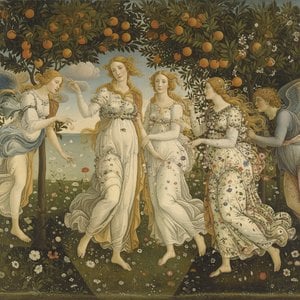
Paolo Morando (Il Cavazzola), A Venetian Renaissance Master
Paolo Morando, better known as Il Cavazzola, was a pivotal figure in the artistic landscape of Verona during the Renaissance—a painter whose legacy continues to resonate through his evocative depictions of religious themes and landscapes imbued with Giorgione’s influence. Born around 1485 in Verona, he emerged from the workshop of Francesco Morone, inheriting not only technical skill but also a profound appreciation for humanist ideals that characterized the era. Vasari's biographical account portrays him as “a young man of excellent character and without any blemish of vice,” reflecting the values upheld by the Florentine Renaissance and highlighting Morando’s moral integrity alongside his artistic prowess.
Francesco Morone, his father, was a cloth merchant—a profession that instilled in Paolo a meticulous attention to detail and an understanding of material culture crucial for capturing the nuances of Venetian life. His formative years were spent absorbing the stylistic precepts of Domenico Morone, who himself had trained under Francesco Bonsignori and Domenico Morone – masters whose combined influence shaped Morando’s artistic vision. This lineage established him firmly within Verona's burgeoning artistic milieu, where he honed his craft amidst a vibrant intellectual ferment.
Morando’s debut work—the *Madonna and Child with Saint John the Baptist*, executed circa 1508—immediately demonstrated his mastery of Venetian painting techniques. Preserved in the Castelvecchio Museum, this canvas exemplifies Morando's stylistic trajectory: soft tonal modelling, harmonious color palettes reminiscent of Giorgione, and a careful consideration for spatial composition—elements that underscore his admiration for the Venetian master’s groundbreaking approach to landscape and figure representation. The influence of Mantegna is palpable in Morando’s early compositions, particularly evident in the monumental *San Zeno Altarpiece*, which served as inspiration for Morando's generation.
His most celebrated achievement arrived in 1517 with the commission for the Polyptych of the Passion—a monumental undertaking undertaken jointly with Francesco Morone for the Church of San Bernardino in Verona. This ambitious project showcased Morando’s exceptional compositional skill and his ability to synthesize diverse artistic currents prevalent at the time—Venetian, Lombard, and Northern European influences blending seamlessly into a unified aesthetic experience. The panel depicting Saint John the Baptist stands out as a testament to Morando's meticulous observation of nature and his masterful rendering of drapery folds—a technique honed under Domenico Morone’s tutelage and reflecting the stylistic sophistication of Verona’s artistic elite.
Tragically, Morando’s prolific artistic activity abruptly ceased on August 13th, 1522, leaving behind a singular masterpiece: *The Altarpiece of the Virtues*, which remains among his finest canvases. This evocative depiction—now housed in numerous European museums—captures Morando's profound sensitivity to human emotion and his unwavering commitment to artistic excellence. His legacy endures as a symbol of Verona’s Renaissance heritage, securing his place amongst the foremost artists of his time and inspiring generations of painters to come.