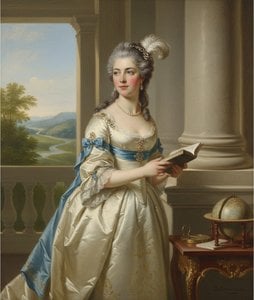
Orest Kiprensky: Life & Legacy
Orest Adamovich Kiprensky (1782-1836) stands as a pivotal figure in the annals of Russian Romantic art, recognized for his profound psychological portraits and masterful depictions of historical events. His artistic journey began amidst unconventional circumstances—the illegitimate son of landowner Alexey Dyakonov—yet blossomed into a career marked by unparalleled success and enduring influence.Early Life and Education (1782-1803)
Born in Koporye, near Saint Petersburg, Kiprensky’s origins were steeped in social complexities. His father, Adam Shvalbe, was a serf who generously liberated him from servitude upon his birth—a gesture that secured him access to the Imperial Academy of Arts at just six years old. This formative experience instilled within him an unwavering dedication to scholarly pursuits and artistic training. He diligently studied Latin, Greek, mathematics, and drawing, mastering techniques honed by observing the works of European masters like Rubens and Rembrandt. The Academy’s curriculum demanded rigorous discipline, shaping Kiprensky into a meticulous craftsman and fostering his intellectual curiosity. Winning first prize for *Prince Dmitri Donskoi after the Battle of Kulikovo* (1805) solidified his reputation as a prodigious talent and paved the way for extended study abroad—a crucial step in developing his artistic vision.European Travels and Artistic Development (1804-1828)
Kiprensky’s artistic ambitions propelled him across Europe, establishing residences in Moscow (1809), Tver (1811), Saint Petersburg (1812), and most notably Rome and Naples from 1816 to 1822. These travels exposed him to the vibrant intellectual currents of the era and fueled his artistic experimentation. His early portrait of Adam Shvalbe—a commission that initially caused considerable confusion among Italian art critics who mistook it for a Rubens masterpiece—demonstrated his remarkable ability to capture subtle nuances of character and emotion. He embraced Romantic ideals, prioritizing expressive brushwork and dramatic composition over strict academic conventions. The influence of Eugène Delacroix is palpable in his canvases, particularly *The Battle of Borodino*, which vividly portrays the horrors of war with unflinching realism. His artistic prowess extended beyond portraiture; he tackled monumental historical subjects with conviction and artistry.Mature Period & Notable Works (1822-1836)
Returning to Italy in 1828, Kiprensky found solace in his relationship with Anne Maria Falcucci—a woman whose freedom he tirelessly championed and whom he entrusted to the care of a Roman Catholic convent. This personal devotion mirrored his artistic commitment—a desire to convey profound human experience through visual representation. His magnum opus remains *Alexander Pushkin*, completed in 1827, an iconic portrait that captured the poet’s gaze with arresting intensity. Pushkin himself famously remarked that “the mirror flatters me,” acknowledging Kiprensky's uncanny ability to distill the essence of his subject into a single image. Alongside Pushkin, he produced portraits of Vasily Zhukovsky, Konstantin Batyushkov, and Sergey Uvarov—each capturing the spirit of its time with remarkable sensitivity. His artistic legacy endures as a testament to the transformative power of Romanticism and the enduring fascination for portraying human psychology through art. He died prematurely in Rome in 1836, leaving behind an indelible mark on Russian artistic history. ## Influences & Artistic Style Kiprensky’s artistic style was profoundly shaped by European masters—particularly Rubens and Rembrandt—whose techniques he meticulously studied. However, he transcended mere imitation, forging a distinctive voice that blended academic precision with Romantic fervor. His portraits are distinguished by their psychological depth, achieved through masterful use of chiaroscuro (light and shadow) and subtle tonal variations. He skillfully rendered facial expressions and body postures to convey emotion and character—a hallmark of Romantic art. Furthermore, Kiprensky’s canvases pulsated with vibrant color palettes inspired by Delacroix and Friedrich—reflecting the Romantic preoccupation with sublime landscapes and dramatic narratives. ## Historical Significance & Legacy Orest Kiprensky is considered the father of Russian portrait drawing, establishing a new standard for artistic excellence within his homeland. His work elevated portraiture beyond mere likeness to encompass psychological insight and emotional resonance—a distinction that resonated deeply with contemporaries and continues to inspire artists today. He remains celebrated for his ability to capture the spirit of Romanticism while simultaneously demonstrating technical mastery. Kiprensky’s legacy extends far beyond his individual paintings; he fundamentally reshaped Russian artistic sensibilities, influencing generations of painters who followed in his footsteps. His enduring fame testifies to the power of art to transcend time and communicate universal human emotions—a testament to Orest Adamovich Kiprensky's unparalleled contribution to the history of Russian art.Perguntas e Respostas
Como posso acompanhar a obra de Orest Kiprensky ano após ano?
As obras de Orest Kiprensky podem ser visualizadas em ordem cronológica na página de Linha do tempo das obras do artista.
Existe uma cronologia da carreira de Orest Kiprensky?
Um relato cronológico da obra de Orest Kiprensky está disponível na página Linha do tempo do artista, onde as obras são apresentadas em ordem de criação, capítulo por capítulo.
Posso navegar pelas obras de Orest Kiprensky por técnica?
A página Por Técnica agrupa as obras de Orest Kiprensky por técnica.