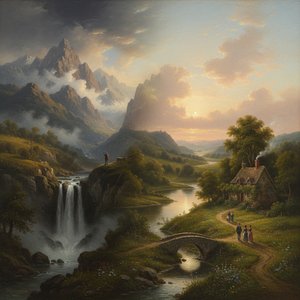
Lazzaro Pasini: A Tuscan Landscape Painter
Lazzaro Pasini (1861–1949) stands as a prominent figure in Italian landscape painting, particularly within the Macchiaioli movement—a group of artists who championed direct observation and expressive brushwork to capture the essence of nature. Born in Reggio Emilia, Italy, Pasini’s artistic journey began under the tutelage of Romualdo Belloli, an engraver who instilled in him a foundational understanding of tonal harmony and meticulous detail. This early training proved invaluable as he embarked on his studies at Florence Academy, where he honed his skills alongside Giovanni Fattori—a fellow Macchiaioli—absorbing the stylistic principles that would define his oeuvre.
- Early Influences: Belloli’s teachings emphasized precision and tonal gradation, shaping Pasini's initial approach to rendering landscapes with remarkable accuracy.
- Florence Academy: Fattori’s studio fostered a spirit of experimentation and encouraged Pasini to explore bolder color palettes and looser brushstrokes—a crucial step toward embracing the Macchiaioli aesthetic.
The Macchiaioli Style and Tuscan Landscapes
Pasini's artistic breakthrough arrived in 1884 with his debut exhibition at Turin, where he presented “Picking Grapes,” a genre scene imbued with the unmistakable hallmarks of Macchiaioli painting. This work exemplifies the movement’s core tenets: capturing fleeting moments of rural life and conveying emotion through vibrant color patches—macchie—that disrupt traditional compositional conventions. Unlike Impressionists who sought to depict optical impressions, Macchiaioli artists prioritized subjective experience and psychological resonance. Pasini's landscapes predominantly focused on the Tuscan countryside, meticulously rendered with a palette dominated by earthy tones punctuated by bursts of luminous color. He skillfully employed atmospheric perspective—a technique perfected during the Renaissance—to convey depth and luminosity, transporting viewers into the heart of the Italian landscape.
- Atmospheric Perspective: Pasini’s masterful use of tonal gradation created an illusion of distance, enhancing the dramatic impact of his compositions.
- Color Palette: Vibrant hues—particularly reds, yellows, and greens—were strategically applied to evoke feelings of warmth, vitality, and immediacy.
Notable Works and Recognition
Among Pasini’s most celebrated paintings are “Twelve Studies of Vesuvius,” a series depicting the eruption of Mount Vesuvius with breathtaking realism—a testament to his dedication to scientific observation combined with artistic sensitivity. This piece secured him the gold medal from the Ministry of Education in 1918, cementing his reputation as one of Italy’s foremost landscape painters. Furthermore, Pasini's works are housed in prestigious museums such as the Pinacoteca di Vicenza and Museo del Novecento in Milan—institutions that recognize his contribution to Italian art history.
- Pinacoteca di Vicenza: The museum houses a significant collection of Pasini’s landscapes, showcasing his artistic evolution over time.
- Museo del Novecento: Visitors can admire “Tile” by Michele Cascella—a striking example of Pasini's stylistic prowess—within Milan’s Museo del Novecento.
Legacy and Artistic Significance
Lazzaro Pasini’s legacy extends beyond his individual paintings; he represents a pivotal moment in Italian landscape painting, marking the transition from academic tradition to expressive naturalism. His unwavering commitment to capturing the beauty of Tuscany—through meticulous observation and emotive brushwork—continues to inspire artists today. He remains an enduring symbol of artistic integrity and a cornerstone of Macchiaioli heritage—a movement that profoundly shaped the course of Italian art at the turn of the century.