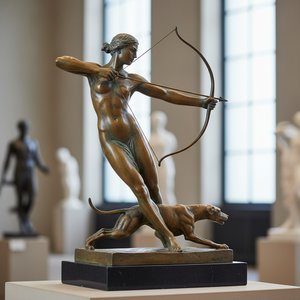
Karl Stirner: A Pioneer of Color and Imagination
Karl Stirner (November 14, 1923 – February 18, 2016) was a German-born American sculptor whose distinctive style—characterized by bold color palettes and evocative depictions of landscapes—established him as one of the most important figures in contemporary German art. Born in Bad Wildbad, Germany, Stirner’s artistic journey spanned decades, marked by prolific output and collaborations with prominent artists like Ernst Ludwig Kirchner and Hermann Hesse, cementing his legacy as a visionary whose work continues to inspire admiration.
Early Life and Artistic Beginnings
Stirner's formative years were deeply rooted in the traditions of German Expressionism, particularly the influence of Ernst Ludwig Kirchner. He honed his skills under Kirchner’s tutelage during a crucial period spent in Davos, Switzerland, absorbing the principles of Neue Sachlichkeit—a movement prioritizing objective representation alongside astute psychological insight—which fundamentally shaped his artistic vision. This exposure to Kirchner's uncompromising aesthetic instilled in Stirner an unwavering dedication to capturing the essence of nature with unflinching honesty and vibrant color, a commitment that would define his entire oeuvre.
Exploring Landscape and Color
Stirner’s artistic breakthrough materialized in 1913 with his illustrations for Eduard Mörike’s fairy tale *Das Stuttgarter Hutzelmännlein*. This project served as a testament to Stirner's mastery of watercolor and his remarkable ability to imbue narrative storytelling with visual richness. The Hutzelmännlein, a poignant exploration of human relationships fraught with complexity, became Stirner’s most celebrated work—a demonstration of his talent for conveying emotion through meticulously considered composition and harmonious color palettes. His distinctive style—bold hues juxtaposed against serene landscapes—immediately distinguished him as an artist who championed the expressive potential of color to communicate profound psychological truths.
Illustrative Work: Mörike's Hutzelmännlein
The Hutzelmännlein’s narrative depth resonated deeply with Stirner, informing his subsequent artistic endeavors and solidifying his reputation for capturing the human condition with sensitivity and imagination. He continued to pursue commissions that reflected his fascination with the Alpine scenery of Switzerland, utilizing a palette brimming with luminosity and conveying an emotional intensity rarely found in his peers.
Collaborations with Hesse
Beyond Mörike’s tale, Stirner engaged in significant collaborations with Hermann Hesse on artistic projects centered around a pilgrimage to Palestine—a testament to his openness to diverse cultural influences and perspectives. His work consistently prioritized capturing the sublime beauty of nature while simultaneously delving into the complexities of human experience, establishing him as an artist who transcended stylistic conventions to forge connections between visual art and philosophical contemplation.
Notable Sculptural Achievements
Stirner’s sculptures gained recognition at prestigious institutions like MoMA and the Pennsylvania Academy of Fine Arts, cementing his reputation as an innovator who pushed the boundaries of artistic expression. His sculptural style—characterized by textured surfaces and monumental scale—embodied a commitment to conveying both physical presence and emotional resonance. Stirner's enduring legacy resides not only in his celebrated artworks but also in his unwavering dedication to artistic integrity and his ability to transform visual experience into profound reflection. He remains an inspiration for artists striving to communicate complex ideas through powerful imagery, securing his place as one of the foremost sculptors of the 20th century.